User Manual Translation: A Complete Guide for Manufacturers and Exporters
Key Takeaways
User manual translation is the process of converting product instruction manuals, operation guides, installation instructions and safety warnings into the official languages of the markets where a product is sold. For manufacturers exporting to the EU, accurate translation of technical manuals is not optional – it is a legal requirement under directives including the Machinery Directive 2006/42/EC and the Medical Device Regulation (EU MDR). Poor or absent translation creates compliance risk, product liability exposure and user safety concerns. This guide covers the regulatory framework, what professional user manual translation involves and how to find a capable supplier.
Table of Contents
ToggleWhat Is User Manual Translation?
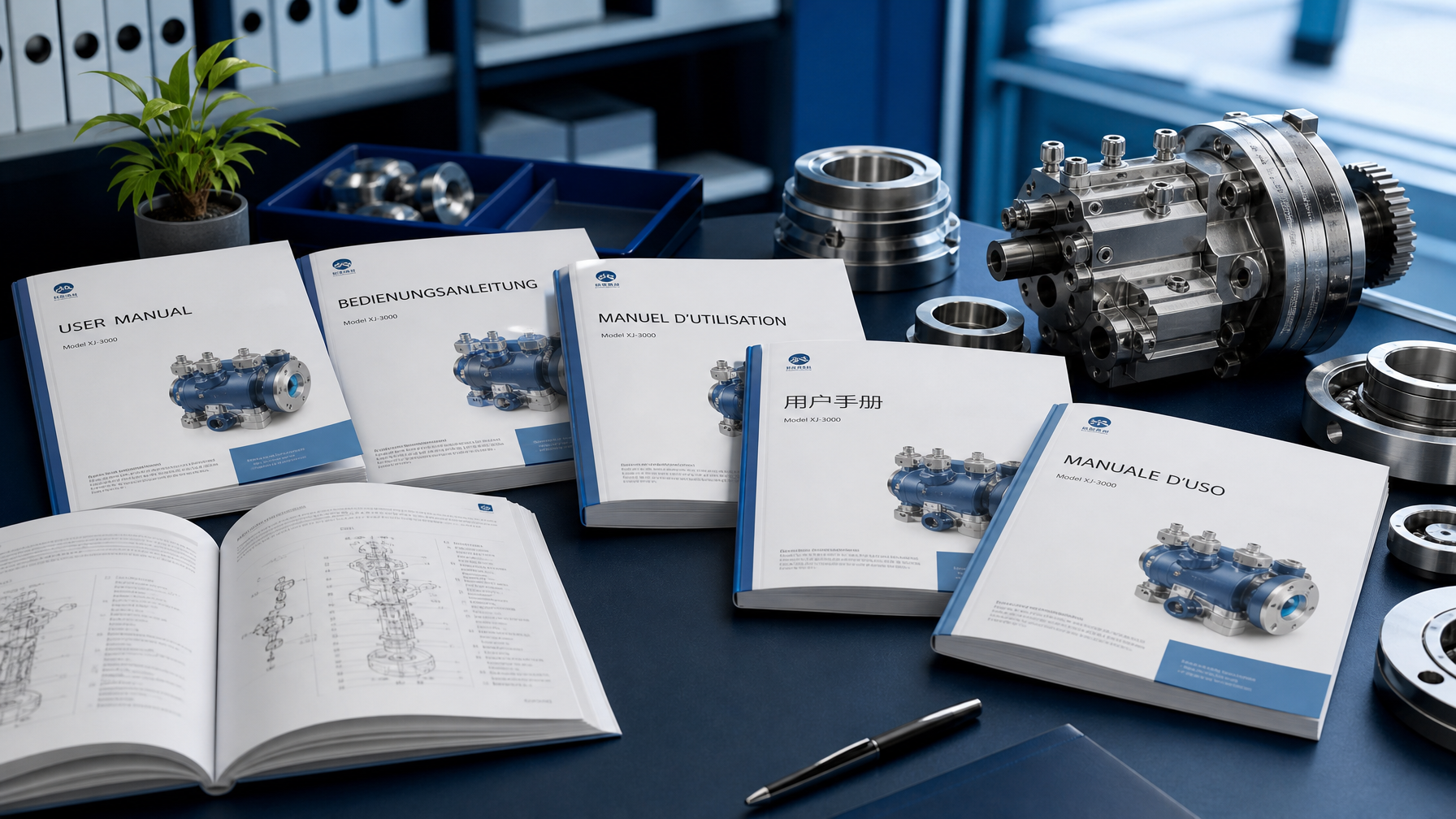
User manual translation is a branch of technical translation focused on product documentation: instructions for use (IFU), operation manuals, installation guides, maintenance handbooks, quick-start sheets, safety data sheets and product labels. It differs from general translation in that accuracy is non-negotiable. A mistranslated marketing headline causes brand embarrassment. A mistranslated safety instruction in a power tool manual causes injury.
The discipline requires translators with both linguistic skill and the technical knowledge to understand – and accurately render – product-specific terminology. A translator working on a CNC machine manual needs to understand both the language pair and the engineering concepts involved. A translator working on a medical device IFU needs to understand clinical terminology alongside regulatory formatting requirements.
Why Is User Manual Translation a Legal Requirement?
The EU Machinery Directive 2006/42/EC
For manufacturers selling machinery in the European Economic Area (EEA), the Machinery Directive 2006/42/EC sets out a clear obligation. Annex I, Section 1.7.4 states:
“All machinery must be accompanied by instructions in the Official Community language or languages of the Member State in which it is placed on the market and/or put into service.”
The Directive further distinguishes between “Original instructions” and a “Translation of the original instructions” – the latter must be accompanied by the original. This means a UK manufacturer selling a hydraulic press in France, Germany and Spain must provide instructions in French, German and Spanish, clearly marked as translations of the English original.
Failure to comply can result in the CE mark being challenged, products being removed from sale and potential liability in the event of an accident.
Low Voltage Directive 2014/35/EU and EMC Directive 2014/30/EU
Electrical equipment sold in the EU under the Low Voltage Directive also requires translated documentation for end users. The EMC Directive carries similar requirements for electromagnetic compatibility documentation.
EU Medical Device Regulation (EU MDR 2017/745)
The MDR requires that all labelling and instructions for use for medical devices placed on the EU market be provided in the official language(s) of the EU member state(s) where the device is sold. For manufacturers with pan-EU distribution, this typically means translating IFU content into up to 24 official EU languages. Our detailed guide to IFU translation for medical devices covers this regulatory framework in full.
Consumer Product Safety
Beyond the specific directives above, the General Product Safety Directive and its successor regulations place a broad obligation on manufacturers and importers to ensure that product documentation provided to consumers is comprehensible in the language of the country of sale. For consumer electronics, household appliances, children’s toys and sports equipment, this encompasses both safety warnings and operating instructions.
What Types of Document Require User Manual Translation?
User manual translation covers a broader category of documentation than the name suggests:
- Operating manuals and user guides – step-by-step instructions for routine use
- Installation guides – instructions for initial setup, commissioning and connection
- Maintenance and service manuals – procedures for scheduled maintenance and fault diagnosis
- Quick-start guides – condensed instructions for initial use
- Safety instructions and warning labels – mandatory safety information, often required in specific formats and prominence levels
- Instructions for use (IFU) – the regulated document type for medical devices and pharmaceutical products
- Software user interfaces – where on-screen text is part of the product experience
- Training materials – where end-user training documentation accompanies the product
For manufacturers who produce documentation in InDesign or other DTP software, InDesign translation forms an integral part of the process – preserving layout, formatting and pagination while substituting the translated text.
Key Challenges in User Manual Translation
Terminology Consistency
A manual may use a specific technical term – “actuator”, “tensioning screw”, “fail-safe relay” – dozens or hundreds of times across its pages. Every instance must be translated identically. Inconsistent terminology within a single manual creates confusion for the end user; inconsistent terminology across a product range creates training problems and warranty claims.
Professional translation agencies address this with a Termbase (or glossary) – a client-specific approved terminology list built at the start of the relationship and maintained across all projects. Combined with a Translation Memory (a database of previously approved sentence-level translations), this ensures that consistency is maintained not just within a project but across the entire product documentation library over time.
Text Expansion and DTP
Languages expand and contract relative to English. German text is typically 20-35% longer; Spanish and French expand by 15-25%. A two-page quick-start guide in English may become a three-page document in German if the translation is not actively managed for word count. For printed documentation with fixed page counts (a common requirement for safety inserts in product packaging), this creates a real formatting challenge.
The solution is to manage translation and desktop publishing together. An agency that delivers a Word document for you to re-lay out in InDesign transfers the problem to you. A full-service technical translation agency delivers a print-ready PDF or InDesign file in the target language with all text expansion managed internally.
Right-to-Left Languages
Arabic and Hebrew text runs right to left. A manual designed for an LTR language requires a mirrored layout for an RTL language: text boxes, page numbers, diagrams with callouts and tables all need repositioning. This is not a simple text substitution – it requires an experienced DTP operator working with the target language.
Regulatory Formatting Requirements
Some document types carry regulatory formatting requirements that must survive translation. EU IFU for medical devices must meet specific font size, symbol usage and layout requirements under EU MDR and the relevant harmonised standards (IEC 82079-1 for instructions for use). A translation agency unfamiliar with these requirements may produce linguistically accurate content that still fails a regulatory audit.
Version Control
Manufactured products change. Components are updated, safety warnings are added, specifications change. Every update to the source document requires a corresponding update to all translated versions. Without a disciplined version control system, manufacturers end up with translated manuals that do not match the current product – a compliance and liability risk.
The User Manual Translation Process: Step by Step
1. Source File Assessment
The agency receives the source manual in its native format (InDesign, Word, FrameMaker, PDF) and assesses word count, layout complexity, image and callout requirements, and any regulated content. A project plan and quote are produced based on this assessment.
2. Termbase and Translation Memory Setup
If no Termbase exists for the client, the agency works with the client’s technical team to establish approved terminology before translation begins. Existing translation memories from previous projects are imported and matched against the new content to identify reusable segments.
3. Translation by Subject-Specialist Linguist
A translator with relevant technical knowledge produces the first draft. For machinery manuals this means engineering expertise; for medical device IFU it means clinical or biomedical knowledge. General translators are not suitable for this work.
4. Technical Editing
A second linguist reviews the translation for accuracy, consistency against the Termbase and adherence to any client style guide. Terminology flagged as inconsistent is resolved before the file proceeds to DTP.
5. Desktop Publishing
The translated text is laid out in the target language using the same DTP application as the source (InDesign, FrameMaker or equivalent). Text expansion is managed through copy editing, font size adjustment or layout modification as appropriate. RTL languages are mirrored. Diagrams with embedded text labels have those labels replaced with translated equivalents.
6. Proofreading
A final proofreading pass checks the laid-out document for typographic errors, broken text, missing translations and layout issues. This is conducted on the final PDF rather than the translation file, to catch DTP-stage errors.
7. Client Review and Approval
The client reviews the final document for technical accuracy. Feedback is incorporated and a final approved version is delivered in the required file format (PDF for print, XML or DITA for structured content management systems).
How to Choose a User Manual Translation Supplier
The manufacturing sector demands translation suppliers who understand both the technical subject matter and the regulatory context. Questions to ask when evaluating agencies:
Do they assign subject-specialist translators? A general translation agency that assigns whoever is available is not appropriate for technical documentation.
Do they maintain client-specific Termbases and Translation Memories? If not, you will pay for the same terminology to be translated multiple times across projects, and consistency will suffer.
Do they handle DTP in-house? If desktop publishing is outsourced to a third party, you lose visibility and control over the final document.
Can they produce print-ready files? For packaging inserts and printed manuals, you need a print-ready PDF – not a Word document.
Do they understand the relevant regulatory framework? For CE-marked machinery and medical devices, the agency should understand the applicable directives and what compliance requires.
Do they offer translation for a range of technical sectors? An agency with experience across manufacturing, engineering and technical translation will bring cross-sector knowledge to terminology challenges.
How Much Does User Manual Translation Cost?
User manual translation is priced primarily by word count, language pair and complexity. Technical content in niche engineering disciplines costs more than standard consumer product documentation due to the specialist knowledge required. DTP work is typically priced separately per hour or per page.
Translation Memory matches reduce cost on projects where significant portions of the content have been translated previously. A 30-page machinery manual that has already been translated and then updated with 20% new content will cost significantly less to update than a full new project.
The most common mistake manufacturers make is treating user manual translation as a commodity and selecting the lowest-cost supplier. The risk is real and quantifiable: a translation error in a safety instruction that contributes to a user injury creates product liability exposure that far exceeds any saving on the translation fee.
How Global LTS Supports Manufacturers and Exporters
Global Language Translation Services works with UK and international manufacturers across engineering, electronics, consumer products, medical devices and industrial equipment. We provide user manual translation, technical editing, DTP and print-ready delivery across 120+ languages.
Our translators are subject specialists, not generalists. Our DTP team works in InDesign, FrameMaker and Word. We maintain client Termbases and Translation Memories to ensure consistency across product ranges and documentation updates. We understand the CE marking and EU MDR translation requirements and can advise on how to structure a documentation localisation programme that is both compliant and cost-effective.
Contact us for a word count analysis and quote on your next manual translation project.
Conclusion
User manual translation sits at the intersection of linguistic precision, technical knowledge, regulatory compliance and desktop publishing. For manufacturers and exporters, it is not a discretionary spend – it is a condition of legal market access in most major international markets. Choosing the right supplier – one with sector knowledge, consistent processes and DTP capability – protects your compliance position, your users and your brand.