Technical documentation is a functional component of any manufactured product. When a product crosses a language boundary, so must its documentation: installation manuals, operating guides, safety instructions, maintenance procedures, and compliance files. A translation error in any of these is not just inconvenient. It creates safety exposure, compliance risk, and warranty liability.
Table of Contents
ToggleFor UK and EU manufacturers, the choice of translation supplier directly affects product launch timelines, regulatory submissions, and what happens in the field.
This article covers what technical translation involves in a manufacturing context, what regulatory requirements apply, and what to look for when choosing a supplier.
What Technical Translation Covers in Manufacturing
Technical translation in manufacturing covers a broad range of documentation. The common thread is precision: every number, unit, warning, and procedure must translate with the same meaning and the same level of accuracy as the source document.
Common document types include:
- Installation manuals – assembly and commissioning instructions for equipment and machinery
- Operating manuals and user guides – instructions for safe and correct use of machinery, including controls, settings, and operational limits
- Maintenance and service documentation – scheduled maintenance procedures, lubrication specifications, replacement part references, and troubleshooting guides
- Safety instructions and warnings – hazard notices, PPE requirements, and lockout/tagout procedures
- Spare parts catalogues – part numbers, descriptions, and exploded diagrams
- Standard Operating Procedures (SOPs) – production procedures and quality control documentation
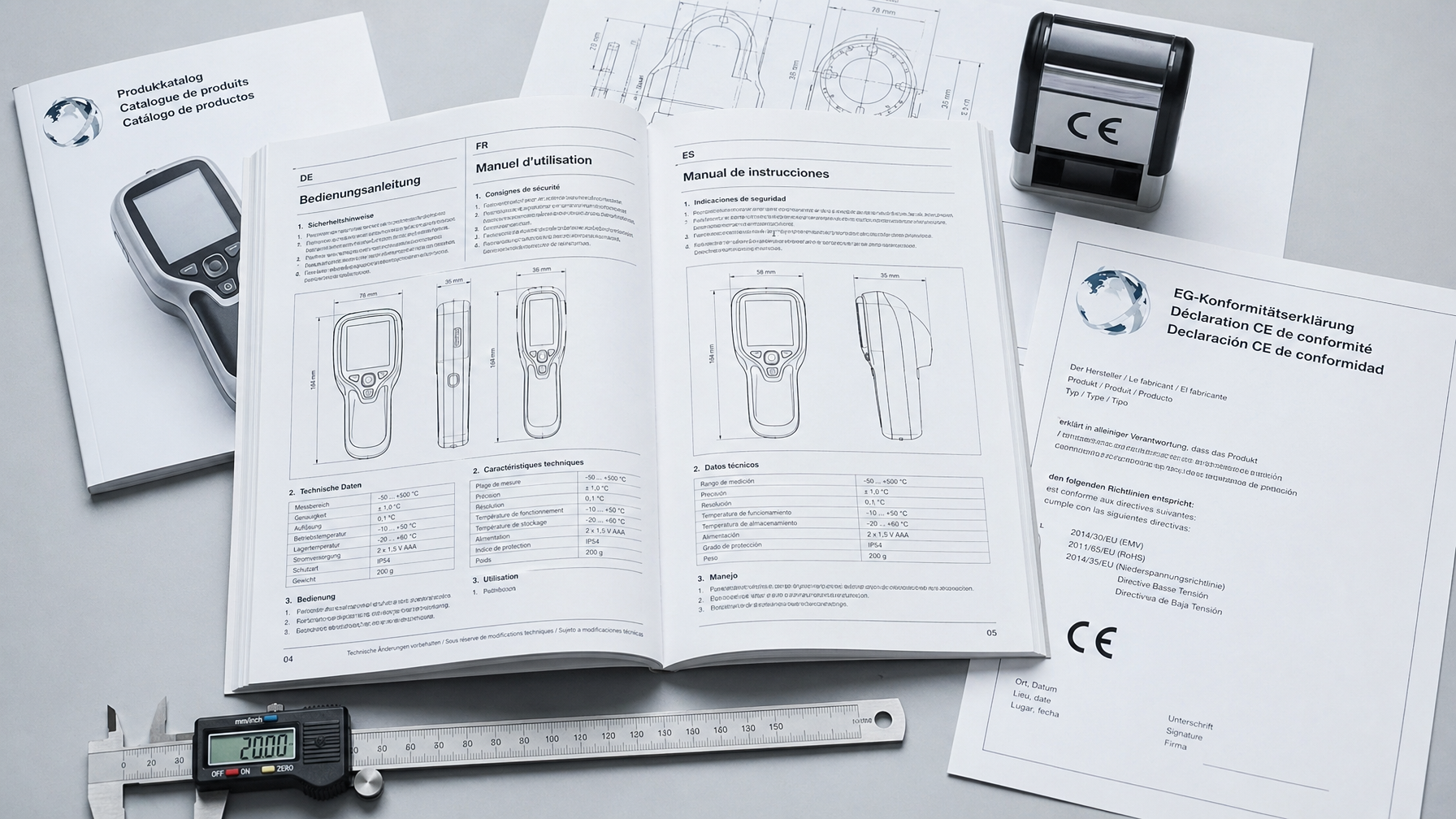
- CE technical files and declarations of conformity – regulatory compliance documentation for EU market entry
- Training materials – operator and maintenance training documentation
Each document type carries its own terminology challenges. A maintenance manual for an industrial press uses different vocabulary from an installation guide for a conveyor system, even if both come from the same manufacturer. The translation supplier must have translators with relevant engineering knowledge for each document type and product category, not just the language pair.
Regulatory Requirements for Manufacturing Documentation
CE Marking and the Machinery Directive
For manufacturers selling machinery in the EU, CE marking under the Machinery Directive (2006/42/EC) requires that operating and maintenance instructions be provided in the official language of the member state where the equipment is used. This is a legal obligation under Annex I of the Directive.
The original instructions must be produced by the manufacturer in one of the EU languages. A “Translation of the Original Instructions” must then be provided for each member state of distribution, clearly identified as such on the document. The declaration of conformity also requires translation in most cases.
UKCA Marking Post-Brexit
For machinery sold in Great Britain (England, Wales, Scotland), UKCA marking applies under the Supply of Machinery (Safety) Regulations 2008. Documentation requirements mirror those of the EU Machinery Directive, with instructions required in English. For Northern Ireland, CE marking under EU rules continues to apply under the Windsor Framework.
A manufacturer selling the same product in both markets needs documentation in English for GB, plus translations into each required EU language for the relevant member states.
The Consequences of Non-Compliance
Non-compliant documentation is a common reason for CE marking audit failures. Inadequate translations, missing translated warnings, or documentation that fails to identify itself as a translation of the original can result in products being barred from market entry or recalled. Beyond formal regulatory consequences, a safety incident traced to a translation error creates significant product liability exposure.
The Real Cost of Poor Technical Translation
The most damaging errors in manufacturing documentation are rarely obvious at first. They appear as:
- A torque value expressed in the wrong units
- A maintenance interval stated incorrectly in translation
- A warning present in the English version but missing or weakened in the German
- A part number that does not match across language versions
- A control description that contradicts the diagram it refers to
By the time these errors surface, the translated documentation is often already in production, distributed to customers, or filed with a regulatory body. Correcting it requires recalling and reprinting documentation, re-filing regulatory submissions, and in some cases, product recalls.
A 2023 CSA Research study found that 40% of global companies have faced regulatory delays due to incomplete or incorrect translations of compliance documents. For manufacturers with tight product launch windows, a documentation delay of even two to three weeks directly affects revenue.
The cost of getting translation right upfront is consistently lower than fixing errors in the field.
6 Things to Look for in a Technical Translation Supplier
1. ISO 17100 Certification
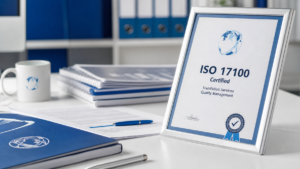
ISO 17100:2015 is the international standard for translation service processes. It mandates a two-stage workflow: translation by a qualified translator, followed by independent revision. For regulated technical documentation, this is the minimum acceptable process standard.
Ask to see the certificate and verify the scope covers technical translation. A general ISO 9001 quality certificate is not the same thing.
2. Translators with Engineering Backgrounds
A translator fluent in German and English cannot reliably translate a hydraulics manual without engineering knowledge. Technical translation requires translators who understand the subject matter, not just the language pair.
Look for suppliers who employ or contract translators with backgrounds in mechanical engineering, electrical engineering, industrial automation, or the specific sector relevant to your product. Ask directly how translators are selected and matched to each project.
3. Terminology Management
Consistent terminology across all documentation is both a quality requirement and a regulatory one. A component described as a “pressure relief valve” in the operating manual must use the same term in the maintenance manual, the spare parts catalogue, and every language version of each document.
Suppliers using translation memory software (MemoQ, SDL Trados, or similar) maintain client-specific glossaries and enforce consistent terminology automatically. This also makes updates faster and cheaper: when you release a new product version, only the changed content requires retranslation, rather than a full project from scratch.
4. DTP and Typesetting Capability
Technical documentation rarely arrives as a plain text file. Manuals are typically formatted in InDesign, FrameMaker, or Word with precise layouts, diagrams, callouts, and tables. Text volume changes in translation: German and French typically run 20-30% longer than English source text.
A supplier with in-house multilingual DTP capability delivers translated files in the original format, ready to print or publish, without requiring you to reformat everything after translation. Without this, DTP rework becomes an additional cost and timeline risk on every project.
5. A Clear Version Control Process
Manufacturing documentation changes. Products are updated, safety warnings are added, regulations evolve. Each update to the source document requires corresponding updates to every translated version.
Ask how a supplier handles document updates. Translation memory tools mean unchanged content is retrieved automatically and only new or changed segments require retranslation. This keeps update costs proportional to the actual scope of change, rather than requiring full retranslation each time.
6. Proven Sector Experience
Case studies and client references from manufacturing or engineering companies are the most reliable indicator of genuine technical translation capability. A supplier with a track record delivering translated documentation for industrial machinery, electronics, or engineered systems has already worked through the terminology challenges specific to those sectors.
Generic translation agencies that handle everything from marketing copy to birth certificates are rarely equipped for complex technical manufacturing documentation.
How Global LTS Supports Manufacturing Companies
Global LTS provides technical translation services for engineering-led manufacturers across the UK and internationally. Our translators are specialists in industrial machinery, electronics, mechanical systems, and manufacturing processes, matched to each project by sector experience rather than language pair alone.
Our technical translation workflow includes:
- ISO 17100:2015-certified processes with mandatory independent revision on every project
- MemoQ-powered translation memory maintaining approved terminology across product lines and document versions
- In-house multilingual DTP for InDesign, FrameMaker, Word, and other formats, delivering print-ready translated files
- Multi-stage QA covering linguistic accuracy, terminology consistency, number and unit verification, and formatting checks
- Lifetime quality guarantee – if anything needs adjustment after delivery, we correct it at no charge
Recent manufacturing projects include:
- Sinclair International – IFU translation for a high-speed fruit labelling machine into eight languages including Brazilian Portuguese, Chinese, Thai, and Polish
- Gericke Ltd – translation of installation, operation, and maintenance manuals for industrial processing equipment into Polish, German, French, and Italian
- GM Instruments – translation of technical and clinical user manuals for rhinometry devices into Spanish across four documents
For manufacturers also dealing with medical device documentation, see our IFU translation guide for regulated device documentation requirements.
Getting a Quote
Technical translation project costs depend on word count, number of target languages, document format, and whether existing translation memory is available from previous projects.
Contact Global LTS with your documentation and the target markets. We will confirm the scope, applicable glossaries, DTP requirements, and turnaround, then provide a detailed quote. Most standard technical translation projects complete within 5-10 working days per language.
For a full overview of our technical translation services, visit our technical translation page.”