Packaging Translation and Multilingual DTP: How the Design Process Works
Key Takeaways
- Multilingual DTP (Desktop Publishing) is the process of reintegrating translated text into packaging artwork files — it is a distinct skill from translation, and packaging projects require both.
- Supplying design files in editable native formats (InDesign .idml is the standard) rather than PDFs makes the entire process faster, cheaper, and less prone to typesetting errors.
- Text expansion of 15–30% is typical when translating from English into European languages — this must be planned at the design stage, not resolved after translation is complete.
- Right-to-left languages (Arabic, Hebrew, Urdu) require a full layout mirror — text direction, alignment, and in some cases the entire structural flow of the packaging design must be adapted.
- The final deliverable from a well-managed packaging translation project is print-ready artwork in each target language, not just a translated text document for the client to reintegrate themselves.
Packaging translation is not simply a language task — it is a design and production task as well. The translated text needs to fit on the packaging, read correctly in the target language, meet the typographic standards of the target market, and be delivered in a format that goes directly to print without requiring additional work on the client side. This guide explains how that process works and what to prepare before briefing your translation partner.
Table of Contents
ToggleWhat Is Multilingual DTP?
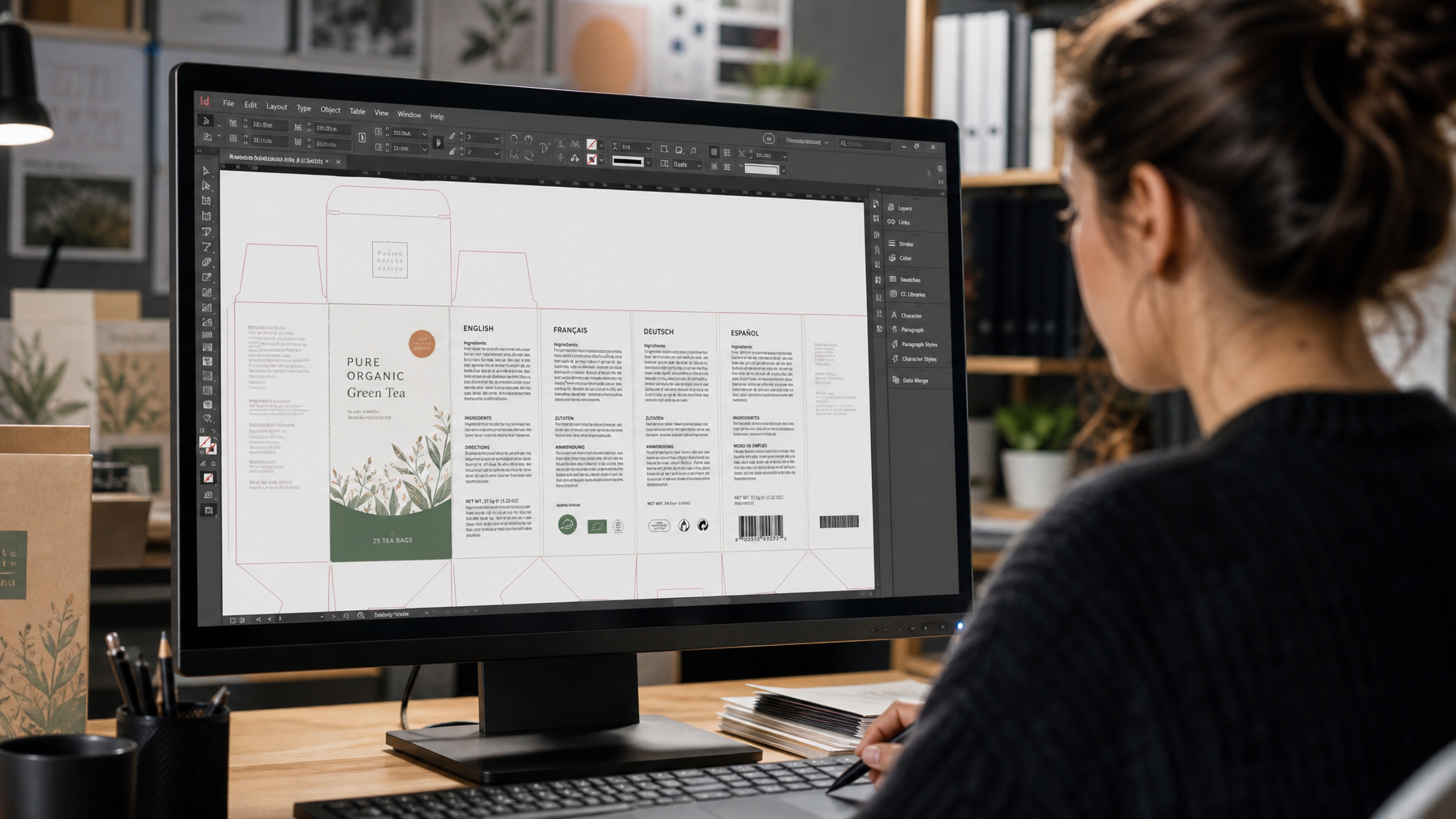
DTP — Desktop Publishing — is the process of setting text within a design file, managing typography, layout, and the relationship between text and visual elements. Multilingual DTP applies this to translated content: taking the translated text produced by the linguist and reintegrating it into the original packaging artwork, adjusted for the specific characteristics of the target language.
For packaging specifically, multilingual DTP involves:
- Importing translated text into the original InDesign, Illustrator, or other design file
- Adjusting text boxes, font sizes, leading, and tracking to accommodate text expansion or contraction
- Ensuring the translated text meets minimum font size requirements where regulations specify them (EU FIC, for example, requires a minimum 1.2mm x-height for mandatory food labelling information)
- Adapting layouts for right-to-left languages
- Applying the correct fonts for languages that use non-Latin scripts (Arabic, Chinese, Japanese, Cyrillic, etc.)
- Checking that the final artwork reads correctly and presents consistently with the original design intent
- Delivering print-ready files in the specified format
Without DTP, a translation project delivers a text document — the client is left to reintegrate that text into their artwork themselves, which is time-consuming and introduces risk of errors. With DTP included, the client receives files ready for print.
File Formats: What to Supply and Why It Matters
The format in which you supply your design files determines how efficiently the translation and typesetting process can be completed.
InDesign (.idml)
InDesign is the industry standard for packaging and print design, and .idml (InDesign Markup Language) is the preferred format for multilingual packaging projects. The .idml format is version-agnostic — it can be opened regardless of which version of InDesign the translation team uses — and allows text to be extracted, translated, and reintegrated using translation memory software, which ensures terminology consistency across language versions and across future projects.
Supply .idml rather than .indd wherever possible. If your files are in .indd, export an .idml version before sending.
Illustrator (.ai) and PDF
Illustrator files can be handled but require more manual work than InDesign. PDFs are the least efficient format — text must be extracted manually, and the typesetting must be recreated from scratch rather than updated within the existing file structure. If the only available format is PDF, the project timeline and cost will reflect the additional work required.
Fonts
Supply all fonts used in the original design alongside the artwork files. If the DTP team does not have access to the correct fonts, they cannot match the original typography in the translated versions. This is one of the most common causes of delay in packaging DTP projects.
Text Expansion: Planning for It at the Design Stage
The most predictable and most commonly overlooked issue in multilingual packaging projects is text expansion. When English copy is translated into most European languages, the translated text is longer. Approximate expansion rates from English:
- French: 15–20%
- German: 20–30%
- Spanish: 15–25%
- Italian: 10–25%
- Polish: 20–30%
For languages with different scripts, the relationship between character count and space required changes significantly — Chinese and Japanese are typically more compact than English; Arabic varies depending on the content.
The practical implications for packaging design:
- Fixed-size text boxes will overflow when translated text is inserted. Either set text boxes to auto-size, or build generous margins around text areas when designing the English source version.
- Ingredients lists and nutritional tables are particularly vulnerable — these are already space-constrained, and expansion into a German or Polish version can require a complete layout revision if space has not been reserved.
- Buttons and callouts (e.g. "New Recipe", "Award Winning", "Now in Three Flavours") are high-risk — short English phrases often expand significantly and may not fit the badge or callout shape designed for them.
The cost of designing a packaging range with multilingual text expansion in mind is negligible. The cost of redesigning a finished pack after discovering the German ingredients list overflows by 30% is not.
Right-to-Left Languages: What Changes
Arabic, Hebrew, and Urdu are written right-to-left. Translating packaging into these languages requires more than inserting translated text — the layout itself must be adapted.
For packaging translated into right-to-left languages:
- Text alignment changes throughout — all text blocks align right rather than left
- Reading direction of the overall layout may be mirrored — what reads left-to-right in English may need to be restructured to read right-to-left
- Nutritional tables and structured data need to be reformatted for right-to-left reading
- Bidirectional text — where Arabic and English (for product names, brand names, or INCI terms) appear on the same line — requires careful typographic handling to ensure the correct reading order
Arabic-speaking markets, including the GCC countries, are significant markets for UK food, cosmetics, and consumer goods exporters. Arabic packaging requirements should be scoped into the project from the outset, not treated as a straightforward add-on to a European language project.
What You Receive at the End of the Project
A well-structured packaging translation and DTP project delivers:
- Translated and proofread text in each target language, reviewed by a native-speaking linguist
- Print-ready artwork files in each target language, typeset and checked by the DTP team
- Translation memory — a record of all translated terminology that can be reused in future projects, ensuring consistency and reducing cost over time
The client should not need to do further design or typesetting work before sending files to print. If a packaging translation project ends with the client receiving a Word document of translated text, the DTP stage has not been completed.
Conclusion
Packaging translation done well is a joined-up process — translation, DTP, and quality review working together to produce print-ready artwork in each target language. The key to an efficient project is preparation: supplying editable files in the right format, planning designs with text expansion in mind, and briefing the translation team with full context before work begins.
Global LTS provides end-to-end packaging translation services including multilingual DTP, with native-speaking translators and an experienced in-house DTP team. We also handle brochure translation and InDesign translation for wider marketing material projects. Contact us to discuss your packaging project.
For related reading, see our guides on EU packaging labelling requirements and food packaging translation.