Multilingual DTP: What It Is and Why InDesign Translation Projects Need It
Key Takeaways
- Multilingual DTP (desktop publishing) is the process of adapting a designed document — InDesign, Word, PowerPoint, or similar — for use in a different language, so that the translated text fits correctly within the original layout.
- Translation alone does not produce a print-ready multilingual document. The translated text must be typeset correctly in the target language before the file is ready for print or publication.
- Text expansion and contraction during translation — up to 35% expansion for European languages, up to 60% contraction for Japanese and Chinese — always requires DTP adjustment.
- Right-to-left languages (Arabic, Hebrew) require full document reconstruction in InDesign, not just text replacement.
- CJK languages (Chinese, Japanese, Korean) require specific fonts, character spacing, and line-break rules that differ fundamentally from Latin-script typesetting.
When businesses translate InDesign documents — brochures, product catalogues, technical manuals, packaging inserts — they often focus on the translation itself as the main deliverable. The translation is necessary, but it is only one part of producing a usable multilingual document. The other part is multilingual DTP: the process of making the translated text fit correctly within the original designed layout, so the final file is ready for print or publication.
Table of Contents
ToggleWithout DTP, a translated InDesign file is an unfinished product. The text may be accurate, but it will not look correct — text will overflow text frames, columns will break at the wrong points, fonts will be missing or incorrect for the target language, and right-to-left layouts will be unreadable.
What is multilingual DTP?
Desktop publishing (DTP) is the use of software to combine text and graphics into a designed layout — product brochures, annual reports, packaging, magazines, instruction manuals. Adobe InDesign is the professional standard for this work.
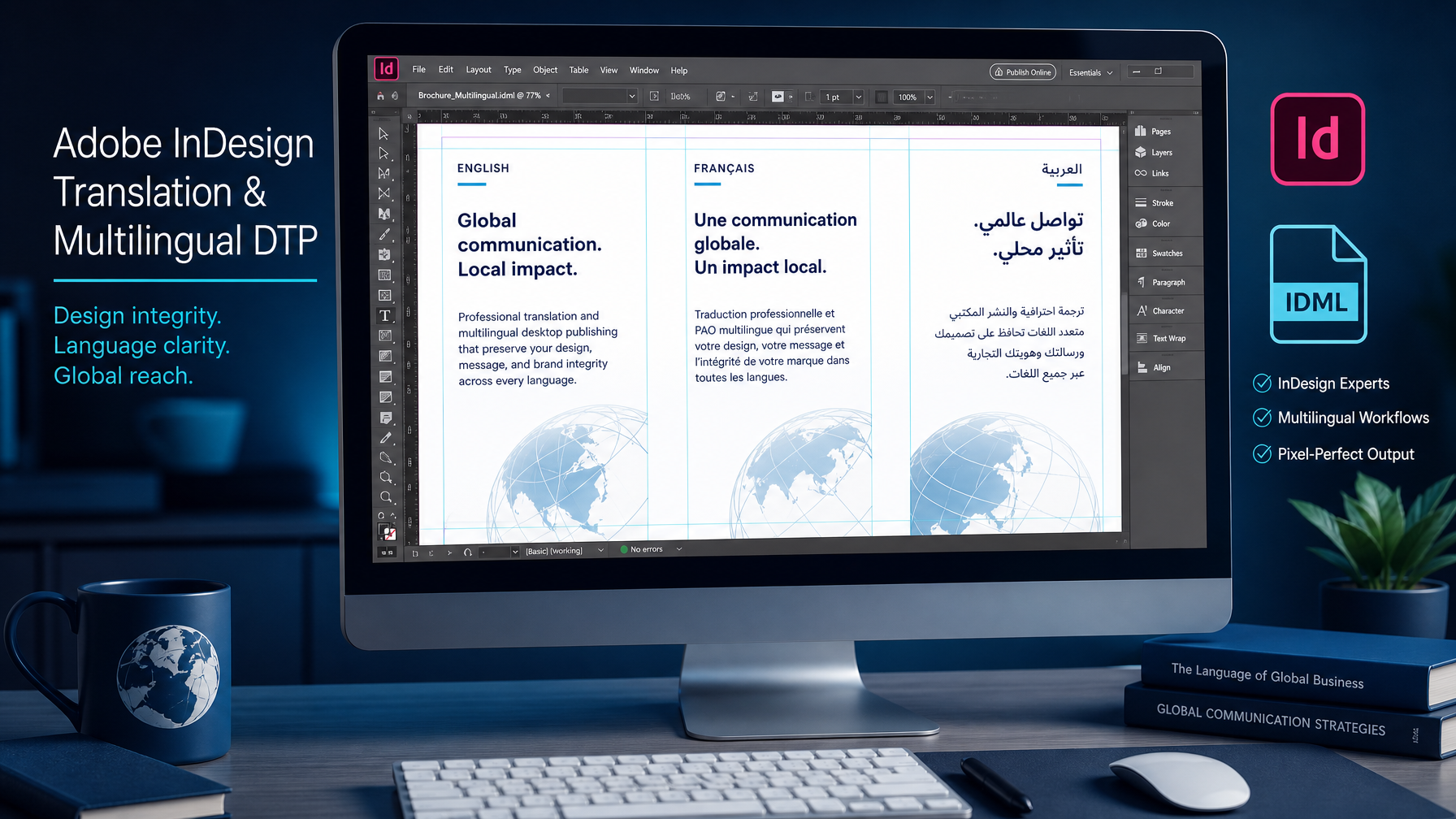
Multilingual DTP is DTP carried out specifically to adapt an existing layout for a different language. It covers everything that needs to change in the layout as a result of translation: text frame adjustments, font substitutions, text reflow, right-to-left reconstruction, character spacing for CJK scripts, and final visual quality checking.
A multilingual DTP specialist works at the intersection of graphic design and translation production. They are not translators — their job is to ensure the translated text is presented correctly within the designed layout, matching the visual standard of the source document.
Why translation alone is not enough
When text is translated from English into another language, the volume of text changes. It almost never remains exactly the same length as the source.
For European languages, translation from English typically increases text volume:
- German: 25 to 35 per cent longer
- French: 15 to 25 per cent longer
- Spanish and Italian: 15 to 25 per cent longer
For CJK languages, translation from English typically decreases text volume:
- Japanese: 40 to 60 per cent shorter
- Simplified Chinese: 30 to 50 per cent shorter
This means that text translated from English into German will overflow text frames designed for English — sometimes by a significant margin. Text translated into Japanese will leave large areas of white space in layouts designed for English proportions.
Neither of these is a print-ready document. The DTP team adjusts text frames, tracking, leading, font sizes, and column widths to accommodate the translated text within the original layout, while maintaining the visual quality and brand consistency of the source document.
What multilingual DTP involves in practice
Text reflow and frame adjustment
After the translated IDML file is reimported into InDesign, the DTP team works through the document page by page. Wherever translated text is longer than the source, text overflows its frame. The DTP team adjusts the frame dimensions, reduces tracking or leading slightly, or — where necessary — makes minor copy edits in consultation with the translator to bring the text within the layout constraints.
Wherever translated text is shorter than the source, the DTP team adjusts spacing and layout to avoid excessive white space and maintain visual balance.
Right-to-left language reconstruction
Arabic and Hebrew are written from right to left. Translating an English InDesign document into Arabic or Hebrew is not a matter of replacing Latin text with Arabic script — it requires reconstructing the entire document in mirror layout.
In a right-to-left InDesign document:
- Text frames are right-aligned
- Columns flow from right to left
- Page flow is reversed (the document reads from back to front in Western terms)
- Paragraph and character styles must be updated for RTL text direction
- Tables, lists, and navigation elements must be mirrored
Adobe InDesign supports right-to-left text through its World-Ready Composer, but enabling and applying it correctly across a complex document requires DTP expertise rather than simply turning on a setting.
CJK typesetting
Japanese, Chinese, and Korean scripts require DTP treatment that differs significantly from Latin-script typesetting:
Fonts — standard Latin fonts do not contain CJK characters. The DTP team substitutes or adds CJK-compatible fonts that match the weight and style of the original Latin font family as closely as possible.
Character spacing (mojikumi) — Japanese typography applies specific spacing rules between different character types (kanji, hiragana, katakana, punctuation, and Latin characters). These mojikumi settings must be applied correctly for the text to meet professional Japanese typesetting standards.
Line breaks (kinsoku) — Japanese and Chinese have rules about which characters can appear at the start or end of a line. Certain punctuation marks, for example, cannot appear at the start of a new line. InDesign's Kinsoku Shori setting enforces these rules, but it must be enabled and configured for the target language.
Vertical text — some Japanese documents use vertical text (tategumi) rather than horizontal text (yokogumi). This requires specific document setup and cannot be converted from a horizontal layout without significant reconstruction.
Final visual review
After all layout adjustments are complete, the DTP team performs a final page-by-page visual review comparing the translated document against the source. This check confirms:
- No overflowing text frames
- No missing text segments
- Correct font rendering for all languages in the document
- Consistent spacing, alignment, and visual balance throughout
- Print-ready PDF export quality
When multilingual DTP is needed
Multilingual DTP is required whenever a designed document is translated and the translation is intended for print or professional digital publication. This includes:
- Product brochures and catalogues
- Packaging inserts and labels
- Technical and user manuals
- Annual reports and financial documents
- Marketing collateral
- Exhibition and event materials
- Training and compliance documentation
It is not typically required for simple text-based documents such as contracts, certificates, or letters, where the layout is straightforward and translation does not affect the document structure. For those documents, translation and formatting review is sufficient.
In-house vs outsourced DTP
Some businesses have internal design teams and attempt to handle multilingual DTP in-house after receiving translated text from an agency. This approach works when the internal team has experience with multilingual typesetting, access to the required CJK or Arabic fonts, and familiarity with InDesign's right-to-left and CJK text settings.
In practice, many internal design teams do not have this experience — the specific requirements of Arabic text reconstruction, Japanese mojikumi settings, and CJK font selection are specialist knowledge that falls outside standard graphic design training.
Using a translation agency with in-house multilingual DTP capability keeps the full workflow under one roof. The translation and DTP teams work together on the same files, with direct communication between linguists and DTP specialists when layout constraints require minor copy adjustments. The final deliverable is a print-ready file, not a translated file that still requires a separate DTP workstream.
Global LTS provides InDesign translation services with in-house multilingual DTP across 120+ languages, including Arabic, Hebrew, Japanese, Chinese, Korean, and all major European languages. Contact us to discuss your project.
For related reading, see our guides on how to translate an Adobe InDesign file and IDML vs INDD: which file format to send your translation agency.