High German vs Austrian & Swiss German: Which Version Does Your Translation Need?
Key Takeaways
- German is spoken by over 100 million native speakers as an official language in Germany, Austria, Switzerland, Liechtenstein, Luxembourg, and parts of Belgium.
- Standard High German (Hochdeutsch) is the universal written standard across all German-speaking countries and is suitable for almost all B2B contracts, technical manuals, and corporate publishing.
- Swiss German (Schweizer Hochdeutsch) has specific spelling differences, including the complete omission of the character "ß" (replaced by "ss"), as well as distinct financial, legal, and institutional vocabulary.
- Austrian German (Österreichisches Deutsch) shares official grammar and spelling rules with Hochdeutsch but uses distinct vocabulary for food, public administration, legal terms, and calendar references.
- German text expands by 25 to 35 per cent compared to English source text, requiring careful layout adjustments in print, packaging, and digital user interfaces.
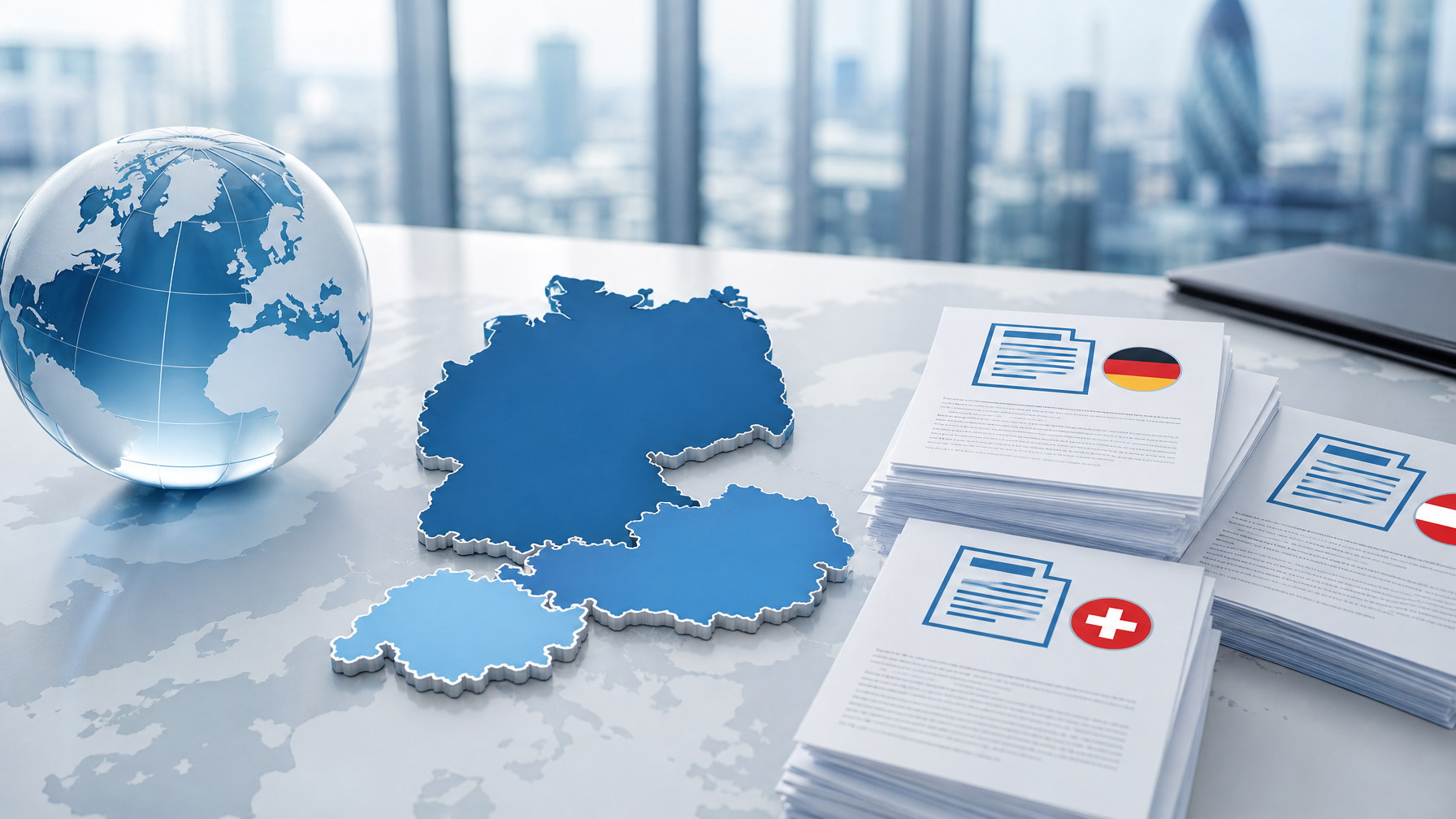
Germany, Austria, and Switzerland represent the DACH region, one of Europe's most lucrative commercial markets. While standard written German provides a unifying foundation across all three countries, local language conventions, regional vocabulary, and specific regulatory environments mean that a one-size-fits-all approach is not always sufficient for UK businesses.
Table of Contents
ToggleThis guide explains when Standard High German works best, where Swiss and Austrian variants differ, and how to brief your German translation projects effectively.
Standard High German (Hochdeutsch): The Global Baseline
Standard High German (Hochdeutsch or Standarddeutsch) is the formal written standard used in education, government, national media, and international business throughout the German-speaking world.
When to use Hochdeutsch:
- B2B commercial contracts, agreements, and corporate governance documents
- Technical documentation, user manuals, and engineering specifications
- International marketing campaigns and corporate websites intended for the entire DACH region
- Academic, medical, and scientific publications
- Certified translations for UK official bodies
Because Hochdeutsch is understood perfectly by educated readers in Germany, Austria, and Switzerland, it serves as the default target language for most UK export translation projects.
Swiss German (Schweizer Hochdeutsch)
It is essential to distinguish between Schwyzerdütsch (the collection of spoken Alemannic dialects used in daily Swiss life) and Schweizer Hochdeutsch (Swiss Standard German, the written language used in Swiss newspapers, books, legislation, and business).
When translating written materials for Switzerland, you will be using Swiss Standard German, which has several distinct rules:
1. No "ß" (Eszett): Swiss Standard German completely eliminated the character "ß" decades ago. In Switzerland, words like Straße (street) or groß (large) are always written as Strasse and gross. Using "ß" in a document targeting Switzerland immediately signals that it was produced outside the country.
2. Banking, Legal, and Institutional Vocabulary: Switzerland has unique legal, tax, and financial frameworks that operate outside the EU. Technical, financial, and legal terms often differ from German usage. For example, a Swiss invoice might reference a Mehrwertsteuer or Mehrwertsteuer-Nummer, but the formatting and associated administrative terminology follow Swiss federal guidelines.
3. Distinct Commercial Terms: In daily commerce and consumer communication, Swiss German uses terms influenced by French or historical Swiss usage. For instance, a ticket or voucher is frequently referred to as a Billet rather than a Fahrkarte or Gutschein.
Austrian German (Österreichisches Deutsch)
Austrian Standard German (Österreichisches Deutsch) is the official language of Austria. It shares the same grammar and core spelling system as Hochdeutsch, including the use of "ß", but includes several thousand distinct words recognized by the official Austrian Dictionary (Österreichisches Wörterbuch).
Key areas of difference in Austria:
- Food and Beverage: Packaging and retail labels require Austrian vocabulary. For example, potato is Erdäpfel (not Kartoffel), cream is Obers (not Sahne), and tomatoes are Par paradeiser (not Tomaten).
- Public Sector and Legal: Administrative terminology, official job titles, and legal bodies differ from Germany. Austrian legal contracts use terms specific to Austrian civil law (AGBG).
- Months and Dates: In Austrian administrative documents, January is often written as Jänner rather than Januar.
Choosing the Formal or Informal Register (Sie vs du)
One of the most critical decisions when translating English content into German is choosing between the formal address (Sie) and the informal address (du). English uses "you" for both, but German requires an explicit choice that shapes verb endings and pronouns throughout the document.
Formal (Sie): Standard for all B2B communications, legal agreements, technical manuals, financial reports, and traditional corporate marketing. It conveys professionalism, authority, and respect.
Informal (du): Increasingly common in modern consumer marketing, social media campaigns, SaaS platforms, and youth-oriented lifestyle brands. However, using du in a corporate B2B context or formal document can feel uncomfortably informal to German business partners.
How to Brief a German Translation Project
To ensure your German translation is perfectly tailored to your target market, include these details in your brief:
- Target Region: Specify whether the material is for Germany, Austria, Switzerland, or a general DACH audience.
- Formality Level: Indicate whether your brand tone requires formal (Sie) or informal (du) address.
- Layout Considerations: German text is approximately 25. 35% longer than English. Ensure your design team provides sufficient space in desktop publishing (DTP) templates or digital UI boxes.
Global LTS provides professional English-to-German and German-to-English translation services tailored to your target market. Our translators are qualified native speakers with specialized sector expertise across engineering, law, medicine, and marketing.
For a free quote, contact us today or visit our German translation services page.