
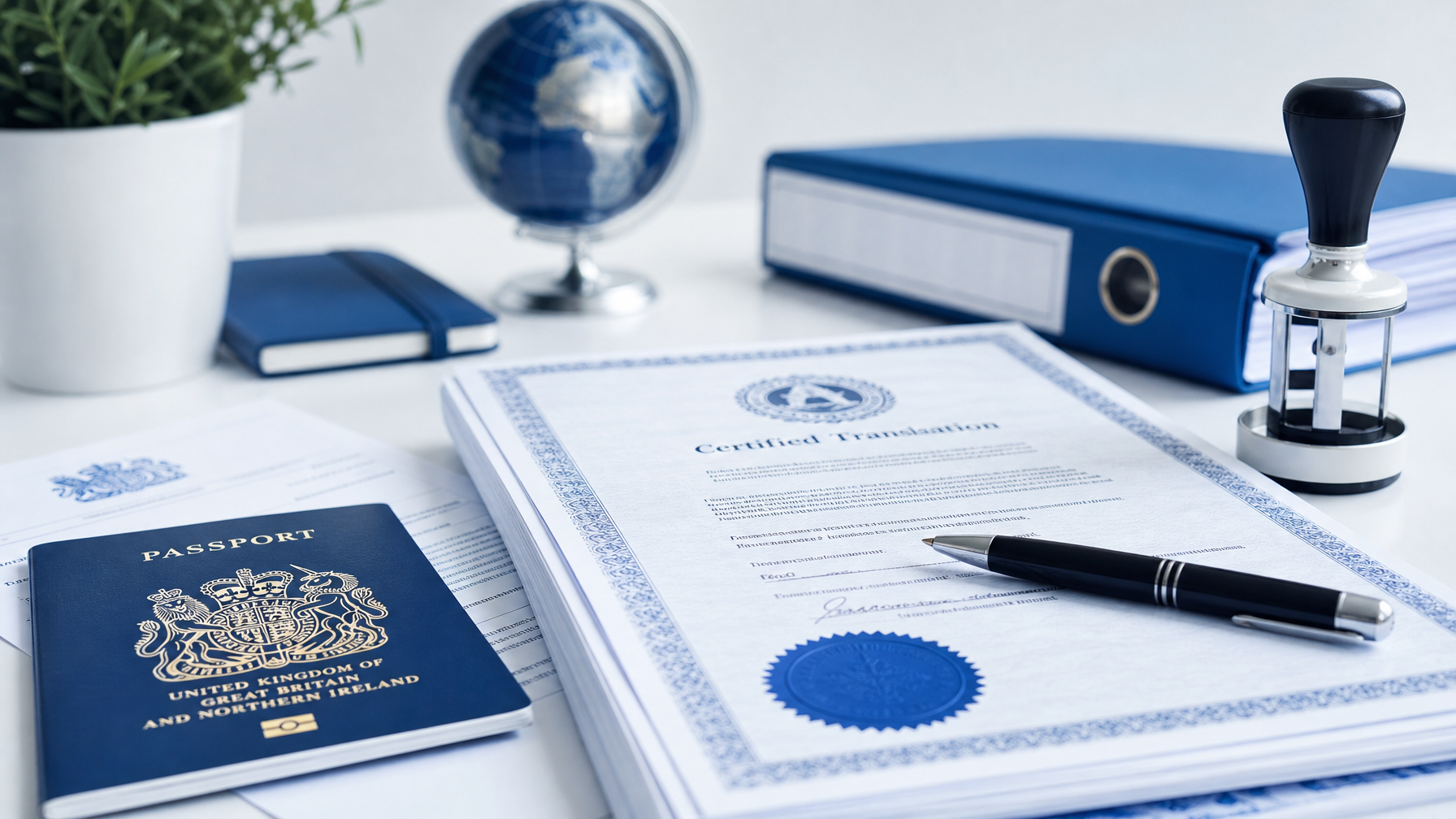
Certified Translation for UKVI: What You Need and Why It Matters
Key Takeaways
- UK Visas and Immigration (UKVI) requires a certified translation for every foreign-language document submitted with a visa or immigration application.
- A compliant translation must state it is “a true and accurate translation of the original”, include the date, and show the translator’s full name and contact details.
- Common documents that require certified translation include birth certificates, marriage certificates, educational qualifications, bank statements, and employment letters.
- The translation must be independently verifiable by the Home Office. Family members and the applicant cannot translate their own documents.
- Choosing an ISO 17100-certified agency removes the risk of rejection due to non-compliant translations.
UK visa applications are rejected every day for a reason that has nothing to do with the applicant’s eligibility: a translation that does not meet Home Office standards. A document translated by a bilingual friend, or one that lacks the required certification statement, can cause the entire application to be refused, even if the underlying evidence is solid.
Table of Contents
ToggleThis guide covers exactly what UKVI expects, which documents need a certified translation, which visa routes are affected, and what to look for in a translation provider.
What Is UKVI and Why Does It Require Certified Translations?
UK Visas and Immigration (UKVI) is the division of the Home Office responsible for processing all UK visa, immigration, and citizenship applications. It operates under the Immigration Rules, which set out precisely what evidence applicants must submit.
Any document that is not in English or Welsh must be accompanied by a certified translation. The rule is absolute. UKVI case workers do not read foreign-language documents, and an untranslated document is treated as if it was not submitted at all.
The reason UKVI specifies certified translation rather than any translation is verifiability. The Home Office needs to confirm that the translation is accurate and that a qualified professional produced it. A certification statement attached to the translation provides that assurance.
Exact Home Office Requirements for a Certified Translation
According to GOV.UK guidance on certifying a document, a certified translation for UKVI must include all of the following on the translation itself:
- A statement that it is “a true and accurate translation of the original document”
- The date of the translation
- The translator’s full name
- The translator’s contact details (address, email, or phone number)
Some agencies also include the translator’s professional credentials and a company stamp. While not always mandatory, these additions strengthen the translation’s credibility and reduce the chance of a case worker raising questions.
What makes a translation non-compliant:
- No certification statement at all
- A statement that is vague (e.g. “translated by” without confirming accuracy)
- Missing contact details for the translator
- Translated by the applicant or a family member
- Produced by a machine translation tool without human review and certification
Which Documents Commonly Require Certified Translation for UKVI
Any document not in English or Welsh needs a certified translation. In practice, the most common documents are:
Personal documents
- Birth certificates
- Marriage certificates
- Divorce certificates or decrees
- Death certificates
- National identity cards
- Passports (where relevant pages are in a non-Latin script)
Financial documents
- Bank statements
- Pension statements
- Property ownership documents
- Tax returns or employer income confirmations
Employment and qualification documents
- Academic certificates and transcripts
- Professional qualifications and licences
- Employment contracts
- Payslips
Legal documents
- Criminal record checks
- Court orders
- Police certificates
If a document type is required by your visa route and it is not in English or Welsh, translate it. Do not leave it to chance.
Which Visa Routes Require Certified Translations
Certified translation requirements apply across all major UKVI visa categories.
Skilled Worker visa
The GOV.UK Skilled Worker visa page states that if documents are not in English or Welsh, a certified translation must be provided. Common documents include academic qualifications and professional certificates.
Spouse and family visas
Spouse and partner visa applications typically require birth certificates, marriage certificates, and financial evidence, all of which must be certified if not in English or Welsh. Any non-English documents must meet Home Office translation standards. (Glovisa spouse visa guide)
Student visa
Education certificates, transcripts, and financial guarantor documents in other languages need certified translation. The requirement applies to both the student applicant and supporting documents from sponsors or parents.
Visitor visa
The UKVI guide to supporting documents for visitor visas specifies that translations must be independently verifiable by the Home Office.
Indefinite Leave to Remain (ILR)
ILR applications often involve documents spanning many years, sometimes from multiple countries. All foreign-language documents must be certified, and any gaps or inconsistencies in translated evidence are a common reason for ILR refusal. (Gherson Immigration)
Common Mistakes That Lead to Rejection
The most preventable causes of UKVI refusal related to translation are:
1. Using a bilingual friend or family member
UKVI requires an independent, professional translation. A translation produced by someone connected to the applicant carries no credibility and will not be accepted.
2. Machine translation without certification
Tools like Google Translate are not certified translations. Even if the translation is accurate, there is no professional accountability attached to it, so the Home Office will not accept it.
3. Missing or incomplete certification statements
A translation with no statement of accuracy, or one that lacks the translator’s contact details, does not meet the standard. This is one of the most common errors, particularly when using a low-cost provider.
4. Translating only part of a document
Every section of a document must be translated. Leaving out stamps, official notes, or annotations is a common error that can raise questions about the completeness of the evidence.
5. Outdated translations
While UKVI does not set a universal expiry date for certified translations, some case workers question translations that are several years old when the application concerns recent events. For time-sensitive documents, a fresh translation is worth considering.
Certified Translation vs. Notarised Translation: What UKVI Requires
This is a source of regular confusion. Here is the difference:
Certified translation: a translation accompanied by a signed statement confirming it is accurate, complete, and produced by a qualified translator. This is what UKVI requires in the vast majority of cases.
Notarised translation: a certified translation that has been additionally signed by a notary public, who verifies the translator’s identity and credentials. UKVI does not routinely require notarisation, but some specific document types, such as powers of attorney or certain legal instruments, may need it.
If you are unsure whether notarisation is required for your specific document, ask your translation provider or consult an immigration solicitor.
Our certified translation services cover both standard certified translations and notarised translations where required.
How to Choose a Certified Translation Provider for UKVI
Not all translation agencies produce translations that meet UKVI standards. When selecting a provider, look for the following:
ISO 17100 certification
ISO 17100 is the international standard for translation services. An ISO-certified agency follows a defined quality process, including translator qualification requirements and review stages. This gives the Home Office confidence in the accuracy of the output.
Clear certification statement included as standard
Ask to see a sample certificate of accuracy. A reputable agency includes this with every translation without needing to be asked.
Experience with UKVI and Home Office submissions
Agencies that regularly handle immigration documents understand exactly what format the certification must take. Ask specifically whether the agency has experience with UKVI applications.
Human translators, not machine output
Confirm that a qualified human translator produces the translation. Some agencies use machine translation and then have a human review it. For official submissions, a fully human-produced translation is the safer choice.
Turnaround times that suit your application timeline
Standard certified translations typically take one to two working days. If your visa appointment is imminent, check whether an urgent service is available.
At Global LTS, our certified translations are produced by qualified specialist translators, include a full certificate of accuracy as standard, and are delivered in a format that meets Home Office and UKVI requirements. We are ISO 17100:2015 certified and cover 120+ languages.
Frequently Asked Questions
Can I translate my own documents for UKVI?
No. UKVI requires an independent professional translation. Applicants and their family members cannot certify their own translations.
Does UKVI accept translations from any translator?
The translator must be a professional with the relevant language expertise. Using an unqualified person, even a fluent speaker, is not sufficient. The certification statement must include the translator’s full name and contact details so the Home Office can verify the translation if needed.
How long does a certified translation take?
Standard turnaround for most documents is one to two working days. Complex or lengthy documents such as full bank statement histories may take longer. Urgent services are available from most professional agencies.
Do I need to send the original document alongside the translation?
In most cases, yes. UKVI typically requires the original or a certified copy of the original alongside the certified translation. Check your specific visa route guidance on GOV.UK for confirmation.
Is a notarised translation the same as a certified translation?
No. A certified translation includes a signed statement of accuracy from the translator. A notarised translation additionally involves a notary public verifying the translator’s credentials. UKVI requires certified translations as a baseline; notarisation is only needed for specific document types.
What happens if my translation is not compliant?
UKVI may refuse to consider the document, which can lead to a refusal of the entire application. In some cases, the applicant is asked to resubmit, but this adds delay and cost. Getting the translation right the first time is always the better approach.
Get a Certified Translation for Your UKVI Application
If you have documents to translate for a UK visa or immigration application, Global LTS provides certified translations that meet Home Office and UKVI standards. Our translations include a full certificate of accuracy, are produced by qualified specialist translators, and are delivered in a format accepted by UKVI.
We cover 120+ languages, offer standard and urgent turnaround, and are ISO 17100:2015 certified. Contact us for a free quote.
Costs depend on the number of words, the language pair required and the turnaround times. The cost per word starts at £0.095 plus VAT.