CE marking is a legal requirement for placing most products on the European market. The mark itself is straightforward to understand. The documentation requirements behind it are less so – and translation is where manufacturers most commonly fall short.
Table of Contents
ToggleEU directives require that certain documents be available in the official language of every member state where a product is sold. The specific requirements vary by directive. Failing to meet them does not just create a compliance problem: it can prevent a product reaching the market at all, trigger enforcement action from national market surveillance authorities, or expose the manufacturer to liability if a safety incident occurs.
This checklist covers which documents require translation, what each directive specifically requires, the most common mistakes that fail audits, and what changes when the new Machinery Regulation takes effect in January 2027.
The Core Principle: Language of the Member State
The underlying rule across all CE marking directives is the same: product documentation must be available in the official language, or official languages, of the member state where the product is placed on the market.
For a manufacturer selling into six EU countries, that typically means six sets of translated documentation. For a product sold across the full EU, it means documentation in up to 24 official languages.
The directives also draw a consistent distinction between the “original instructions” – produced by the manufacturer in one EU language – and the “translation of the original instructions” for each target market. Translated versions must be clearly identified as translations. This is not a formatting preference: it is a specific legal requirement under the Machinery Directive and several others.
CE Marking Translation Checklist by Document Type
The documents below represent the most common translation requirements across CE marking directives. Which apply to your product depends on which directives govern it.
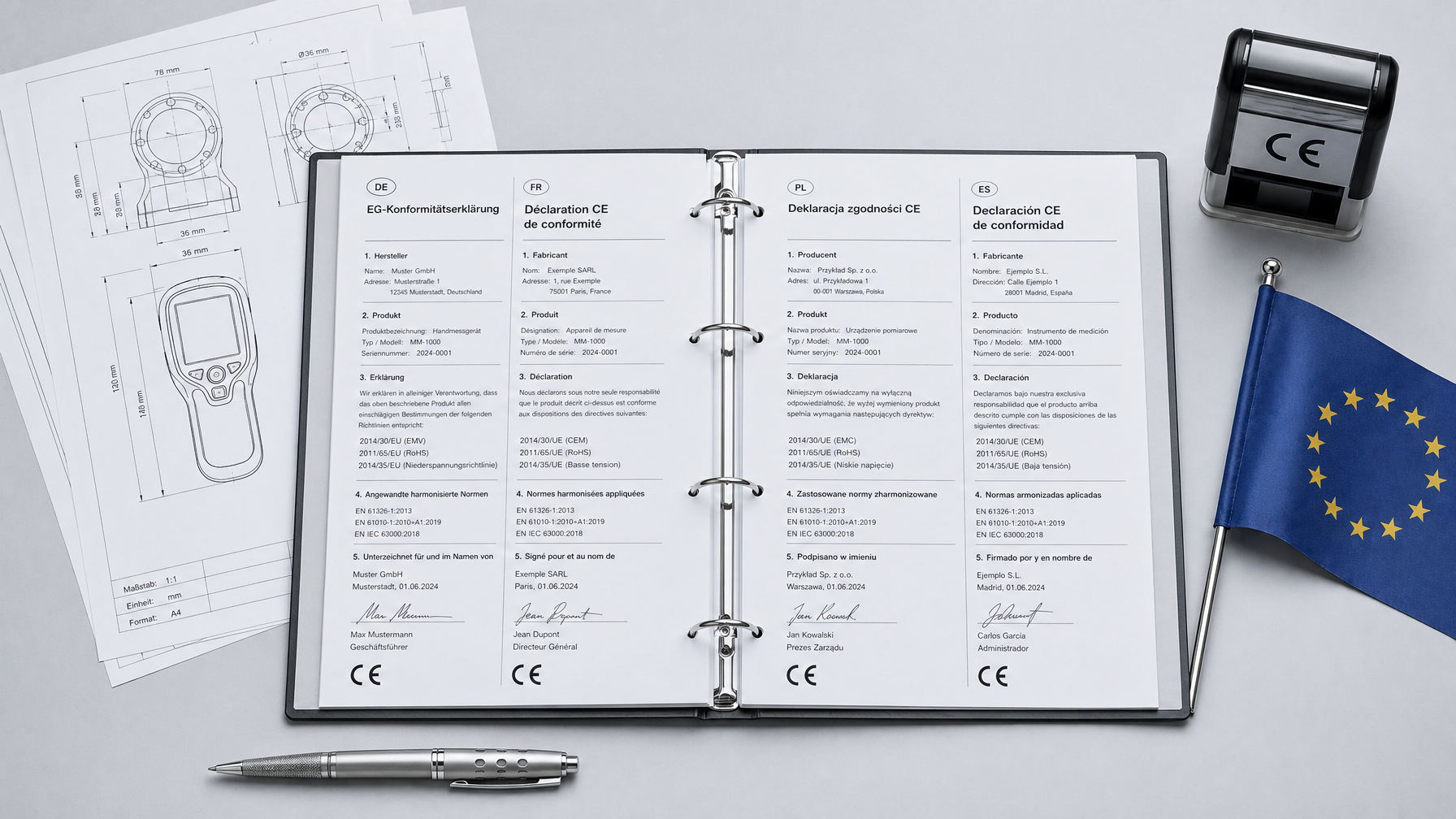
EU Declaration of Conformity (DoC)
- Required by: Machinery Directive, Low Voltage Directive, EMC Directive, PPE Regulation, Medical Devices Regulation, and most other CE marking frameworks
- Translation requirement: Must be available in the language(s) of the member state(s) where the product is marketed in most directives. Some directives permit English-only DoCs for market surveillance purposes, but this varies.
- Common mistake: Issuing a single English-language DoC and assuming it satisfies all markets. Market surveillance authorities in Germany, France, Spain, and others expect documentation in their own language.
Instructions for Use / Operating Manual
- Required by: Machinery Directive (Annex I), Low Voltage Directive, Medical Devices Regulation, PPE Regulation, and most product-specific directives
- Translation requirement: The Machinery Directive is explicit: the manufacturer must provide a “translation of the original instructions” in the language of the country of use. The translated document must carry the words “Translation of the Original Instructions”.
- Common mistake: Providing an English manual only, or providing a translation that does not carry the required identification wording.
Safety Instructions and Warnings
- Required by: All directives that mandate user-facing documentation
- Translation requirement: Safety warnings, hazard notices, and mandatory safety instructions must appear in the language of the end user. These cannot be left in English for a French or Polish market.
- Common mistake: Translating the main manual but leaving safety callouts, warning boxes, or panel labels in English. Labels affixed to the product itself are also subject to language requirements under most directives.
Technical Data Sheets
- Required by: REACH regulation (for safety data sheets), certain product-specific directives
- Translation requirement: Safety Data Sheets (SDS) under REACH must be provided in the official language of the member state where the product is supplied. Technical data sheets accompanying the product may also require translation depending on the applicable directive.
- Common mistake: Treating SDS translation as optional or providing a single multilingual document rather than separate language versions as required.
Product Labels and Markings
- Required by: Varies by directive and product type
- Translation requirement: Mandatory label information – including warnings, usage instructions, and identification data – must appear in the official language of the destination market. For physical products, this often means country-specific labelling or multilingual labels covering all target markets.
- Common mistake: Producing a single label for all markets using English only, or assuming that pictograms are sufficient to replace translated text requirements.
Technical File
- Required by: All CE marking directives
- Translation requirement: The technical file itself is typically maintained in one language (often English) and made available to market surveillance authorities on request. However, some national authorities may require translation of specific elements. The technical file does not generally require full translation for routine market entry, but the documents derived from it (DoC, user instructions) do.
Directive-by-Directive Summary
| Directive / Regulation | DoC Translation | Instructions Translation | Labels |
|---|---|---|---|
| Machinery Directive 2006/42/EC | Required | Required, must state “Translation of Original Instructions” | Language of country of use |
| Low Voltage Directive 2014/35/EU | Required | Required | Language of country of use |
| EMC Directive 2014/30/EU | Required | Required where provided | Language of country of use |
| PPE Regulation (EU) 2016/425 | Required | Required | Language of country of use |
| Medical Devices Regulation (EU) 2017/745 | Required | Required in all official languages of distribution countries | Language of country of use |
| Pressure Equipment Directive 2014/68/EU | Required | Required | Language of country of use |
The New Machinery Regulation: What Changes in January 2027
On 20 January 2027, Regulation (EU) 2023/1230 on machinery becomes fully applicable, replacing the current Machinery Directive 2006/42/EC. This is a significant change that manufacturers selling machinery in the EU should already be planning for.
Unlike a directive, which requires national transposition, a regulation applies directly and uniformly across all EU and EEA member states from the same date. Key changes relevant to documentation and translation include:
- Digital instructions permitted: The new regulation allows instructions to be provided in digital format rather than exclusively in print. However, the language requirements remain the same: digital instructions must still be available in the official language of the member state of use.
- Expanded scope: The regulation covers AI-enabled and collaborative machinery that fell outside the previous directive’s scope. New or updated technical documentation will be required for products in these categories.
- Cybersecurity documentation: Manufacturers of machinery with digital components will need to include cybersecurity information in their technical file and instructions, creating new translation requirements for this documentation.
Manufacturers currently compliant with Directive 2006/42/EC will need to review their documentation against the new regulation ahead of January 2027. Any documentation updates will require corresponding translation updates for all active markets.
Common Mistakes That Fail Audits
1. Translating only the markets you have been asked about
Manufacturers often translate for their top three or four markets and overlook smaller ones. Market surveillance authorities in any member state where the product is sold have the right to request compliant documentation. A missing translation for the Czech Republic or Romanian market is as much a compliance failure as a missing German translation.
2. Omitting the “Translation of the Original Instructions” identification
The Machinery Directive is specific: translated instructions must carry this wording. A translation that does not identify itself as such fails a formal compliance check, even if the content is accurate.
3. Not updating translations when the product changes
A product modification that affects safety, operation, or compliance requires updates to the technical file, the DoC, and the instructions. All translated versions of those documents must be updated accordingly. Many manufacturers update the English source but do not cascade those changes through the translated versions.
4. Using machine translation for safety-critical content
Machine translation tools produce output that is often plausible but unreliable for technical terminology. A safety instruction that appears grammatically correct in German but uses imprecise terminology – or subtly changes the instruction level from mandatory to advisory – creates both a compliance problem and a liability exposure. National market surveillance authorities reviewing documentation will identify terminology that does not align with the applicable standards.
5. Treating the declaration of conformity as translation-exempt
Some manufacturers translate the user instructions but leave the DoC in English for all markets. This does not satisfy the requirements of most directives. The DoC must be available in the language of the member state, even if it is a short document.
Planning Translation Across Multiple Markets
For manufacturers selling across multiple EU member states, the translation requirement is significant in volume but manageable with the right process.
The most efficient approach combines:
- Translation memory: All translated content is stored against the source text. When documentation is updated, only changed segments require retranslation. This keeps update costs proportional to the actual scope of change across all language versions.
- Client terminology glossaries: Product-specific terminology is agreed and locked before translation begins. Component names, process terms, and safety terminology are applied consistently across every document and every language version.
- Parallel processing: Large documentation sets can be translated into multiple languages simultaneously rather than sequentially, keeping project timelines tight even for wide distribution footprints.
- Format preservation: Working with a supplier that offers multilingual DTP capability means translated files are returned in the original format – InDesign, FrameMaker, Word – ready for review and submission without additional layout work.
How Global LTS Supports CE Marking Documentation
Global LTS provides technical translation services for manufacturers preparing CE marking documentation across EU and EEA markets. Our translators have engineering and regulatory backgrounds and are experienced with the documentation structures required under the Machinery Directive, Low Voltage Directive, EMC Directive, and PPE Regulation.
Our CE marking translation workflow includes:
- ISO 17100:2015-certified processes with mandatory independent revision on every project
- Verified compliance formatting including correct identification of translated instructions under Machinery Directive requirements
- Terminology management across all language versions and document types in your technical file
- Parallel language delivery for manufacturers entering multiple markets simultaneously
- Update management using translation memory to minimise cost when documentation changes
For manufacturers also producing medical device documentation under EU MDR, see our medical translation services and our IFU translation guide.
Getting a Quote
CE marking translation projects vary in scope depending on the number of target markets, document types, word counts, and whether existing translation memory is available from previous work.
Contact Global LTS with your documentation set and target markets. We will confirm the scope, identify any terminology or formatting requirements specific to your product category, and provide a detailed quote. Most CE marking documentation projects complete within 5-10 working days per language depending on volume.