Arabic Technical Translation: What to Look for in a Service
Key Takeaways
- Arabic technical translation requires translators with both linguistic expertise and subject-matter knowledge — fluency alone is not enough.
- Technical terminology in Arabic is not fully standardised across regions; a translator who knows their sector avoids costly errors.
- ISO 17100 certification is the key quality benchmark for professional translation agencies.
- Right-to-left formatting, numbering conventions, and unit standards all require careful handling in technical Arabic documents.
- The right service will have sector-specific translators, a review process, and a track record in your industry.
Technical translation is one of the most demanding areas of Arabic language services. A mistranslation in a user manual, a safety specification, or a regulatory submission doesn't just cause confusion — it can create liability, delay product launches, or fail compliance checks in Arabic-speaking markets.
Table of Contents
ToggleThis guide covers what makes Arabic technical translation different from general translation, what to look for when choosing a service, and the specific challenges that come up most often.
Table of contents
- What is Arabic technical translation?
- Why Arabic technical translation is harder than it looks
- Key things to look for in a service
- Industries that commonly need Arabic technical translation
- RTL formatting and technical documents
- How Global LTS approaches Arabic technical translation
What is Arabic technical translation?
Arabic technical translation covers any document where accuracy of specialised terminology is critical. This includes:
- User manuals and product guides
- Engineering specifications and technical drawings
- Safety data sheets and regulatory documents
- Medical device instructions for use (IFU)
- Software and UI localisation
- Patents and intellectual property documents
- Scientific research papers
- Manufacturing process documentation
The common thread is that errors carry real consequences. A mistranslated safety instruction on a piece of industrial equipment can create genuine risk. A poorly localised software interface frustrates users and damages brand perception. An inaccurate patent translation can affect intellectual property protection.
Why Arabic technical translation is harder than it looks
Terminology is not fully standardised across the Arab world. Unlike European languages where technical vocabulary tends to converge around established terms, Arabic technical terminology varies across regions. The Gulf states, Egypt, and the Maghreb sometimes use different terms for the same concept. A translator working for a Saudi Arabian client needs different vocabulary choices than one working for a Moroccan audience — even in the same technical domain.
Translators need domain knowledge, not just language skills. A fluent Arabic speaker without engineering or medical knowledge will produce technically weak output. The best technical translators work within a specific field — they understand the concepts, not just the words.
Arabic is a morphologically rich language. Arabic words derive from three-letter roots, with meaning modified by patterns of vowels and affixes. Creating accurate technical terms — especially for new technologies — requires careful linguistic judgement to produce terms that are clear, unambiguous, and consistent throughout a document.
Right-to-left layout affects more than just text direction. Technical documents often contain diagrams, numbered lists, tables, and cross-references. In Arabic, these need careful adaptation — not just text flipping. A document reformatted carelessly can become confusing even if the translation itself is accurate.
Key things to look for in a service
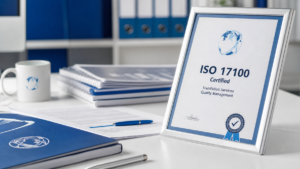
ISO 17100 certification. This is the international standard for translation services, specifying requirements for the translation process, translator qualifications, and quality control. An ISO 17100-certified agency follows a documented review process — translation, revision, and quality check — not just a single pass.
Subject-matter specialist translators. Ask whether the agency assigns translators with experience in your sector. A general Arabic translator and a technical Arabic translator with 10 years in the oil and gas industry are not the same thing.
A revision process. Professional technical translation should involve at least two linguists — one to translate, one to review. Single-translator output without review is higher risk for technical content.
Experience with your document type. Ask for examples or case studies in your industry. An agency that regularly handles medical device documentation will produce better IFU translations than one that mostly does marketing content.
Formatting capability. Can they deliver the translated document in the same format as the source — InDesign, Word, XML, or whatever your workflow requires? Reformatting a technical document from scratch adds time and risk.
Confidentiality and data handling. Technical documents often contain proprietary information. Check that the agency has a clear confidentiality policy and that translators sign NDAs.
Industries that commonly need Arabic technical translation
Oil and gas. The Gulf region is a major hub, and the sector generates enormous volumes of technical documentation — drilling specifications, safety procedures, maintenance manuals, and regulatory filings.
Manufacturing and engineering. UK and European manufacturers exporting to Arab markets need product documentation, CE marking compliance documents, and technical specifications translated.
Medical devices and pharmaceuticals. Regulatory submissions to Gulf and MENA health authorities require precise Arabic translation of clinical data, instructions for use, and product labelling.
Technology and software. UI localisation, technical support documentation, and software manuals for Arabic-speaking users require RTL adaptation as well as linguistic accuracy.
Construction and infrastructure. Major infrastructure projects across the Gulf require translated project documentation, contracts, and technical specifications.
RTL formatting and technical documents
Arabic reads right to left, which affects every aspect of document layout. This is straightforward for running text — but technical documents add complexity.
Numbered lists in Arabic run from right to left in terms of reading direction, but the numbers themselves remain in Western (Arabic-Indic) format in most technical contexts. Tables are mirrored. Diagrams with callouts need Arabic labels repositioned. Cross-references to figures and page numbers need updating.
For software localisation, RTL requires code-level changes as well as translation — text rendering, input fields, and UI element positioning all need to work in both directions if the product needs to support both Arabic and English interfaces.
The practical implication: when briefing a technical translation service, provide editable source files rather than PDFs wherever possible. It makes the formatting work significantly easier and reduces turnaround time.
How Global LTS approaches Arabic technical translation
Our Arabic translation services include technical translation across a range of sectors — manufacturing, medical, legal, financial, and technology. We're ISO 17100 certified, which means every project goes through translation and independent revision before delivery.
Our translators are matched to projects by sector knowledge, not just language pair. We handle RTL document formatting and can deliver in your preferred format.
For ongoing or high-volume technical translation requirements, we offer project management to maintain terminology consistency across large document sets.
Contact us with your documents for a free quote. We'll confirm which translators are best suited to your sector and provide a turnaround estimate.