
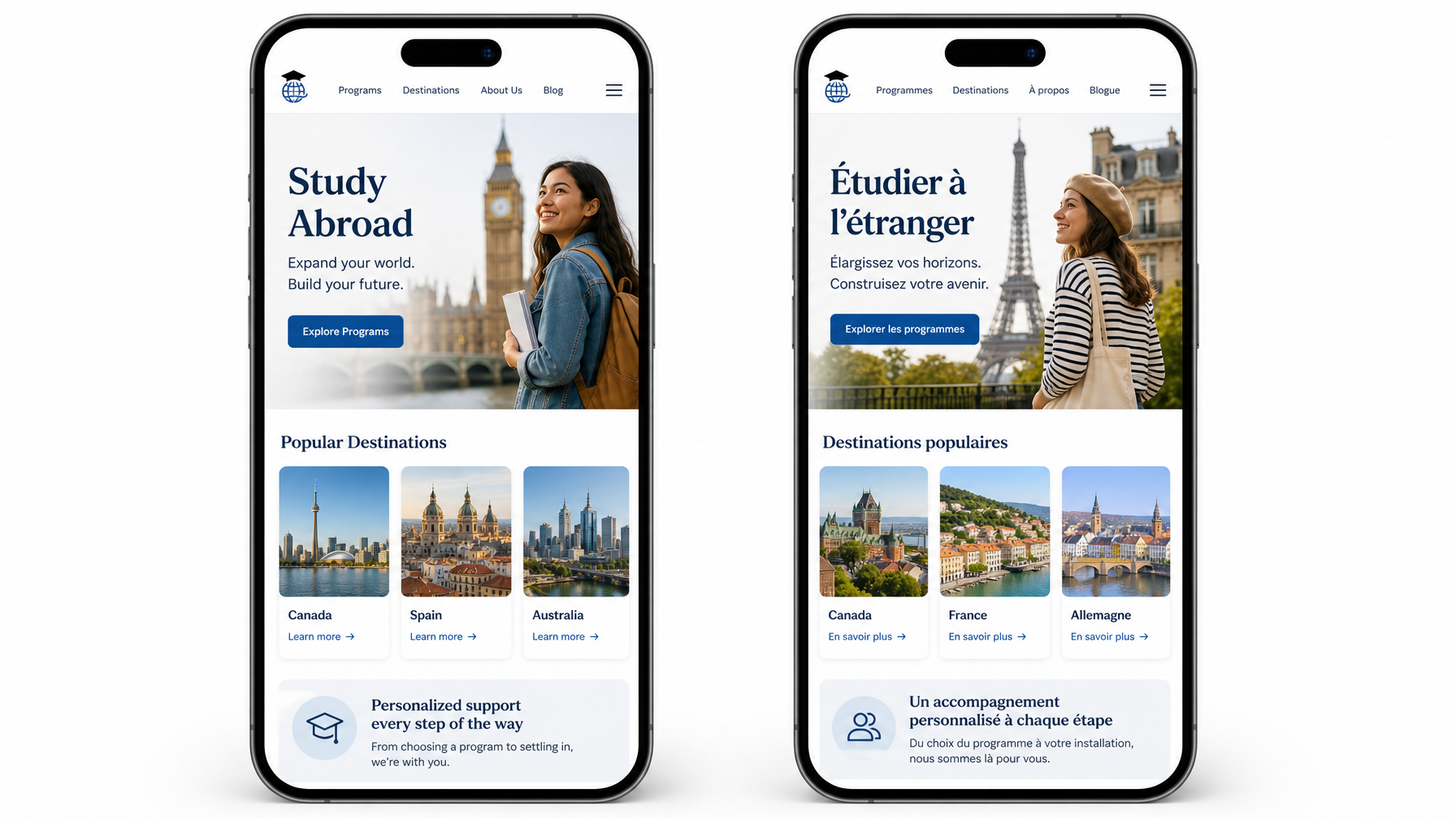
Website Localisation vs Website Translation: What's the Difference and Which Does Your Business Need?
Key Takeaways
- Translation converts text from one language to another. Localisation adapts content so it is appropriate for the specific culture, conventions, and expectations of the target market — it goes beyond language.
- For most business websites, some degree of localisation is necessary alongside translation. Pure word-for-word translation frequently produces content that is linguistically correct but culturally misaligned.
- The elements that require localisation beyond translation include date and number formats, currency, units of measurement, cultural references, imagery, colour associations, and tone.
- The level of localisation required depends on your content type and target market. Technical documentation requires less cultural adaptation than consumer marketing; some markets require more adaptation than others.
- Localisation should be planned as part of the translation brief, not treated as an afterthought.
Website translation and website localisation are related but distinct concepts, and confusing the two leads to either under-investment (translating when localisation is needed) or over-complication (applying full localisation processes to content that only needs translation). This guide explains the difference, when each is appropriate, and how to brief your translation project accordingly.
Table of Contents
ToggleWhat Is Website Translation?
Website translation converts the text content of a website from one language into another. The goal is linguistic accuracy — conveying the meaning of the source content correctly in the target language. A professional translator working into their native language produces content that is grammatically correct, uses appropriate vocabulary, and reads naturally in the target language.
Translation is appropriate for content types where the primary requirement is conveying information accurately: technical documentation, legal and compliance pages, product specifications, support articles, and factual content. A user manual translated into German needs to be technically accurate and clearly written in German. It does not usually need to reflect German cultural norms or adapt its content for the German market — the information itself is what matters.
What Is Website Localisation?
Localisation adapts content for a specific locale — a combination of language and cultural context. It includes translation, but goes further to ensure that the content is appropriate for the specific audience in the specific market, not just linguistically correct.
Localisation addresses elements that translation alone does not:
Format conventions — dates, times, numbers, and addresses are formatted differently in different countries. In the UK, dates are written DD/MM/YYYY; in the US, MM/DD/YYYY; in many European countries, DD.MM.YYYY. A UK website translated into American English for the US market should adapt date formats throughout. Similarly, decimal separators (1,000.50 in the UK vs 1.000,50 in Germany), telephone number formats, and address structures all vary by country and should be adapted for each locale.
Currency and pricing — a website serving multiple markets should display prices in local currency where possible. Beyond currency symbols, pricing conventions also differ — in some markets, prices ending in .99 are standard; in others, round numbers are more common or expected.
Units of measurement — the UK and US use imperial measurements in some contexts; most other markets use metric. Content referencing product dimensions, weights, distances, or temperatures should use the appropriate measurement system for each locale.
Cultural references and idioms — idioms, colloquialisms, and cultural references that are immediately understood by a British or American audience may be meaningless or confusing to audiences in other markets. Marketing copy in particular relies heavily on culturally specific references — humour, sporting metaphors, seasonal references — that require adaptation rather than translation.
Imagery and visual content — localisation extends to visual content. Images featuring people, settings, or cultural contexts associated with one country may feel alien or disconnected to audiences in another. A website selling consumer products in Japan may need photography featuring Japanese settings and subjects, not simply the same photography used for the UK market with translated captions.
Colour associations — colours carry different cultural meanings in different markets. White is associated with mourning in many Asian cultures; red carries positive connotations of good fortune in China but may have political associations in some other markets. Consumer-facing websites targeting culturally distinct markets should consider these associations in design choices for each locale.
Tone and register — the appropriate level of formality differs significantly between markets and languages. German business communication tends to be more formal than equivalent British communication. Japanese communication has multiple formal register levels embedded in the language itself. French consumer marketing uses conventions that differ from British equivalents. A translated page that preserves the tone of the English original may read as inappropriately casual or unnecessarily formal in another language.
Legal and regulatory references — privacy policies, terms and conditions, and compliance content must reflect the legal framework of the target country, not just translate the UK version. Consumer rights, returns policies, and warranty terms differ by jurisdiction. Legal content for non-UK markets should be reviewed by someone with knowledge of the relevant local legal requirements.
When to Use Translation, When to Use Localisation
The appropriate level of adaptation depends on the content type and the target market.
Translation is generally sufficient for:
- Technical documentation and user manuals
- Product specifications and data sheets
- Academic or scientific content
- Internal business documents
- Legal contracts between parties who have agreed on the governing language
Localisation is appropriate for:
- Consumer-facing marketing copy — homepages, campaign landing pages, product marketing
- E-commerce product descriptions where purchase decisions are emotionally influenced
- Social media content and digital marketing
- Brand communications and tone-of-voice driven content
- Any content where cultural relevance affects engagement or conversion
Market also matters. Some markets require more localisation than others. Translating UK English content into American English for the US market requires relatively minor localisation — shared cultural context means most references translate with small adjustments. Adapting UK content for Japanese, Chinese, or Arabic-speaking markets involves substantially more cultural adaptation, because the cultural distance between the source and target context is greater.
How to Brief a Localisation Project
The distinction between translation and localisation should be part of the brief you provide to your translation agency, not something discovered partway through the project.
A useful briefing framework:
Specify the target market, not just the target language. French for France and French for Canada require different localisation decisions. Spanish for Spain and Spanish for Mexico involve different vocabulary, register, and cultural references. Specifying the language alone is not sufficient.
Provide brand guidelines. Your tone of voice, brand values, and communication style should be provided to the localisation team. Localisation that adapts your content for the target market should still feel like your brand — not a generic version of your content in another language.
Flag culturally specific content. Identify idioms, cultural references, humour, or imagery in the source content that may require adaptation. This allows the localisation team to focus attention on the elements that need the most work.
Agree on format conventions. Specify the date, number, currency, and measurement conventions for each target locale before the project starts, so they are applied consistently throughout.
Consider a style guide for each locale. For businesses with ongoing multilingual content needs, a brief style guide for each target locale — covering tone, terminology preferences, format conventions, and any market-specific restrictions — is a worthwhile investment that improves quality and consistency across all future content.
Conclusion
Most business websites benefit from a combination of translation and localisation — accurate linguistic conversion as the foundation, with cultural adaptation applied to the elements where it matters most for the target market.
Global LTS provides website translation and localisation services for UK businesses, with native-speaking translators who understand both the language and the cultural context of their target markets. Contact us to discuss your project.
For related reading, see our guides on multilingual SEO and how to choose the right CMS setup for a multilingual website.