
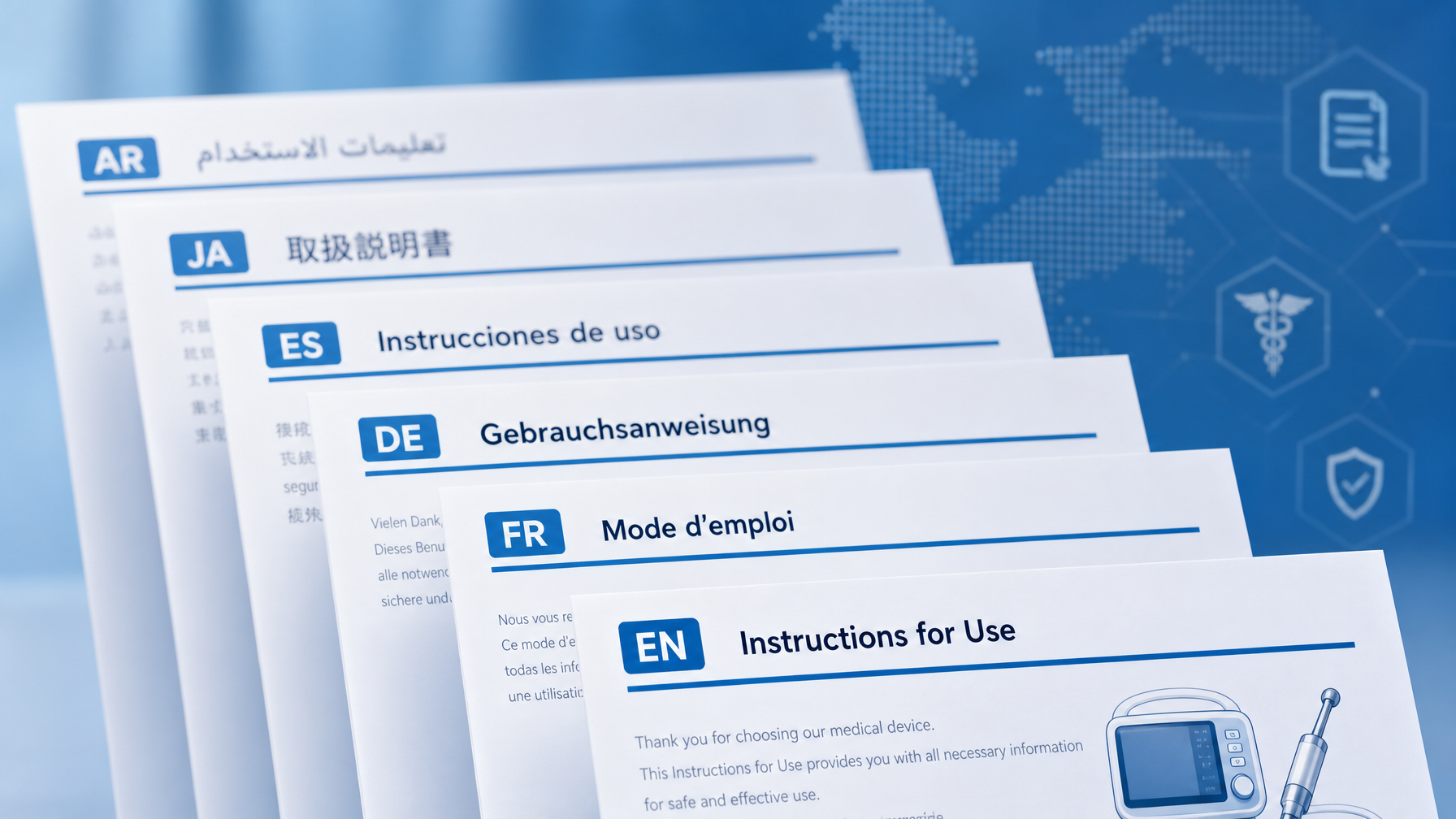
IFU Translation for Medical Devices: Requirements, Process, and Common Mistakes
Key Takeaways
- IFU translation is a regulatory requirement under EU MDR (Regulation (EU) 2017/745) and IVDR — not an optional step before market entry.
- Every EU member state sets its own accepted languages for IFUs; selling across the EU typically means translating into 24 or more languages.
- The IFU must be translated in full — partial translations, summaries, or English-only versions do not satisfy MDR requirements in most member states.
- Common mistakes include inconsistent terminology across product lines, translating from a draft rather than the final approved source, and failing to update translations when the source IFU changes.
- A translation memory built from your first IFU project significantly reduces cost and turnaround on subsequent updates.
You have designed a medical device, completed your clinical evaluation, and assembled your technical file. Market entry now depends on one more requirement: every member state where you sell must receive an IFU in its accepted language or languages. For a manufacturer entering the full EU market, that means up to 24 language versions of the same document — each one accurate, terminologically consistent, and compliant with the language requirements set by that country’s competent authority.
Table of Contents
ToggleThis guide covers what IFU translation involves, what the regulations actually require, and what goes wrong when manufacturers treat it as a last-minute task.
What Is an IFU?
An IFU — Instructions for Use — is the document supplied with a medical device that tells the user how to use the device safely and effectively. Under EU MDR Annex I, the IFU must include information such as the intended purpose, contraindications, warnings, method of use, storage conditions, and details of any residual risks.
Not all devices require a printed IFU. EU MDR allows certain low-risk devices to omit one if the device can be used safely without instructions. For the majority of devices, however, the IFU is a mandatory component of the labelling and must accompany the device in every market where it is sold.
The IFU is distinct from the label — the label is the information printed directly on the device or its packaging, while the IFU is the accompanying documentation. Both require translation, but the IFU is typically the longer and more complex document.
IFU Translation Requirements Under EU MDR
EU MDR (Regulation (EU) 2017/745) sets out the framework for IFU language requirements, but the specific languages accepted in each member state vary. The European Commission publishes an overview of language requirements for manufacturers, updated regularly, which lists the accepted languages for labels, IFUs, and other documentation by country.
Key points from the regulation:
- The manufacturer is responsible for ensuring the IFU is available in the language or languages accepted by the member state where the device is placed on the market. This responsibility cannot be transferred to a distributor without a formal legal manufacturer agreement.
- Most member states require their official national language. Countries with multiple official languages — Belgium (French, Dutch, German), Switzerland (French, German, Italian) — may require all of them.
- English is not universally accepted as an alternative. Some member states accept English in professional-use contexts; most require the national language for consumer-facing or patient-facing devices.
- The translation must be complete. Partial translations, translated summaries, or abbreviated versions do not satisfy MDR requirements. The content of the translated IFU must be identical to the original. (European Commission MDR Language Requirements)
For IVD devices, IVDR (Regulation (EU) 2017/746) applies equivalent requirements with its own language requirements table.
UKCA marking and the UK market
Following Brexit, UKCA marking requirements apply separately to the UK market. The MHRA sets its own requirements for IFU language — English is required for products placed on the Great Britain market. Manufacturers who previously held CE marking and sold into the UK must ensure their IFUs meet UKCA requirements independently of their EU MDR compliance.
What Does IFU Translation Actually Involve?
Translating an IFU is not a simple text conversion. A typical IFU translation project for a single device across the full EU market involves:
Source text preparation
The IFU must be finalised before translation begins. Any changes made after translation has started require the affected sections to be retranslated in all languages — a significant cost and time impact on large multilingual projects. Freezing the source text before briefing your translation provider is essential.
Terminology management
Medical devices often have proprietary component names, procedural terms, and product-specific descriptions that need consistent translation across all language versions and across the full product line. A device referred to differently across its IFU, label, and training materials creates regulatory inconsistency. Translation providers working on IFU projects should build and maintain a client glossary from the outset. (ALM Translations)
Translation and specialist review
The IFU is translated by a linguist with direct experience in the relevant device category — not a generalist medical translator. A second linguist with equivalent expertise reviews the translation before delivery.
DTP and file reconstruction
IFUs are typically supplied as InDesign, Word, or PDF files. The translated text must be flowed back into the original layout, with DTP handling any text expansion, font changes for non-Latin scripts, and right-to-left reflow for Arabic or Hebrew. The delivered file should be print-ready, not a raw translation document requiring reformatting.
Version control
IFUs change. Device updates, post-market surveillance findings, and regulatory feedback all trigger IFU revisions. A translation memory built during the initial project means that only changed sections need retranslating on subsequent updates, rather than the full document — reducing cost and turnaround significantly on ongoing programmes.
Common IFU Translation Mistakes
Translating from a draft rather than the final approved IFU
This is the most frequent cause of rework on IFU projects. If the source document changes after translation has begun, every affected language version must be updated. Always confirm the IFU is in its final approved state before issuing it to a translation provider.
Using machine translation without specialist review
Machine translation quality has improved, but it produces errors in medical terminology that a non-specialist reviewer will not catch. Under EU MDR, the manufacturer is responsible for the accuracy of the IFU — using unreviewed machine translation does not satisfy that requirement and introduces patient safety risk. (Elsmar Cove)
Inconsistent terminology across product lines
A manufacturer with multiple devices in the same category may find that different translation providers have translated the same component or procedure differently across products. This creates inconsistency in technical files and confusion for end users. Centralising IFU translation with a single provider using a shared translation memory resolves this.
Failing to update translations after source changes
IFU revisions triggered by post-market surveillance or regulatory feedback must be reflected in all language versions simultaneously. Manufacturers sometimes update the English master and delay updating translations — creating a version mismatch that can be identified during audit. (Novalins)
Sending a PDF rather than the source file
A PDF of the IFU cannot be edited directly. Translation from a PDF requires the text to be extracted and the layout rebuilt from scratch, adding cost and the risk of formatting errors. Always provide the native source file — InDesign (.indd), Word (.docx), or equivalent.
Overlooking eIFU requirements
Some manufacturers supply IFUs electronically (eIFU) rather than in print. EU MDR and Commission Regulation (EU) 207/2012 set specific conditions for eIFU use, including registration requirements and ensuring the eIFU is available in the required languages. The language requirements are identical to those for printed IFUs. (MakroCare)
How to Prepare Your IFU for Translation
A well-prepared source document reduces cost, turnaround time, and the risk of errors across all language versions.
1. Finalise the source before briefing your provider
Confirm the IFU has passed internal review, regulatory affairs sign-off, and any notified body review before issuing it for translation.
2. Provide the native source file
Send the editable source file, not a PDF. Include any linked images, fonts, and style sheets if working in InDesign.
3. Provide a terminology glossary
List any product names, proprietary terms, component names, and acronyms that require consistent handling across languages. Note any terms that should not be translated.
4. Specify the target markets
Confirm the full list of countries where the device will be sold. Your translation provider will map these to the required languages using the current EU MDR language requirements table.
5. Flag any time-critical regulatory deadlines
If the IFU translation is on the critical path for a CE marking submission or market launch, communicate this upfront. Urgent turnaround is available but requires early notice.
IFU Translation and the Full MDR Documentation Package
The IFU is one part of a broader documentation package that requires translation for EU MDR compliance. Manufacturers selling across the EU typically also need translations of:
- Device labels and outer packaging
- Summary of Safety and Clinical Performance (SSCP) — required for Class III and implantable devices, the SSCP must be translated into all official EU languages
- Post-market surveillance reports (PSURs, PMCF documentation)
- Field Safety Notices (FSNs) — if a safety-related communication is issued, it must be translated and distributed to the relevant markets
Managing these as a coordinated programme with a single translation provider — using a shared translation memory and glossary — produces significant cost and consistency benefits compared to commissioning each document separately.
At Global LTS, our medical translation services cover the full MDR documentation package: IFU translation, labelling, SSCP, post-market surveillance materials, and technical file documentation. We work with medical device manufacturers across the UK and EU, delivering translations in all required languages with in-house DTP and print-ready file delivery. Contact us for a free quote.
Frequently Asked Questions
What languages are required for an IFU under EU MDR?
Each EU member state sets its own accepted languages. Most require their official national language. For manufacturers selling across all 27 EU member states, this typically means 24 or more language versions. The European Commission publishes and maintains the definitive language requirements table by country.
Does the IFU need to be translated in full?
Yes. EU MDR requires the content of the translated IFU to be identical to the original. Partial translations, summaries, or abbreviated versions do not satisfy the regulation.
Can I use machine translation for my IFU?
Machine translation may be used as part of the process, but the output must be reviewed and verified by a specialist human translator before use. The manufacturer is responsible for the accuracy of the IFU — unreviewed machine translation does not satisfy MDR requirements.
What file format should I send for IFU translation?
Send the native source file — InDesign (.indd), Word (.docx), or equivalent. Avoid sending PDFs where possible, as these require the layout to be rebuilt from scratch.
How long does IFU translation take?
A typical IFU of 3,000–5,000 words translated into a single language takes 3–5 working days. A full EU package across 24 languages is typically delivered in 2–3 weeks, depending on DTP complexity and whether the source file requires additional preparation.
What happens when the IFU is revised?
Only the changed sections need retranslating if a translation memory was built during the original project. This significantly reduces cost and turnaround compared to retranslating the full document. Version control is the responsibility of the manufacturer — all language versions must reflect the current approved IFU simultaneously.