EU MDR Translation Requirements: A Manufacturer’s Guide to Language Compliance
Key Takeaways
- EU MDR (Regulation (EU) 2017/745) requires manufacturers to provide IFUs, labels, and certain other documents in the official language or languages accepted by each member state where the device is sold.
- The specific languages required vary by country. Belgium requires French, Dutch, and German; Finland requires Finnish and Swedish; Luxembourg requires French, German, and Luxembourgish.
- The SSCP (Summary of Safety and Clinical Performance) is required for Class III and implantable devices and must be translated into all official EU languages — currently 24.
- The technical file itself does not need to be translated for notified body review, but supporting documentation submitted to national competent authorities may require translation.
- Non-compliant documentation means the device is considered unduly placed on the market — with consequences ranging from market withdrawal to regulatory action.
EU MDR came into full application in May 2021 after a one-year postponement triggered by the COVID-19 pandemic. For most manufacturers who had CE marking under the previous Medical Devices Directive (MDD), the transition brought a significant increase in documentation requirements — and a much stricter approach to language compliance.
Table of Contents
ToggleUnder MDD, translations were often completed after certification. Under MDR, translations must be in place before the device is placed on the market. For manufacturers selling across all 27 EU member states, that can mean up to 24 language versions of IFUs, labels, and other patient-facing materials — all of which must be complete, accurate, and consistent with the approved English source.
This guide sets out exactly what MDR requires to be translated, which documents are affected, and what the language requirements look like in practice.
What EU MDR Says About Translation
EU MDR does not set a single universal language requirement. Instead, it gives member states the authority to determine the languages they accept for different document types. The relevant provisions are:
- Article 10(11): Manufacturers must ensure that the device is accompanied by information in the language or languages accepted by the member state where the device is placed on the market.
- Annex I, Chapter III: Sets out the requirements for information supplied with the device, including labelling and IFUs, and requires them to be in the language or languages accepted in the member states where the device is marketed.
- Article 32: Requires that the SSCP for Class III and implantable devices be made available in the official EU languages via EUDAMED.
The European Commission and member states maintain a language requirements table for manufacturers, updated regularly, which lists the accepted languages for each document type by country. This is the definitive reference for planning a translation programme.
Which Documents Require Translation Under EU MDR?
Instructions for Use (IFU)
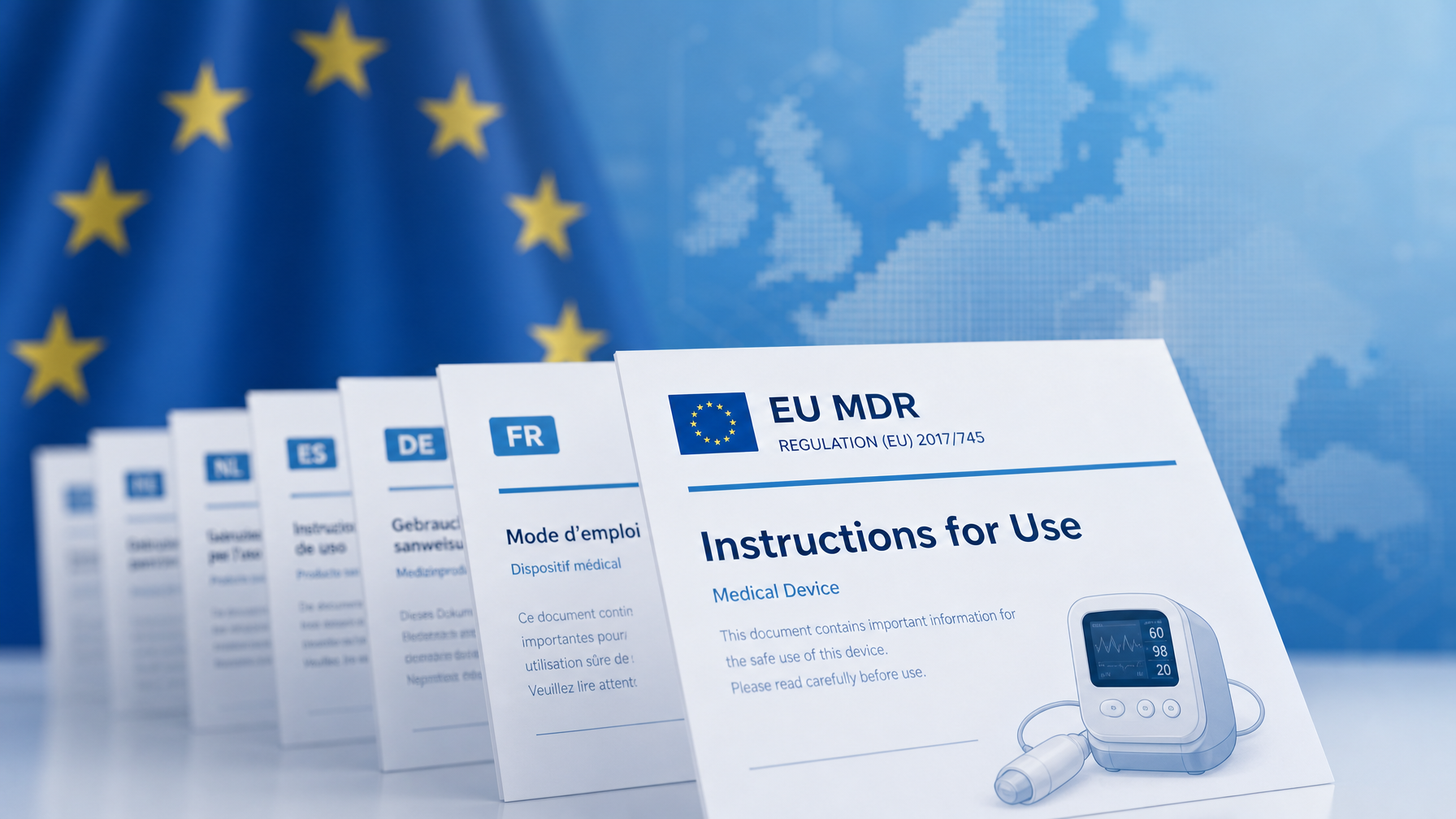
The IFU is the primary document subject to language requirements. It must be available in the language or languages accepted by each member state where the device is sold. For most member states, this means their official national language. The IFU must be translated in full — partial translations and summaries do not satisfy the requirement.
Certain low-risk devices may be permitted to omit a printed IFU if they can be used safely without one, subject to the conditions set out in MDR Article 8(2). For all other devices, the IFU is mandatory in each market language.
Labelling
Device labels, outer packaging, and any text appearing on the device itself must comply with the language requirements of each member state. This includes product names, intended purpose statements, warnings, contraindications, storage conditions, and shelf-life information. Symbol-only labelling can reduce the volume of text requiring translation, but any accompanying text must still be translated. (Decomplix)
Summary of Safety and Clinical Performance (SSCP)
The SSCP is a new requirement under EU MDR with no equivalent in the previous MDD framework. It is required for Class III devices and implantable devices (with limited exceptions). Once validated by the notified body, the SSCP must be published on EUDAMED in all official EU languages — currently 24.
This is one of the most significant translation burdens introduced by MDR. A single SSCP must be translated into Bulgarian, Croatian, Czech, Danish, Dutch, Estonian, Finnish, French, German, Greek, Hungarian, Irish, Italian, Latvian, Lithuanian, Maltese, Polish, Portuguese, Romanian, Slovak, Slovenian, Spanish, and Swedish — in addition to English. (European Commission SSCP Guidance)
Declaration of Conformity (DoC)
The Declaration of Conformity does not need to be translated into all member state languages under MDR, but it must be available in English and may need to be provided in the national language if requested by a national competent authority. Some member states include the DoC in their language requirements tables.
Field Safety Notices (FSNs)
If a manufacturer issues a Field Safety Notice — a communication to users or patients about a safety-related issue with a device already on the market — it must be translated into the languages of all markets where the affected device has been distributed. This is time-sensitive and applies to all device classes.
Implant Cards
For implantable devices, MDR Article 18 requires manufacturers to provide an implant card to the patient. The implant card must be in the language or languages accepted by the member state where the device is implanted.
What Does Not Need Translation
The technical file submitted to the notified body for conformity assessment does not need to be translated — English is generally accepted for technical documentation. However, if a national competent authority requests the technical file as part of a post-market investigation or audit, they may require it in the national language. (STP Trans)
Language Requirements by Member State
The MDR does not specify a single list of required languages. Each member state determines which languages it accepts, based on its official national language or languages. The key points for manufacturers:
Single-language markets: Most member states require only their official national language — Germany (German), France (French), Spain (Spanish), Italy (Italian), Poland (Polish), and so on.
Multi-language markets: Several member states have more than one official language and may require all of them:
- Belgium: French, Dutch, German
- Finland: Finnish, Swedish
- Luxembourg: French, German, Luxembourgish (Luxembourgish required for some document types)
- Ireland: English and Irish (Irish is rarely enforced for medical devices)
Countries that may accept English: Some member states accept English as an alternative for professional-use devices or under specific conditions. This varies by country and document type — it cannot be assumed without checking the current language requirements table. (Lionbridge)
Non-EU EEA markets: Iceland, Liechtenstein, and Norway have implemented MDR and have their own language requirements. Turkey also applies MDR-equivalent requirements.
The language requirements table published by the European Commission is updated periodically as member states revise their positions. Manufacturers should verify requirements against the current version before finalising translation scopes for new market entries.
MDR vs. IVDR: Key Differences
IVDR (Regulation (EU) 2017/746), which covers in vitro diagnostic devices, applies equivalent language requirements to MDR. The document types affected are the same — IFUs, labels, SSCP (for Class C and D IVDs), implant cards where applicable, and FSNs. The language requirements by member state are set out in a separate IVDR language requirements table, also published by the European Commission.
The main practical difference is device classification. IVDR uses a four-tier risk classification (Class A, B, C, D) rather than MDR’s three-tier system, and SSCP requirements apply to Class C and D IVDs rather than Class III devices. (European Commission IVDR Language Requirements)
Consequences of Non-Compliance
Under MDR, a device placed on the market without the required language documentation is considered to have been placed on the market unlawfully. The consequences can include:
- Market withdrawal: National competent authorities can require the device to be withdrawn from their market until compliant documentation is provided.
- Regulatory action: Repeated or serious non-compliance can lead to formal regulatory action by the national competent authority.
- Delayed market entry: For new devices, missing translations at the point of CE marking application means the device cannot be placed on the market until they are complete.
- Audit findings: Missing or out-of-date translations in technical files or post-market documentation are a common audit finding during notified body surveillance.
Non-compliance with language requirements is rarely treated as a minor administrative issue. It is treated as a fundamental failure of the labelling requirements that underpin device safety. (Novalins)
Planning Your MDR Translation Programme
A structured approach to MDR translation avoids the most common compliance failures.
1. Map your markets before briefing a provider
Confirm the full list of countries where the device will be sold before commissioning translations. Adding markets after translations are complete means additional languages must be commissioned separately. Scope the full translation programme upfront.
2. Identify all documents requiring translation
Use the checklist above as a starting point. For Class III or implantable devices, SSCP translation into all 24 EU languages is a significant workload — plan for it well in advance of your CE marking timeline.
3. Finalise all source documents before translation begins
Any changes to IFUs, labels, or other source documents after translation has started require the affected sections to be retranslated in all languages. Freeze source documents before briefing your provider.
4. Build a translation memory from the outset
MDR documentation is updated regularly — post-market surveillance findings, device revisions, and regulatory feedback all trigger document changes. A translation memory ensures that only changed content is retranslated on subsequent updates, reducing cost and turnaround on an ongoing basis.
5. Plan for SSCP updates
The SSCP must be updated whenever the notified body updates the certificate or when the periodic safety update report (PSUR) triggers a significant change. Each update requires all 24 language versions to be updated simultaneously.
At Global LTS, our medical translation services cover the full MDR documentation package: IFU translation, labelling, SSCP into all EU languages, FSNs, implant cards, and post-market surveillance materials. We work with medical device manufacturers across the UK and EU, with in-house DTP, print-ready delivery, and a dedicated translation memory for every ongoing account. Contact us for a free quote.
Frequently Asked Questions
Does the technical file need to be translated under EU MDR?
No. The technical file submitted to the notified body for conformity assessment is generally accepted in English. However, national competent authorities conducting post-market surveillance may request it in the national language.
Which device classes require an SSCP?
Class III devices and implantable devices under MDR. Class C and Class D IVDs under IVDR. The SSCP must be translated into all 24 official EU languages and published on EUDAMED once validated by the notified body.
Can English be used as the IFU language across all EU markets?
No. Most member states require their official national language. Some accept English for professional-use devices under specific conditions, but this varies by country and must be verified against the current language requirements table.
When must translations be complete — before or after CE marking?
Before the device is placed on the market. Under MDR, all required language versions of the IFU and labelling must be complete before the device is distributed in each member state. This is a significant change from the previous MDD framework, where translations were often completed after certification.
What happens if a device is sold without the required translations?
The device is considered to have been placed on the market unlawfully. National competent authorities can require market withdrawal until compliant documentation is in place.
Do FSNs need to be translated?
Yes. Field Safety Notices must be translated into the languages of all markets where the affected device has been distributed. Timing is critical — FSNs are issued in response to safety concerns and must reach users quickly.
Does IVDR apply the same language requirements as MDR?
Equivalent requirements apply, but the document types and device classifications differ. The European Commission publishes a separate IVDR language requirements table. SSCP requirements apply to Class C and D IVDs rather than Class III devices.