

The Easiest Languages for English Speakers to Learn — Including Tonal Languages
Do you want to sharpen your foreign language skills but feel overwhelmed about the resources and commitment needed? Learning a new language can be daunting at first, especially when coming from the perspective of a native English speaker.
Fortunately, there are certain languages closely related to English, which makes the process of learning much more attainable.
This blog post will focus on breaking down what makes some languages easier than others, provide an overview of the easiest languages that native English speakers can learn quickly and which are the hardest languages to learn for them.
We’ll also cover the benefits a foreign language learning process may have on your brain and your career.
Why some languages are easier for English speakers to learn?
The language family tree is a concept that fascinated linguists for centuries. Ever since the dawn of mankind, languages evolved and changed as they adapted to shifting cultural and geographical factors.
Through linguistic comparison, we can now identify connections between all major existing languages, spanning all continents.
The idea of a language family tree suggests that some languages are more closely related than others. For instance, English is a Germanic language and belongs to the West Germanic language family along with other Germanic languages such as Dutch and German, which share many common features.
By examining these similarities in detail, we can trace back where each language comes from and build a language tree that links them all together in an interesting way.
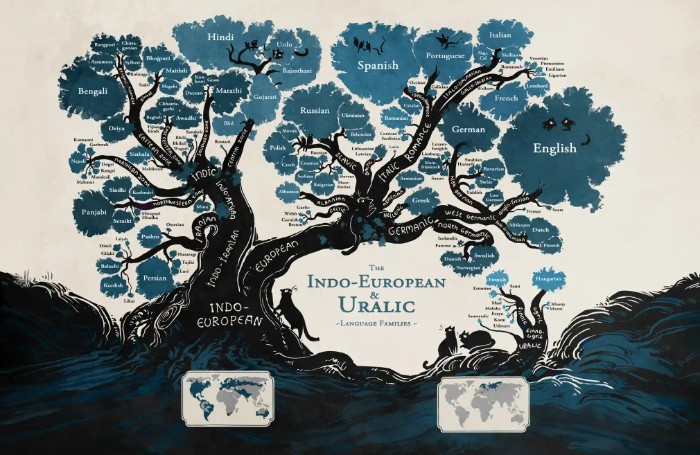
Languages that are derived from the same language family as English, such as German, Dutch and Afrikaans, tend to be much easier for native English speakers to learn because they share a great amount of vocabulary and some of the grammar rules.
This makes it possible for learners to pick up on the logic behind the new language. Therefore it’ll be easier to learn.
Additionally, having the same alphabet as English will make it much easier to read, write, recognize words and understand the new writing system in the foreign language. OK, other European languages will have some extra characters in their writing system (such as ë, ł, ñ, ô, etc.) but they are still based on the Latin alphabet.
On the other hand, the hardest languages to learn for native English speakers are those which come from a completely different language family. Examples of this would be Chinese, Japanese or Arabic – all of which have vastly different grammatical rules, writing systems and pronunciation.
Language Difficulty – why some languages are harder to learn?
Non-Latin Characters
Learning a language with writing systems based on non-Latin characters is perhaps one of the most difficult languages to learn for native English speakers.
For example, the Chinese language has over 50,000 different characters. You don’t have to learn them all to achieve professional language proficiency, but you do need to learn thousands of new characters which require memorization.
Learning so many characters is a specific skill, so language difficulty increases substantially for languages based on an entirely new alphabet.
Tonal Languages — How They Work and Which Is Easiest to Learn
Tonal languages use pitch to distinguish between words that would otherwise sound identical. In English, tone conveys emotion or emphasis — but the meaning of the word itself does not change. In a tonal language, the same syllable spoken on a different pitch becomes an entirely different word.
The most widely cited example is Mandarin Chinese. The syllable “ma” has four meanings depending on the tone used:
-
mā (flat tone) — mother
-
má (rising tone) — hemp
-
mǎ (dip tone) — horse
-
mà (falling tone) — to scold
For native English speakers this is genuinely unfamiliar territory. English speakers are not trained from childhood to hear or produce tonal distinctions, which is one reason tonal languages rank among the hardest to acquire.
Which tonal languages are there?
The major tonal languages include Mandarin Chinese, Cantonese, Vietnamese, Thai, Lao, Burmese, and many languages spoken across Sub-Saharan Africa including Yoruba and Igbo. Most are geographically clustered in East and Southeast Asia and West Africa.
Which is the easiest tonal language to learn?
For English speakers, the consensus among linguists and language learners is that Thai and Vietnamese are somewhat more approachable than Mandarin or Cantonese, for a specific reason: the writing systems. Vietnamese uses a Latin-based alphabet with diacritical marks that show the tone directly above or below the vowel. This means learners can read tone from text from the start, which significantly reduces the cognitive load compared to learning Chinese characters simultaneously with tones.
| Language | Tones | Writing system | Relative difficulty (English speakers) |
|---|---|---|---|
| Vietnamese | 6 | Latin alphabet with diacritics | Most approachable |
| Thai | 5 | Thai script | Moderate |
| Mandarin | 4 | Characters (Pinyin for learning) | Hard |
| Cantonese | 6–9 | Characters | Very hard |
Mandarin has fewer tones than Cantonese or Vietnamese, but the character-based writing system adds a significant separate learning challenge. Thai script is learnable but adds complexity beyond Vietnamese.
For most English speakers starting from zero, Vietnamese offers the clearest entry point into tonal language learning — the writing system reflects the tones directly, and the grammar has no verb conjugation or noun gender.
Languages Ranked by Difficulty
Now that we know why some languages are hard to learn or easier to learn when your mother language is English, the below table is of no surprise.
The below groups are for learning by a native English speaker and are based on the FSI ranking:
Group 1 – most related languages to English:
Afrikaans, Danish, Dutch, French, Italian, Norwegian, Portuguese, Romanian, Spanish, and Swedish.
Group 2 – languages similar to English:
Group 3 – languages with prominent cultural differences and linguistic differences:
Indonesian, Malaysian, Swahili.
Group 4 – languages with big and significant cultural differences and linguistic differences:
Albanian, Amharic, Armenian, Azerbaijani, Bengali, Bosnian, Bulgarian, Burmese, Croatian, Czech, Estonian, Finnish, Georgian, Greek, Hebrew, Hindi, Hungarian, Icelandic, Khmer, Lao, Latvian, Lithuanian, Macedonian, Mongolian, Nepali, Pashto, Persian (Dari, Farsi, Tajik), Polish, Russian, Serbian, Sinhala, Slovak, Slovenian, Tagalog, Thai, Turkish, Ukrainian, Urdu, Uzbek, Vietnamese, Xhosa, Zulu
Group 5 – the hardest languages with the biggest cultural and linguistic differences:
Arabic, Mandarin (Chinese), Cantonese (Chinese), Japanese, and Korean.
Benefits of learning foreign languages.
Learning a new language can unlock a treasure trove of rewards, not least of which is the improvement of your native language.
Not only will you be able to understand people who natively speak a different language, but your language-learning journey creates important links in your brain that help strengthen native language skills and introduce new pathways of thinking.
And let’s face it—being multilingual is one skill that looks good on a resume!
So why not take advantage and enjoy all the knowledge that learning another language can bring?
This journey can bring more than just improved native sentence structuring; it can bring with it an appreciation for cultures from all over, broaden your view of the world, and open up job opportunities to boot!
Improved cognitive abilities
Learning a foreign language can help improve your focus and concentration, as well as your memory and problem-solving skills.
Research shows that it’s easier to learn and retain information when you’re learning a foreign language, as it engages your brain in multiple ways.
Plus, the skills you gain from learning a language can transfer over to other areas of life, such as helping with schoolwork or studying for exams.
Greater cultural understanding
By learning another language you gain insight into the culture of its native speakers. You learn about their customs, values and beliefs which helps you to gain a better understanding of the culture.
This can further lead to more meaningful relationships with people from around the globe, expanding your horizon in ways that may have been previously impossible. Knowing different languages also opens the door to new job possibilities or travel opportunities.
Increased job opportunities
Many employers are looking for people with bilingual or multilingual skills, so mastering another language can give you an edge over other applicants.
Knowing a foreign language can also come in handy if you’re looking to work with international clients or travel for business purposes.
Furthermore, having the ability to speak more than one tongue is generally seen as a sign of great intelligence and dedication by employers, increasing your chances of getting your dream job.
Improved communication skills
Being able to speak more than one language increases your ability to communicate effectively in different situations.
With the ability to communicate in more than one language, you can better express yourself and understand people from other cultures. Additionally, speaking a second language can help you get your point across accurately and effectively, as different languages have different nuances in expressing the same ideas.
Being multilingual provides you with an advantage to communicate across cultures and in various scenarios. Whether it be in your daily life or business, the ability to speak a second language can open up many opportunities for growth, understanding, and relationships.
Enhanced travel experiences
Speaking the local language will make it easier to navigate around a new country and connect with locals on a deeper level. With native language proficiency, you can better understand the culture and customs of that country, increasing your overall travel experience.
Furthermore, native speakers will be more likely to accept and open up to those who speak their native tongue as it shows respect for their culture.
Mental stimulation
Learning a foreign language can be an enjoyable challenge that helps keep your mind sharp and active.
It can improve your memory, increase your problem-solving abilities and even help enhance creativity.
Learning a new language is a great way to challenge your brain. It is harder than other activities, but it is also very rewarding.
By continually exercising your mind with the new characters, rules and concepts of a foreign language, you’ll benefit from improved cognitive skills.
A sense of accomplishment
Mastering another language is an achievement that you can be proud of!
Learning a new language is no easy feat, so it can be incredibly satisfying to learn and practice all the different components that make up another language. Learning a new complex grammar in other languages is very satisfying.
Translation Services for Global Languages
If you are working with tonal or non-Latin script languages in a business context — translating documents, websites, e-learning content, or marketing materials into Mandarin, Thai, Vietnamese, or other Asian languages — Global LTS provides specialist translation services with native translators working into their target language. See our website translation services, e-learning translation services, and certified translation services for more detail.
Language Learning
The best way to learn a new language is by immersion – living in a country where the language is spoken all the time and being surrounded by that language’s native speakers will make it much easier for new language learners.
Learning a new language does require dedication, discipline, and determination. However, with the right approach and tactics, anyone can become proficient in a foreign language.
With extra practice, you can even take it to professional working proficiency. The process includes writing system study, native speaker conversations practice as well as daily schedule planning for consistent learning intensity over time.
With the proper tools such as online courses or apps for language learning available today, everyone has access to resources that make it easier than ever for language acquisition.
Writing system
Writing is a fundamental part of humanity’s history and a key component of how different cultures cultivate their ideas through language.
While many languages are written using the Latin alphabet, there are many other writing systems in the world.
There are dozens of non-Latin writing systems in use around the globe, with each language family often developing its specific arrangement of letters that can vary greatly.
Furthermore, different word structures create unique challenges when learning how to read and write in these unfamiliar languages – veering from traditional horizontal lines of text to even vertical columns.
Altogether, this makes for a fascinating array of approaches that offer insight into the rich complexities of human language.
Based on the language family tree, if the distance of a language increases away from English it is safe to assume that the language difficulty also increases.
European languages have writing systems which are easier to understand for a native English speaker as they are closer to English.
And, languages from groups 3 and 4 have a higher language difficulty for a native English speaker because they developed differently from English and have writing systems based on different rules and different characters.
Some writing systems even rely on the right-to-left direction of reading, such as Arabic or Hebrew.
Vocabulary
Although mastering the intricate nuances of a foreign language’s grammar can be daunting, it is nothing compared to the challenge of memorizing thousands upon thousands of words for you to communicate effectively. Thus, vocabulary must not be overlooked; as it plays an integral role in one’s ability to learn and comprehend any given language.
Let’s consider French, for starters. A significant reason why this language is known to be straightforward for English speakers is the large volume of cognates or identical words in both languages. These similarities make French easier to understand and learn as a second language.
For nearly a millennium – to be exact, since 1066 when the Normans invaded England- English has borrowed an immense amount of words from French; currently, it is estimated that approximately one third of all English vocabulary has been derived from French.
If you’re an English speaker, learning French can be a massive advantage since many words are already in your vocabulary bank. Likewise with German and other languages in Europe – though to a lesser degree – this is also true. In short, it’s like having one foot in the door when it comes to picking up a foreign language!
In stark comparison, languages such as Chinese and Tamil have a minuscule number of loan words from English. Examples include 沙发 shāfā which means ‘sofa’. Consequently, if you are keen on learning Chinese or Tamil, there is an abundance of new vocabulary to master that proves more testing to memorize due to their dissimilarity with the language you already know.
Pronunciation
Pronunciation can be another obstacle to overcome.
If you’re a native English speaker, mastering the “r” sound in French, German, and Spanish can be quite intimidating – each language has its own unique way of pronouncing it.
Going one step further, the Czech ř has such a complex pronunciation that even native learners must be taught how to speak it correctly during their school years.
However, there is another universe of pronunciation rules when it comes to languages such as Chinese or Tamil.
Speakers of these tonal languages comprehend that words pronounced with varied tones are just as exclusive and distinct as two English terms, like “read” and “road,” sound to an English speaker.
However, if you don’t speak a language where intonation matters, this notion may seem unfamiliar.
It gets even more confusing when words with opposite meanings are only differentiated by intonation. Take Chinese, for instance; the characters 买 măi and 卖 mài both mean “buy” and “sell,” respectively – but they are pronounced differently! The former has a falling-then-rising tone while the latter features a singularly declining pitch.
Summary
Learning a foreign language has many benefits.
It can improve communication skills, enhance travel experiences, stimulate the mind, and provide a sense of accomplishment.
To effectively learn a language, it is recommended to use an immersive approach by living in a country where the language is spoken. Additionally, accessing modern tools like online courses or apps can make learning more efficient.
Lastly, the writing system and complexity of grammar should be taken into consideration when selecting a language to learn. With a little dedication and structured practice, anyone can become proficient in another language!
This will not only help you to communicate better with people from different backgrounds, but it will also give you an extra sense of accomplishment when mastered.
Having language proficiency can open doors to a range of career and study opportunities that would otherwise be inaccessible.
By learning another language, you will be able to apply for more options with potential employers. Language skills are also highly valued in fields such as international business, diplomacy, and translation services.
Knowing multiple languages could also be a great asset when applying for international studies or working abroad.
After all the hard work you put into learning another language, it can be incredibly rewarding to have access to opportunities you wouldn’t otherwise have been able to experience.