
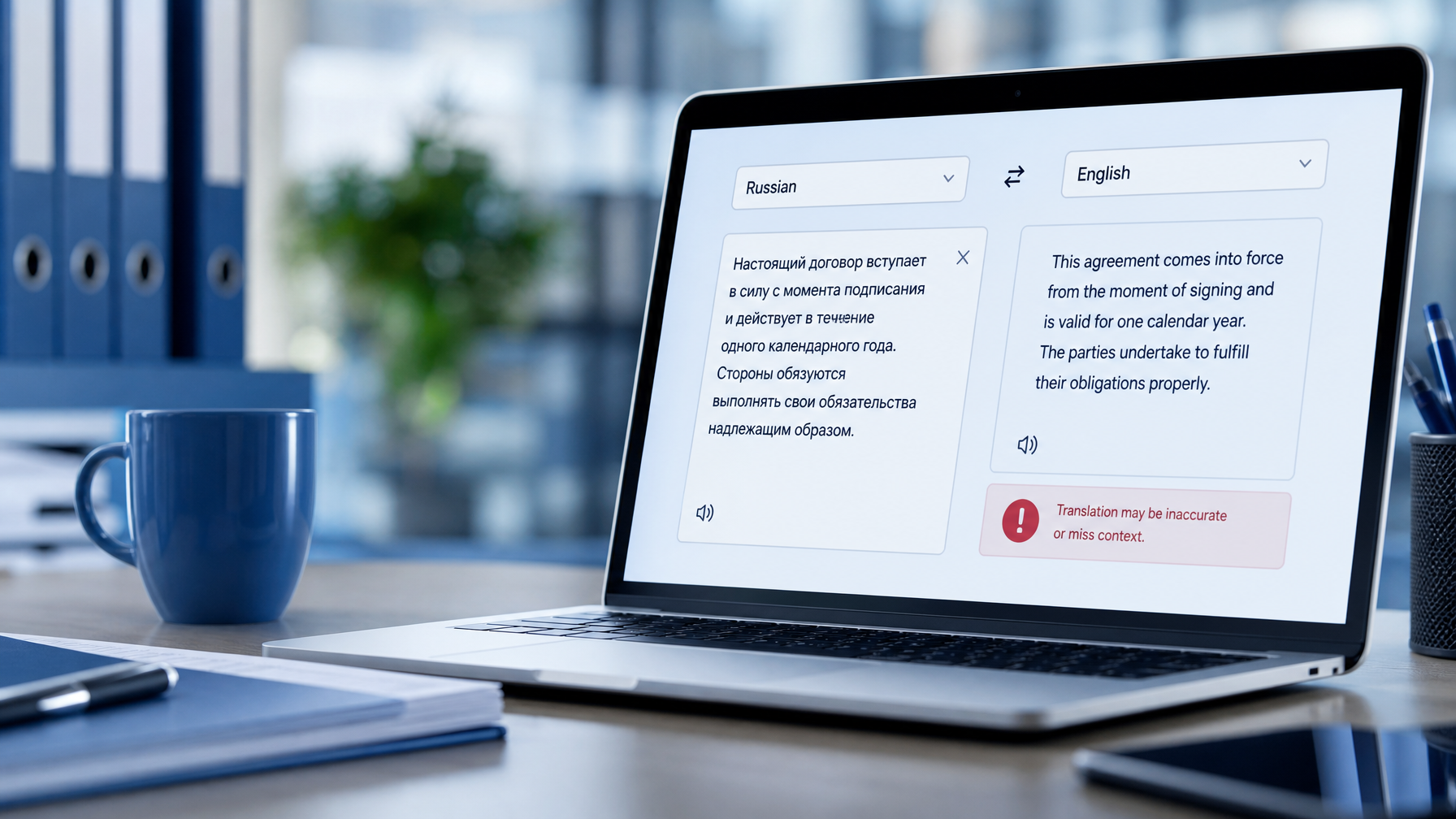
Why Machine Translation Fails for Russian Business Documents
Key Takeaways
- Russian grammar is significantly more complex than English grammar. Machine translation tools handle the basics but consistently fail on case endings, aspect pairs, and formal register, all of which matter in business documents.
- A study published in the Journal of Medical AI found that ChatGPT produced an unacceptably high rate of translation errors in Russian medical documents and should not be used alone to translate Russian content.
- Machine translation tools cannot identify terminology errors in specialist subject matter. A grammatically correct translation can still be factually wrong.
- Documents submitted to official bodies (UKVI, courts, Companies House, regulatory authorities) require certified human translation. Machine-translated documents are not accepted.
- The cost of correcting a machine-translated business document often exceeds the cost of having it translated professionally from the start.
Machine translation tools have improved significantly over the past decade. For reading a foreign-language webpage or understanding the general meaning of a document, they are genuinely useful. For business documents, legal submissions, technical content, and official applications, they fall short in ways that are not always obvious at first glance.
Table of Contents
ToggleRussian presents specific challenges for machine translation that make the gap between machine output and professional quality larger than it is for many other languages. This guide explains why, and where the risks are highest.
What Makes Russian Difficult for Machine Translation
Case system. Russian has six grammatical cases, each of which changes the ending of nouns, pronouns, adjectives, and numerals depending on their role in the sentence. English has almost no case system, which means English-trained machine translation models have limited exposure to how case interacts with meaning in Russian. Errors in case endings can change the meaning of a sentence entirely or produce output that sounds grammatically broken to a native speaker.
Verb aspect. Russian verbs come in pairs: perfective (completing an action) and imperfective (ongoing or repeated action). Choosing the wrong aspect changes whether an instruction means "do this once" or "keep doing this," a distinction that matters enormously in procedural and technical documents. Machine translation tools frequently select the wrong aspect because the distinction is context-dependent in ways that require understanding of the subject matter.
Formal register. Russian business and legal writing uses a formal register with specific conventions for honorifics, passive constructions, and sentence structure that differ significantly from spoken Russian. Machine translation models are trained on a wide range of Russian text including informal sources, which affects register consistency in formal output.
No shared alphabet. The Cyrillic alphabet means that technical terms, product names, and proper nouns must be either transliterated or translated into Russian. Machine translation handles common borrowed terms reasonably well but struggles with specialist terminology, newer technical terms, and proper nouns that do not have established Russian equivalents.
Where Machine Translation Fails in Practice
Legal and contract documents
Contract language relies on precise, unambiguous phrasing. A single case error or an incorrect modal verb can change whether a clause is obligatory, conditional, or optional. Machine translation output in legal Russian frequently sounds unnatural to a native reader, which signals immediately that the document was not produced by a professional. For contracts submitted to Russian counterparties, this affects credibility. For documents submitted to courts or regulatory bodies, it can render the document inadmissible.
Medical and pharmaceutical content
A study published in the Journal of Medical AI found that ChatGPT produced an unacceptably high rate of translation errors when translating medical documents from English to Russian, and concluded it should not be used alone for this purpose. Medical terminology in Russian has specific established equivalents that differ from what a general machine translation model produces. Errors in dosage instructions, contraindications, or clinical procedures carry direct patient safety risk.
Immigration and official documents
UKVI, the Home Office, and other official bodies do not accept machine-translated documents. Certified translations must be produced by a human professional who can sign a statement of accuracy. Beyond the formal requirement, machine-translated birth certificates, academic transcripts, and legal documents frequently contain errors in names, dates, and reference numbers that cause applications to be queried or refused.
Technical and manufacturing documentation
Technical content relies on precise terminology. A machine translation tool cannot tell the difference between two Russian terms that are similar in general usage but have different meanings in an engineering context. The output reads as approximately correct but contains terminology errors that engineers and technicians identify immediately.
Marketing and commercial content
Russian marketing copy requires cultural adaptation, not just translation. Machine translation produces literal output. Russian consumers respond to language that sounds natural and culturally appropriate. A machine-translated product description or marketing email reads as foreign and reduces trust in the brand.
The Hidden Cost of Machine Translation
The appeal of machine translation is speed and cost. The reality is that machine-translated business documents almost always require significant post-editing by a professional translator before they are usable, and poorly post-edited output still carries residual errors.
Post-editing a machine-translated Russian document requires a translator who can identify not just grammatical errors but also terminology errors, register inconsistencies, and cultural mismatches. That is the same skill set as translating from scratch. For long or complex documents, post-editing often takes nearly as long as translating, at a comparable cost, with a lower quality ceiling because the translator is constrained by the structure of the machine output.
For short, simple documents with limited specialist terminology, machine translation post-editing can be cost-effective. For business contracts, technical manuals, legal submissions, certified documents, and any content where accuracy affects commercial or legal outcomes, professional translation from the start is the more cost-effective choice when total cost, including risk, is considered.
When Machine Translation Is Acceptable
Machine translation is a reasonable tool for:
- Internal reference: understanding the general content of a Russian document before deciding whether to commission a professional translation
- High-volume, low-risk content: internal communications or informal notes where approximate meaning is sufficient
- Gisting: getting the overall meaning of a document quickly, with no intent to use the output externally
It is not appropriate for any document that will be submitted to an official body, shared with a Russian-speaking counterparty, used in a legal or regulatory context, or published to a Russian-speaking audience.
What Professional Russian Translation Provides That Machine Translation Cannot
Terminology accuracy. A professional translator with subject-matter expertise selects the correct Russian term for the context, not the most statistically probable one.
Register consistency. Professional translators apply a consistent formal register throughout a document, matching the conventions of Russian business or legal writing.
Cultural adaptation. For commercial and marketing content, a professional translator adapts the content for a Russian-speaking audience rather than translating it literally.
Certifiability. Only a human translator can provide a signed statement of accuracy. Certified translations are required by UKVI, courts, and many official bodies.
Accountability. A professional translation agency is accountable for the quality of its output. Machine translation tools are not.
Global LTS provides professional English to Russian and Russian to English translation for UK businesses. Our Russian translators are native speakers with subject-matter expertise, and every project follows our ISO 17100:2015 certified process with a second linguist review before delivery.
Contact us for a free quote, or see our Russian translation services page for the full range of documents and sectors we cover.