
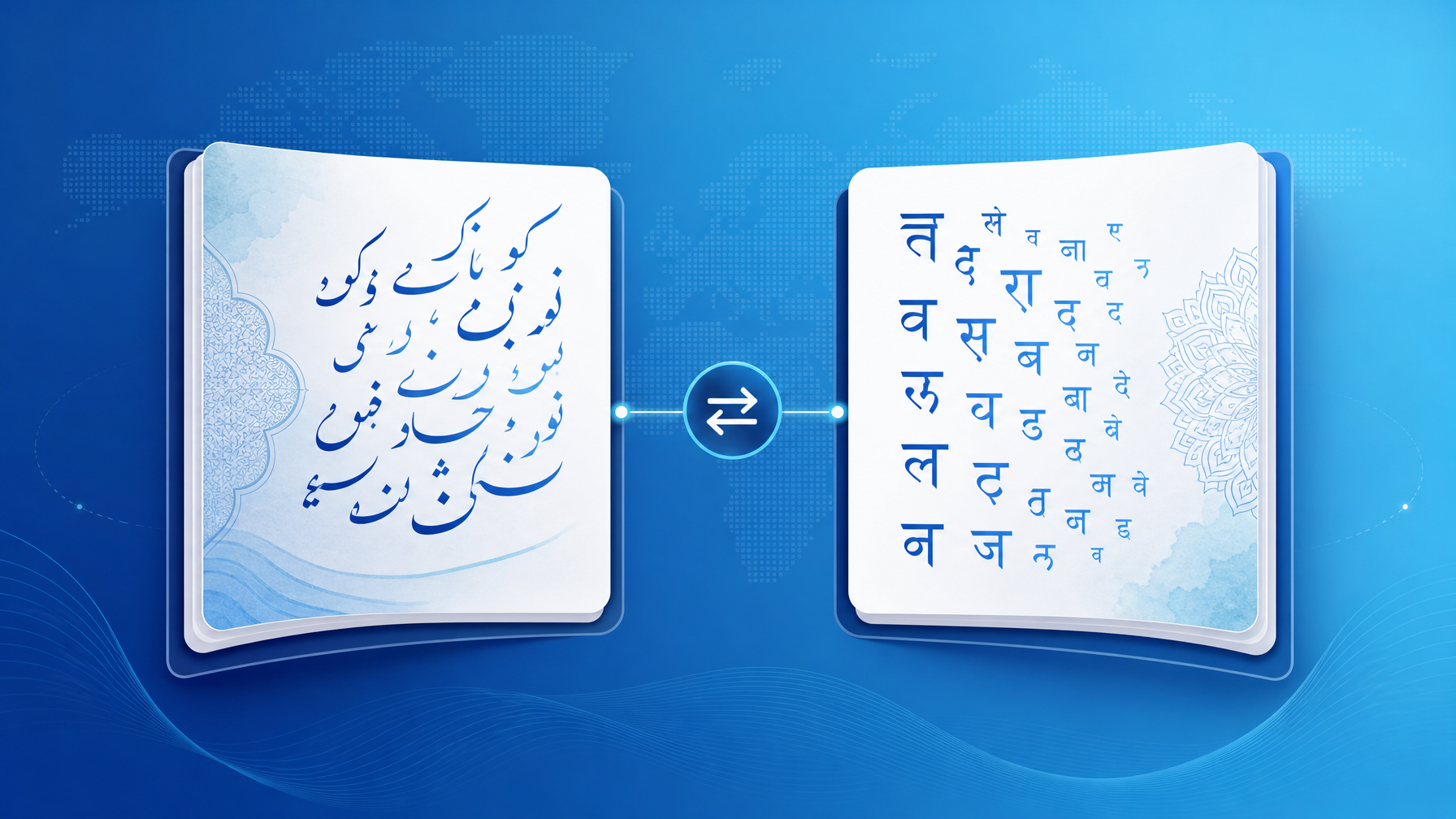
Urdu vs Hindi: Key Differences for Translation and Localisation
Key Takeaways
- Urdu and Hindi share much of their spoken grammar and everyday vocabulary but diverge sharply in script and formal/technical vocabulary.
- Urdu uses a Persian-Arabic script written right to left; Hindi uses Devanagari, written left to right.
- Formal Urdu draws vocabulary from Persian and Arabic; formal Hindi draws from Sanskrit — meaning the two diverge most in legal, technical, and literary content.
- Urdu and Hindi translations are not interchangeable for business, legal, or official documents, despite sounding similar when spoken casually.
If you've been told "Urdu and Hindi are basically the same language," that's true up to a point, and misleading beyond it. For a translation project, the differences matter more than the similarities.
Table of Contents
ToggleAre Urdu and Hindi the Same Language?
At the level of everyday spoken conversation, Urdu and Hindi are largely mutually intelligible; this shared spoken form is sometimes called Hindustani. But the two diverge as soon as you move into writing or formal register. Wikipedia's overview of Urdu notes that "while formal Urdu draws literary, political, and technical vocabulary from Persian and Arabic, formal Hindi draws these aspects from Sanskrit," which means the two languages sound closer in casual speech than they read on paper.
What's the Script Difference Between Urdu and Hindi?
This is the most visible difference. Urdu uses a script adapted from Persian-Arabic, written right to left. Hindi uses Devanagari, the same script used for Sanskrit, written left to right. A breakdown of Indian language scripts confirms this is where the two languages diverge most clearly for anyone reading rather than listening.
For translation purposes, this means Urdu and Hindi versions of a document are never simply transliterations of each other; they're fully separate written outputs.
Why Does Vocabulary Diverge in Formal Contexts?
Everyday vocabulary overlaps heavily between the two languages. Once you move into legal, technical, government, or academic vocabulary, they pull apart, since Urdu draws these terms from Persian and Arabic roots while Hindi draws the equivalent terms from Sanskrit. A legal contract or technical manual translated into "Hindi-Urdu" as if it were one language will read as noticeably foreign to a fluent reader of either.
Who Speaks Urdu vs Hindi?
Urdu is the national language of Pakistan and one of 22 officially recognised languages of India, though it's the first language of a comparatively small percentage of Pakistanis (around 7%) while being widely understood as a second language across the country. Hindi is one of India's official languages, spoken far more widely across northern and central India.
For business or government translation, this distinction matters for audience targeting: Urdu content generally serves Pakistani markets and Pakistani diaspora communities (including the sizeable Urdu-speaking population in the UK), while Hindi content serves the broader Indian market.
Can the Same Translator Handle Both Languages?
Not reliably. Fluency in spoken Hindustani doesn't automatically translate into professional competency in both the Devanagari and Persian-Arabic writing systems, let alone the separate formal vocabularies each language draws on. A project needing both Urdu and Hindi versions should be treated as two separate translation briefs with two specialist translators, not one translation "adapted" into two scripts.
Does This Affect Certified Translation for UK Purposes?
Yes. If a UK institution such as UKVI requires a certified translation of a document originally in Urdu, that translation needs to be done by an Urdu translator, not a Hindi translator working from a transliteration. The Certificate of Accuracy needs to reflect the correct source language.
At Global LTS, we translate both Urdu and Hindi with native specialist translators for each, rather than treating them as interchangeable. See our full Urdu translation services, our guide to certified Urdu translation for UKVI applications, or contact us to discuss your project.