
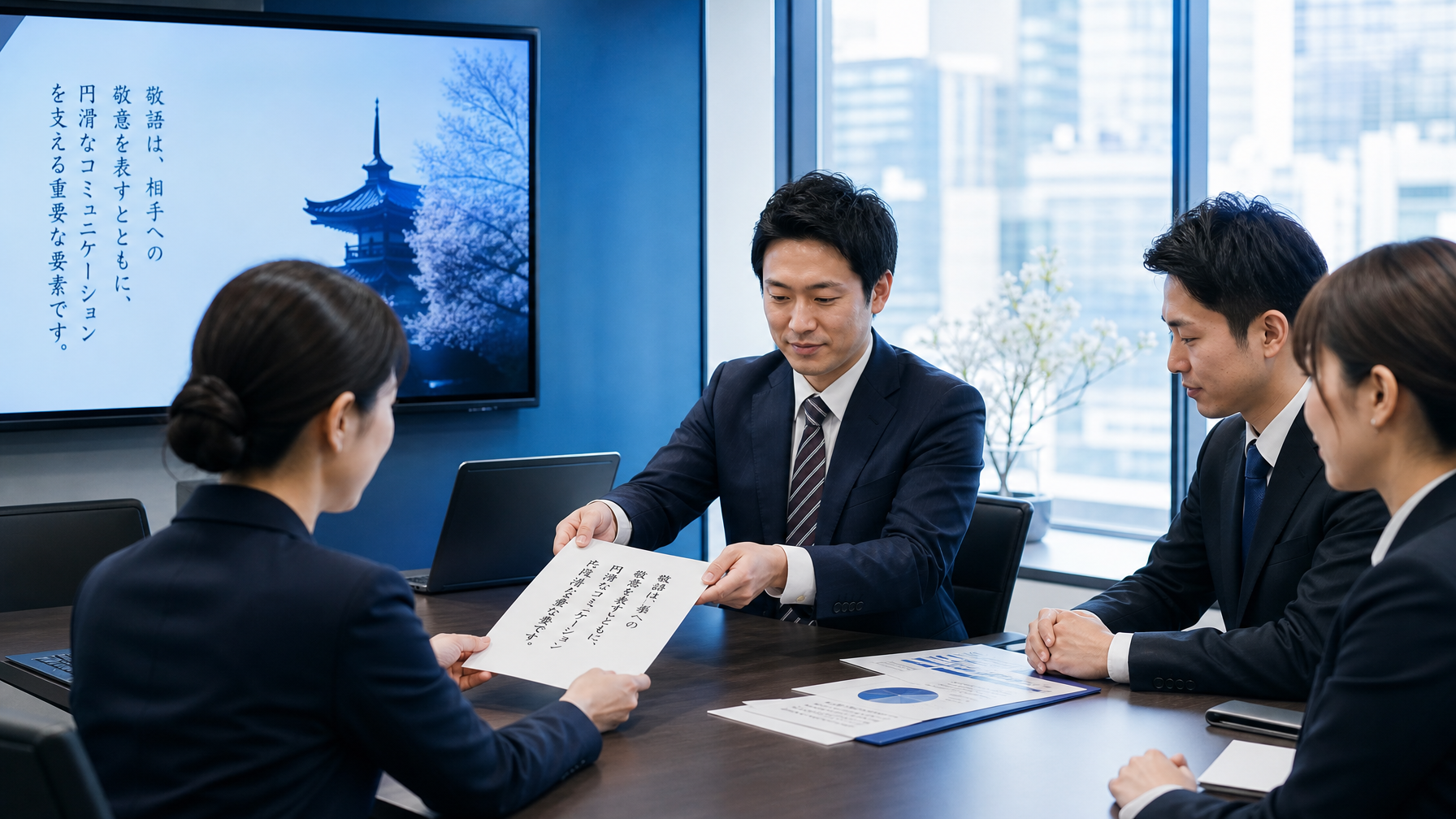
Keigo and Register in Japanese Business Translation: Why It Matters for UK Companies
Key Takeaways
- Keigo is the Japanese system of formal honorific language that encodes the social relationship between writer and reader directly into the grammar and vocabulary of the text. It is not a style choice. It is a grammatical requirement of Japanese business communication.
- Using the wrong level of formality in Japanese business correspondence is immediately apparent to Japanese readers and signals that the communication was produced by someone unfamiliar with Japanese business culture.
- Machine translation frequently produces incorrect keigo, defaulting to informal or inconsistent register that reads as unprofessional or culturally inappropriate.
- Different document types require different keigo treatment. A business email to a client requires different register from a user manual, which requires different register from a product brochure.
- A native Japanese translator with business writing experience applies the correct register automatically. It is not something you can brief your way out of with a non-specialist.
For UK businesses communicating with Japanese partners, clients, suppliers, or customers, the quality of Japanese-language communication affects how your organisation is perceived. Japanese business culture places significant weight on formality, hierarchy, and the correct expression of professional relationships. Language is central to this.
Table of Contents
ToggleKeigo is the aspect of Japanese that encodes these relationships directly into how you speak and write. This guide explains what keigo is, why it matters for business translation, and what goes wrong when it is handled incorrectly.
What Is Keigo?
Keigo (敬語) is the Japanese system of formal honorific speech and writing. Unlike English, where formality is expressed mainly through vocabulary and sentence structure, Japanese encodes the social relationship between speaker and listener directly into verb forms, noun forms, and grammatical endings.
Keigo has three main components, all of which are used in combination in formal business contexts:
Sonkeigo (尊敬語). Respectful language. Used to elevate the actions and status of the person you are addressing or speaking about. In a business email to a client, sonkeigo is used when referring to what the client does, says, has, or thinks. For example, the verb "to come" has a specific sonkeigo form (いらっしゃる, irassharu) that is used when the client is the subject of the action.
Kenjōgo (謙譲語). Humble language. Used to lower the speaker's own actions and status in relation to the other party. The same email uses kenjōgo when referring to what the sender's own company does. The same concept of "to come" or "to go" has a different kenjōgo form (参る, mairu) used when you are the subject.
Teineigo (丁寧語). Polite language. The baseline register for all professional and business Japanese. It establishes a formal rather than casual tone through specific verb endings and sentence constructions. All business Japanese uses teineigo at minimum; sonkeigo and kenjōgo are layered on top of this when appropriate.
These three components are used simultaneously in formal Japanese business writing. A business email to a client will use sonkeigo to describe the client's actions, kenjōgo to describe the sender's actions, and teineigo throughout as the baseline register. Applying them correctly requires understanding who is the subject of each action in each sentence.
Why This Matters for Business Translation
It affects how your organisation is perceived. Japanese business counterparts judge professional credibility in part through the quality of business correspondence. A letter or email with incorrect keigo signals that the sender either does not know Japanese business conventions or did not invest in professional communication. Both are reputationally damaging in a business relationship context.
Different documents require different treatment. A business email to a senior executive requires full formal keigo. A product user manual uses polite but neutral language without the relational honorifics of correspondence. Consumer marketing copy for a mass-market product uses a different register from consumer marketing for a luxury brand. Each document type has established conventions, and a professional translator applies the correct convention without additional instruction.
It compounds across a document. A single keigo error in a business email is noticeable. Inconsistent keigo throughout a contract or a product brochure signals that the document was not produced by a professional. Japanese readers will identify this immediately, and it affects how much trust they place in the document and the organisation behind it.
What Goes Wrong with Machine Translation and Non-Specialist Translators
Machine translation defaults to inconsistent register. Machine translation tools are trained on large, mixed-register datasets. They do not have a stable model of the social relationship between writer and reader in a specific document. As a result, machine-translated Japanese business content frequently mixes formal and informal forms, uses sonkeigo and kenjōgo interchangeably or incorrectly, and produces a register inconsistency that reads as unnatural and amateur to any native Japanese business reader.
Non-specialist translators may produce grammatically correct but register-inappropriate output. A translator who is fluent in Japanese but without business writing experience may produce Japanese that is technically correct but uses the wrong keigo level for the context. For example, a translator who is used to translating technical manuals may not apply the relational honorifics required in business correspondence, or vice versa.
The error is invisible to the English-speaking client. Because keigo is encoded in forms that have no English equivalent, a UK business reading a back-translation or trusting a non-specialist translator cannot detect register errors. The document looks plausible in English. The Japanese reads as inappropriate or unprofessional to a native reader.
Keigo in Practice: What Each Document Type Requires
Business correspondence (emails, letters, proposals). Full formal keigo with sonkeigo and kenjōgo applied correctly relative to the relationship between sender and recipient. Opening and closing phrases follow established conventions. Direct English equivalents often do not exist for these phrases, and a translator must know the correct Japanese forms.
Contracts and legal documents. Formal Japanese legal register uses specific vocabulary and sentence constructions that differ from everyday formal Japanese. Contracts are impersonal and objective in register, without the relational honorifics of correspondence. They use a distinct legal vocabulary with specific terms for obligations, rights, and definitions that must be translated accurately.
User manuals and technical documentation. Polite, neutral register using teineigo. Instructions are typically in the imperative or a polite instructional form. Sonkeigo and kenjōgo are not used because the document is not a relationship between two named parties.
Consumer marketing copy. Register varies by brand positioning. Mass-market consumer brands may use a casual, friendly register with minimal keigo. Mid-market brands use standard polite forms. Luxury brands use elevated, highly formal language. The target register should be specified in the brief; the translator should confirm the appropriate form for the positioning.
Website content. Varies by section. Company pages and investor relations content use formal register. Product pages use register matched to brand positioning. FAQ sections use clear, polite, accessible language. A website translation project requires register guidance for each section, or a translator experienced enough to apply the correct register to each page type independently.
What to Specify When Briefing Japanese Business Translation
You do not need to specify keigo levels in detail. A professional Japanese translator with business writing experience applies the correct register without instruction. What you should specify:
The relationship. Who is writing and who is reading? A communication from your company to a Japanese client uses different keigo from a communication within your organisation. The translator needs to understand the relational context.
The document type. Email, contract, brochure, website, manual. Each has different register conventions.
Brand positioning for marketing content. Formal, mid-market, or casual. For luxury or premium brands, specify that elevated formal register is required.
The audience. Technical engineers, senior executives, procurement teams, or consumers. The audience determines vocabulary level and the depth of technical language required.
Global LTS provides professional Japanese translation for UK businesses across all document types. Our Japanese translators are native speakers with business writing experience and sector expertise, and apply the correct keigo for each document type and audience without additional instruction.
Contact us for a free quote, or see our Japanese translation services page for more information on the documents and sectors we cover.