
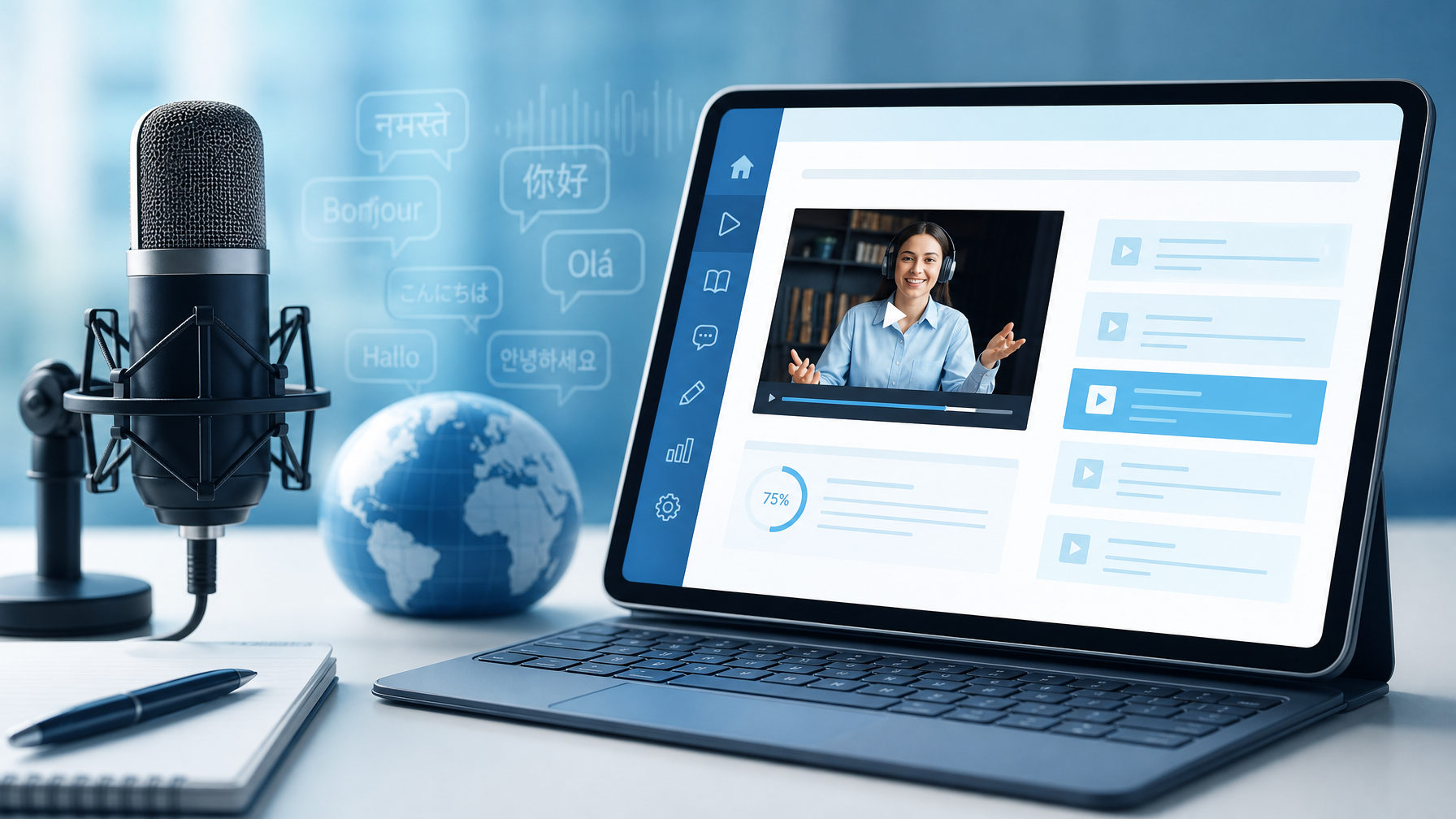
Multilingual Voice Over for E-Learning: What Production Teams Need to Know
Key Takeaways
- Text expansion in translation affects audio timing. Spanish and French translations of English scripts typically run 20-25% longer, according to Eriksen Translations. Without a timed script, recordings will overrun the module.
- E-learning modules are built around audio timing. Voice over for e-learning is more technically constrained than voice over for video, and the brief needs to reflect this.
- Subject-matter expertise matters more in e-learning than in general corporate video. Compliance, technical, and medical training content requires translators and voice artists who understand the subject.
- Platform compatibility should be confirmed before recording, not after delivery.
- Combining voice over with same-language subtitles improves accessibility and supports learners in noisy or muted environments.
E-learning translation is one of the most technically demanding voice over applications. Unlike a corporate video, where overrunning audio by a few seconds is a minor edit, an e-learning module is built around precise audio timing. Animations trigger on narration cues. Quiz elements appear at specific points in the audio. Screen transitions are timed to match what the narrator is saying.
Table of Contents
ToggleWhen the voice over recording runs longer than the original, the module breaks. Getting multilingual voice over right for e-learning requires a more structured brief than most production teams realise.
Why E-Learning Voice Over Is Different from Corporate Video Voice Over
A corporate video plays from start to finish. If the German voice over runs 15 seconds longer than the English original, the solution is to extend the video by 15 seconds. Not ideal, but manageable.
An e-learning module does not work this way. The audio narration triggers other elements within the module: animations, highlight boxes, quiz questions, branching scenarios. If the narration overruns its allocated time, those elements fire at the wrong moment, the learning flow breaks, and the module may fail to function correctly on the platform.
This means that multilingual voice over for e-learning requires precise timing management from the moment the project is briefed, not as a post-production fix.
The Text Expansion Problem
Translating from English into European languages produces longer text. According to Eriksen Translations, Spanish and French translations of English source text typically run 20-25% longer. German word lengths increase character counts significantly even when sentence counts are similar.
For a voice over recording, a 20-25% longer script means a 20-25% longer recording. If the original English narration for a module section runs 60 seconds, the French narration may run 72-75 seconds. If the module has 30 sections, the cumulative timing difference is substantial.
There are three ways to manage this:
Option 1: Tighten the translation. The translator is given the timing constraints and instructed to produce a translation that conveys the full meaning within the available time. This requires a translator with enough flexibility to adapt, not just translate, and it requires timing information to be provided from the start.
Option 2: Adjust the module timing. The e-learning developer extends the allocated time for each section in each language version to accommodate the longer recording. This works but requires development resource and adds cost.
Option 3: Re-record the original at a slower pace to create headroom. Some production teams re-record the English narration deliberately slowly to create space for longer language versions. This is the cleanest solution for large-scale multi-language e-learning programmes, but it requires planning at the original production stage.
The worst option is to provide the translator with a script and no timing information, have them translate it at natural length, and discover the timing issue during recording.
How to Brief a Multilingual E-Learning Voice Over Project
A complete brief for e-learning voice over includes:
A timed script. Every section of narration should have a start time and an end time. This is not optional for e-learning. Your authoring tool (Articulate Storyline, Adobe Captivate, Lectora, or equivalent) can export audio timing data. If it cannot, your e-learning developer should be able to provide a timing sheet.
The source audio files. Providing the original English recordings allows the translator to hear the intended pace, tone, and emphasis. It also allows the translator to assess where the text can be tightened if timing is tight.
Platform and file format requirements. Confirm the audio format your platform requires before recording begins. Common formats include MP3 at 128kbps or 192kbps, and WAV at 44.1kHz. Some platforms have file size limits per audio clip. Delivering recordings in the wrong format after a full recording session is an avoidable problem.
The authoring tool and version. If the supplier is responsible for importing audio back into the module, they need to know which authoring tool is in use and how audio is structured within the project files.
Target markets and regional variants. As with all voice over projects, specify the target region, not just the language. Spanish for Spain and Spanish for Latin America require different translators and different voice artists.
Subject-Matter Expertise in E-Learning Translation
E-learning content covers a wide range of subject matter. Health and safety, compliance, technical skills, medical procedures, financial regulation, customer service. The subject matter of a module determines what kind of translator it needs.
A compliance module for a financial services firm requires a translator who understands the regulatory concepts being communicated, not just the words. A medical training module for clinical staff requires a translator with medical knowledge. A technical skills module for manufacturing operatives requires a translator with relevant technical vocabulary.
This is not about the translation being harder. It is about the translated narration making sense to an expert audience. A fluent but non-specialist translator of a clinical training module will produce a grammatically correct translation that a clinician immediately identifies as wrong.
When briefing a multilingual e-learning voice over project, specify the subject matter and the intended audience. A reputable supplier assigns translators and voice artists based on this information.
Voice Artist Selection for E-Learning
The voice artist for an e-learning module is the learner's companion through the content. The wrong tone makes a significant difference to engagement.
For instructional and compliance content, a clear, measured, authoritative tone typically works best. Overly casual or performance-heavy delivery can feel mismatched to the content and distract from learning.
For softer skills training or onboarding content, a warmer, more conversational tone is appropriate.
For technical or procedural content, precision and clarity matter most. The voice artist needs to deliver terminology correctly and consistently across the full recording.
Request sample recordings before confirming a voice artist. The sample should use a section of your actual script, not a generic demo, so you can assess how the artist handles your content and terminology.
Combining Voice Over with Subtitles for E-Learning
Adding same-language subtitles to a voice over recording improves accessibility and supports learners in environments where audio is not available. Many e-learning platforms are accessed on mobile devices in commuting or office environments where headphones are not always used.
Subtitles also support learners with hearing impairments and those for whom the target language is a second language, even if they speak it well.
For regulated industries such as healthcare, pharmaceuticals, and financial services, same-language subtitles create a written record of the narration that supports regulatory compliance and audit.
Global LTS provides subtitling translation services that can be produced alongside voice over recordings from the same translated script, keeping the two in sync.
Practical Checklist for E-Learning Voice Over Projects
Before briefing the project:
- Export a timed script with start and end times for every narration section
- Confirm target markets (language and region)
- Specify subject matter and target audience
- Identify platform and audio file format requirements
- Confirm whether audio import into the authoring tool is in scope or handled by your developer
- Allow time for voice artist sample approval before recording sessions are booked
During the project:
- Review translated scripts for timing before recording, not after
- Confirm voice artist selection from samples using your actual script
- Build in one round of amends to the brief before recordings are approved
After delivery:
- Test audio in the authoring tool before signing off
- Run a full playback of each language version to check synchronisation
- Confirm platform compatibility before distributing to learners
Global LTS handles multilingual voice over for e-learning end to end, from script translation by subject-specialist translators to professional studio recording and delivery in your platform's required format. We work alongside your e-learning developers or authoring team to manage timing and file compatibility from the start. Contact us to discuss your project, or see our e-learning translation services page for more on how we approach e-learning localisation.