
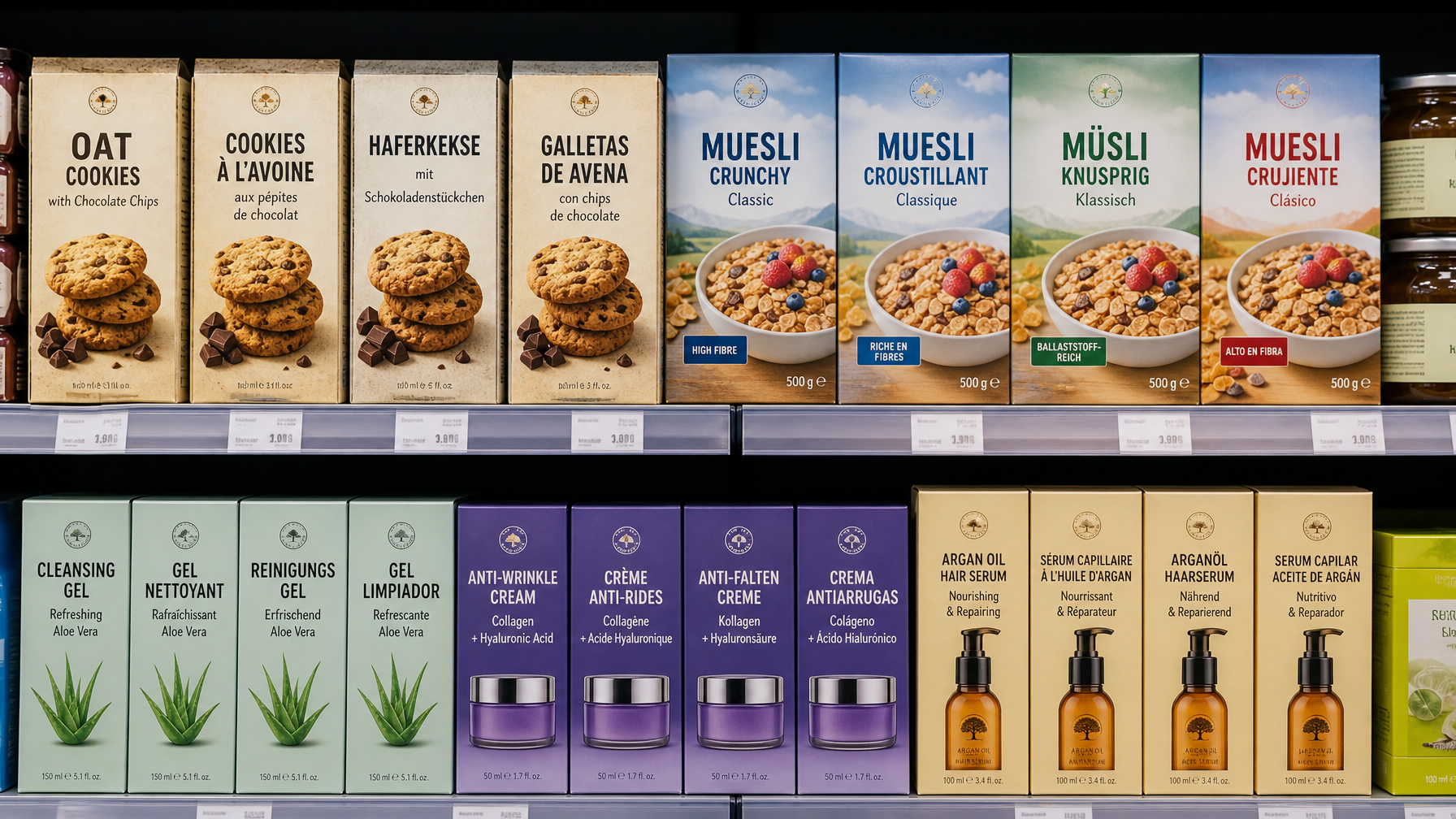
How to Translate Product Packaging for the EU Market: Labelling Requirements Explained
Key Takeaways
- Selling products in EU member states requires packaging information to appear in the official language(s) of each country where the product is sold — this is a legal requirement, not a recommendation.
- Different product categories are governed by different EU regulations: food products fall under EU FIC (Regulation 1169/2011), cosmetics under the EU Cosmetics Regulation, and medical devices under EU MDR. Each has specific language and content requirements.
- Bilingual and multilingual markets — including Belgium, Switzerland, Canada, and Luxembourg — require packaging to carry text in multiple official languages simultaneously, which has direct implications for available space and design layout.
- Machine translation is not suitable for regulatory packaging copy — errors in allergen declarations, dosage instructions, or safety warnings carry legal and safety consequences.
- Translation should be commissioned alongside the packaging design process, not after finalisation, to avoid costly redesigns caused by text expansion in the target languages.
For UK businesses exporting products into EU markets post-Brexit, packaging translation is both a commercial and a legal requirement. This guide explains what the EU requires, which regulations apply to which product types, and what to consider when commissioning packaging translations for European markets.
Table of Contents
ToggleThe General Principle: Language Requirements in EU Member States
The core requirement across EU product regulations is that mandatory information on packaging must appear in the official language(s) of the member state(s) where the product is marketed. For a product sold in France, mandatory information must be in French. For a product sold across multiple EU countries, each country's version of the packaging must carry the mandatory information in that country's official language.
This applies to the information that regulations designate as mandatory — product name, ingredients or components, net quantity, date markings, allergens, warnings, usage instructions, and manufacturer/importer details. Non-mandatory marketing copy (slogans, brand descriptions, product stories) is not subject to the same language requirement, though translating this content is strongly recommended for commercial reasons.
EU FIC: Food Packaging Translation Requirements
Regulation (EU) No 1169/2011 on the provision of food information to consumers (EU FIC) sets out the mandatory labelling requirements for food products sold in the EU. Key requirements relevant to packaging translation include:
- Mandatory particulars must be in the official language(s) of the member state where the product is sold. Where a product is sold in multiple member states, each version must carry the relevant language(s).
- Allergen information must be emphasised within the ingredients list — typically through bold or capitalised text — and accurately translated. Mistranslated allergen declarations carry serious safety and legal consequences.
- Nutritional declarations follow a standardised format and must use the correct terminology in the target language — translators must know the conventional local terms, not just a dictionary translation.
- Net quantity, date markings, and storage instructions must appear in the mandatory language(s) and use the correct local conventions for units and date formats.
EU FIC also specifies minimum font size requirements for mandatory information. Packaging designs must account for these when incorporating translated text.
EU Cosmetics Regulation: Packaging Requirements
Regulation (EC) No 1223/2009 (the EU Cosmetics Regulation) requires that cosmetic product labels carry certain information in the official language(s) of the member state where the product is sold. Mandatory information includes:
- Ingredients list — using INCI (International Nomenclature of Cosmetic Ingredients) nomenclature. INCI names are standardised Latin/English terms and do not change between languages. The word "Ingredients" or its equivalent in the target language must precede the list.
- Function — if not clear from the product's presentation, the function must be stated in the mandatory language.
- Warnings and precautions — any required warnings must be translated accurately.
- Responsible person details — the name and address of the responsible person in the EU must appear on the label.
For UK businesses, Brexit means that a UK-based responsible person is no longer sufficient for EU market products — an EU-based responsible person must be named on EU market packaging.
Medical Devices: EU MDR Language Requirements
Medical devices placed on the EU market under Regulation (EU) 2017/745 (EU MDR) must carry instructions for use and labelling in the official language(s) of the member state(s) where the device is sold. Translation of medical device packaging and IFU documents requires translators with specific expertise in medical terminology and familiarity with MDR labelling requirements. See our medical translation services page for more detail on this sector.
Multilingual Markets: Belgium, Switzerland, Luxembourg, Canada
Some markets require packaging to carry multiple languages simultaneously on the same pack:
- Belgium requires French and Dutch (and German for products sold in the German-speaking community).
- Switzerland (non-EU but with aligned standards) conventionally requires German, French, and Italian.
- Luxembourg requires French and German.
- Canada requires English and French under the Consumer Packaging and Labelling Act.
For these markets, available space on packaging must accommodate two or more full sets of mandatory information. This needs to be planned at the design stage — attempting to fit bilingual text into a pack designed for a single language almost always requires a layout redesign.
Practical Steps for EU Packaging Translation
- Identify the target markets and the specific regulations that apply to your product category in each.
- Commission translation at the design stage, not after finalisation — text expansion of 15–30% in European languages means designs need to accommodate the translated versions from the outset.
- Supply editable design files (InDesign .idml is the preferred format) so translated text can be reintegrated directly into artwork without manual copy-pasting.
- Use native-speaking translators with sector knowledge — food, cosmetics, and medical device packaging each have regulatory terminology conventions that a generalist translator may not know.
- Review the translated packaging against the regulatory requirements of the target market before going to print.
Global LTS provides packaging translation services for UK businesses entering EU and international markets, with native-speaking translators experienced in food, cosmetics, medical device, and consumer product sectors. Contact us to discuss your project.
For related reading, see our guides on packaging translation and multilingual DTP and food packaging translation.