
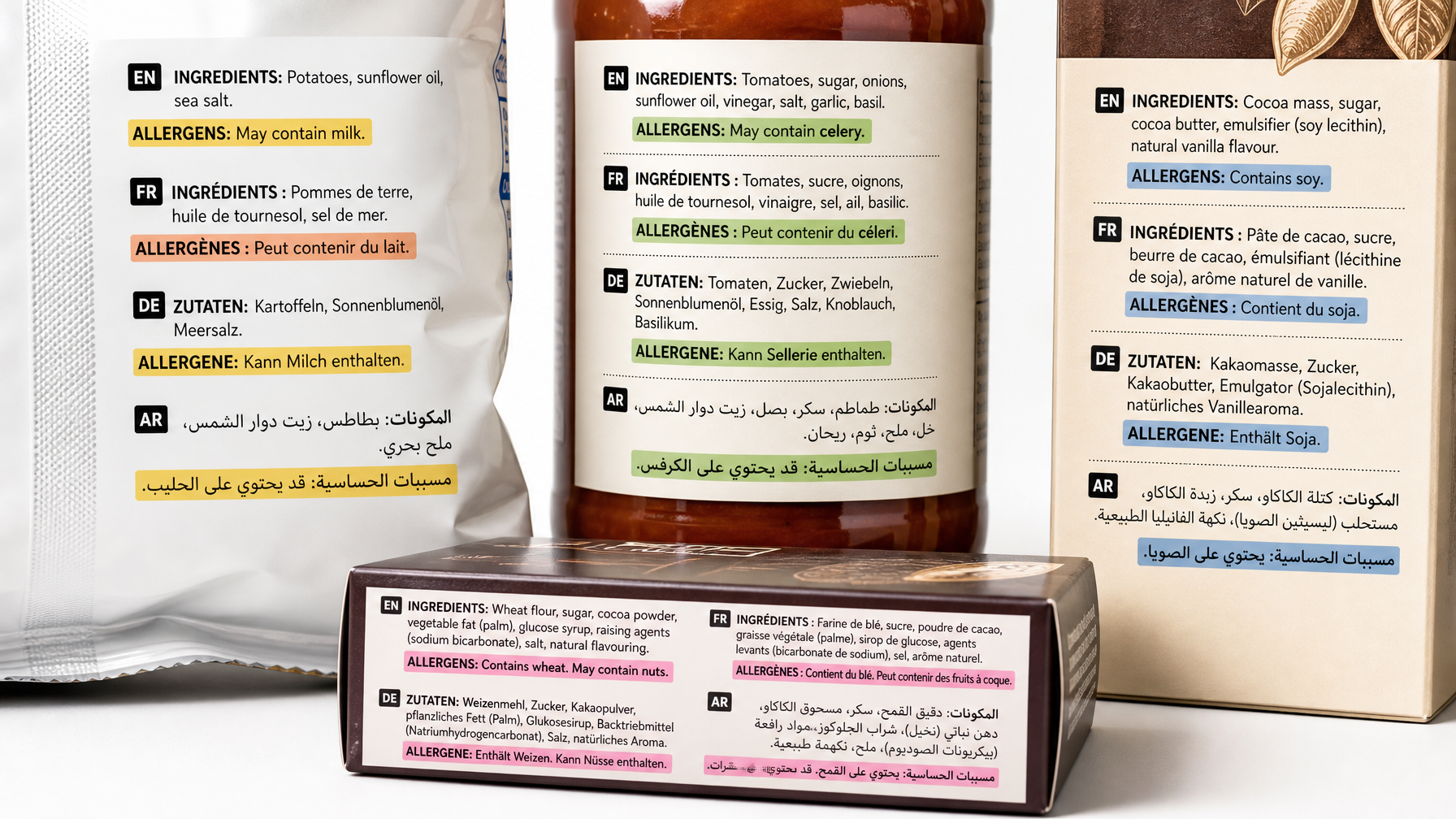
Food Packaging Translation: Ingredients Labels, Allergens and Regulatory Requirements
Key Takeaways
- Food packaging sold in EU member states must carry mandatory labelling information — including allergen declarations — in the official language(s) of each country where the product is sold, under EU FIC Regulation 1169/2011.
- Allergen mistranslations carry direct safety consequences and legal liability — this is not an area where machine translation or non-specialist translators are appropriate.
- Nutritional declarations follow a standardised format under EU FIC — translators must use the correct local terminology for each nutrient, not just a dictionary translation of the English term.
- Date markings, net quantity, storage instructions, and manufacturer details all have specific language requirements and local conventions that must be followed in each target market.
- Post-Brexit, UK food businesses exporting to the EU must treat EU member states as separate markets, each with their own language requirements — a single "European" version of the label is not sufficient unless it carries all relevant official languages.
Food packaging translation is one of the most regulated forms of translation work. Ingredients lists, allergen declarations, nutritional tables, and storage instructions are subject to specific EU and national regulations that determine what information must appear, how it must be presented, and which language it must be in. This guide explains the key requirements UK food businesses need to understand when translating packaging for international markets.
Table of Contents
ToggleEU FIC: The Core Regulation
Regulation (EU) No 1169/2011 — commonly called EU FIC (Food Information to Consumers) — is the primary regulation governing food labelling across EU member states. It sets out the mandatory particulars that must appear on food packaging and specifies that these must be in the official language(s) of the member state where the product is marketed.
The mandatory particulars under EU FIC that require translation include:
- The name of the food
- The ingredients list
- Allergen information (emphasised within the ingredients list)
- Net quantity
- Date of minimum durability or use-by date
- Storage conditions and conditions of use (where relevant)
- Name and address of the food business operator
- Country of origin (for specified product categories)
- Instructions for use (where omission would make appropriate use of the food difficult)
- Nutritional declaration
For UK businesses exporting to the EU post-Brexit, each member state's official language(s) apply independently. Selling in France requires French. Selling in Germany requires German. A product sold across multiple EU countries needs a separate language version for each, or a single pack carrying all the required languages simultaneously.
Allergen Translation: Why Accuracy Is Non-Negotiable
EU FIC requires that the 14 major allergens — including cereals containing gluten, crustaceans, eggs, fish, peanuts, soybeans, milk, nuts, celery, mustard, sesame seeds, sulphur dioxide and sulphites, lupin, and molluscs — are emphasised within the ingredients list. This is typically done through bold text, capitalisation, or a contrasting typeface.
Translating allergen information requires both accurate translation of the allergen name into the target language and correct emphasis formatting in the translated text. Both elements must be present and correct — an accurate translation with missing emphasis formatting, or correct formatting with an inaccurate translation, both represent a labelling failure.
The consequences of allergen mistranslation are serious: a consumer with a severe allergy who relies on a label that has been incorrectly translated faces a direct safety risk. From a business perspective, allergen labelling errors can result in product recalls, regulatory action, and legal liability. This is one of the clearest cases in which food packaging translation must be done by experienced, qualified translators — not machine translation tools.
Ingredients Lists: Terminology Conventions
Ingredients lists follow a standard format under EU FIC — listed in descending order of weight, using the name of the ingredient or an E-number for authorised additives. Translating an ingredients list requires familiarity with the conventional terms used in the target language for each ingredient, which are not always the same as a direct dictionary translation.
For example, the English term "glucose-fructose syrup" has specific regulatory translations in EU languages — the French equivalent is "sirop de glucose-fructose," the German is "Glucosefructosesirup." These are established regulatory terms, and using a literal translation rather than the correct conventional term can create compliance issues.
Compound ingredients — those that are themselves made up of multiple components — have their own formatting requirements under EU FIC. Translators working on ingredients lists need to understand these rules, not just the language.
Nutritional Declarations
EU FIC requires a standardised nutritional declaration on most prepacked food products, covering energy, fat, saturates, carbohydrate, sugars, protein, and salt. The declaration must use the correct local terminology for each nutrient in the target language.
The format of the nutritional declaration is also regulated — the order of nutrients, the units used, and the presentation (tabular format is standard) are all specified. DTP work on nutritional tables needs to maintain this structure in the translated version.
Per-portion declarations and reference intake percentages, where included, must also be translated and reformatted correctly.
Date Markings and Storage Instructions
EU FIC specifies the terminology to be used for date markings:
- "Best before" (minimum durability date) — in French: "À consommer de préférence avant"; in German: "Mindestens haltbar bis"
- "Use by" (safety-critical date) — in French: "À consommer jusqu'au"; in German: "Zu verbrauchen bis"
These are regulated phrases — using an approximate translation rather than the correct conventional term is a labelling error. Translators working on food packaging must know the correct term for each member state.
Storage instructions ("Store in a cool, dry place," "Refrigerate after opening," "Once opened, consume within X days") similarly have conventional phrasings in each language that should be used rather than free translations.
Bilingual and Multilingual Food Markets
Several food markets require packaging to carry multiple languages simultaneously:
- Belgium requires French and Dutch (and German for the small German-speaking community in the east).
- Luxembourg requires French and German.
- Ireland requires English and Irish (Gaelic) on certain product categories under national rules.
- Switzerland (outside the EU but following closely aligned standards) conventionally requires German, French, and Italian.
For these markets, the entire mandatory information section of the packaging must appear in each required language. The space implications of this must be planned into the packaging design before translation is commissioned.
Post-Brexit: What UK Food Exporters Need to Know
Since January 2021, UK food businesses exporting to EU member states must treat the EU as a separate regulatory market. Key practical implications for packaging:
- Great Britain is no longer an accepted country of origin within the EU for certain product categories — labelling must reflect the actual country of origin correctly.
- UK addresses are no longer sufficient for the food business operator declaration on EU market products — an EU-based operator address must be present.
- Language requirements apply independently for each member state — a UK food business selling in France, Germany, and the Netherlands needs packaging (or separate label versions) in French, German, and Dutch respectively.
Global LTS provides packaging translation services for UK food businesses entering EU and international markets, with native-speaking translators experienced in food labelling requirements and EU FIC compliance. Contact us to discuss your project.
For related reading, see our guides on EU packaging labelling requirements across product categories and packaging translation and multilingual DTP.