
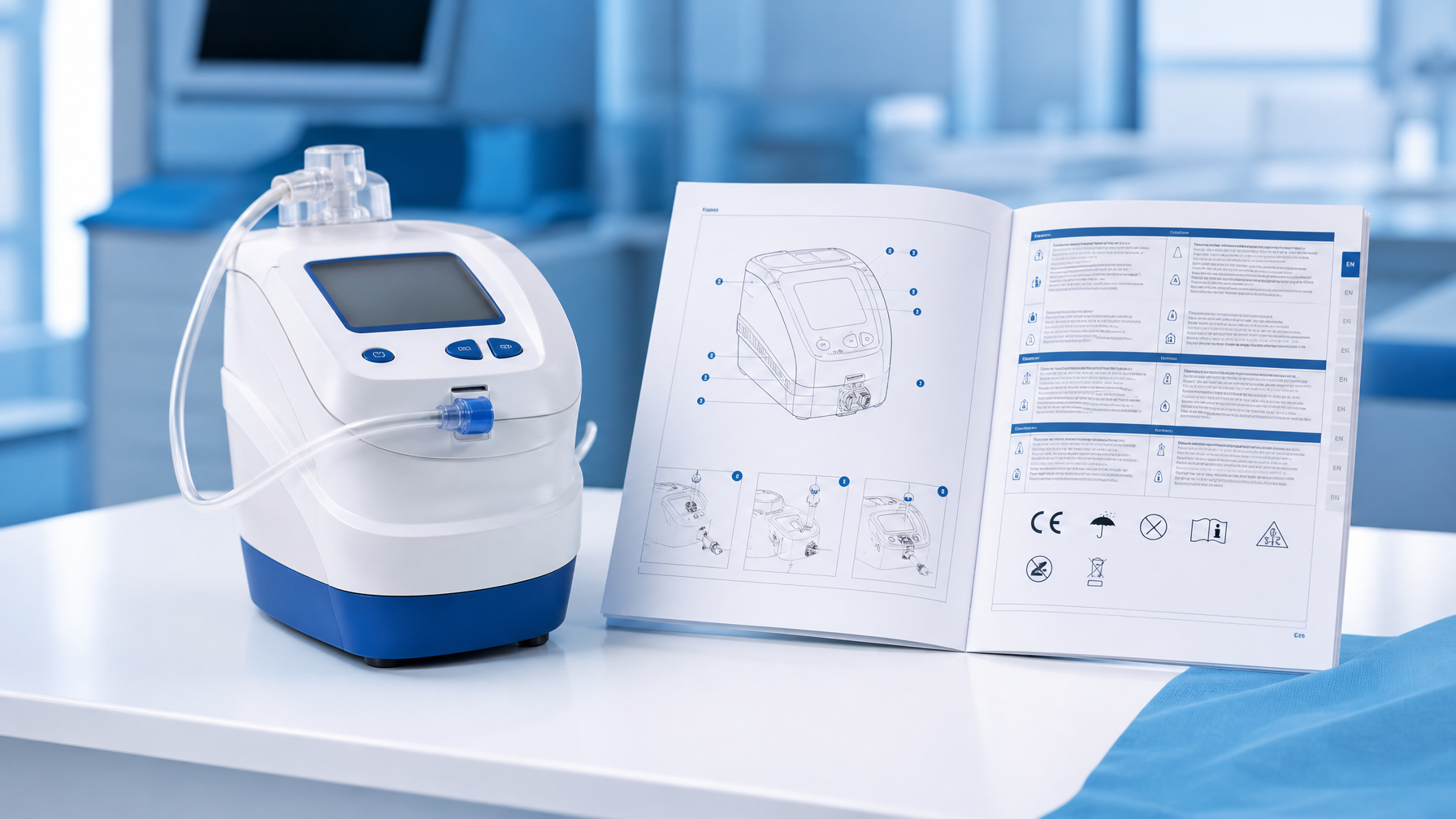
User Manual Translation for Medical Devices: IFU Requirements and Best Practice
Key Takeaways
- EU MDR (Regulation (EU) 2017/745) requires medical device IFUs and labelling to be provided in the official language of every EU member state where the device is marketed.
- For the UK market, UKCA marking requirements apply separately following Brexit.
- IFU translation must be performed by translators with medical device expertise — not general technical translators.
- Terminology consistency across IFUs, labelling, and post-market surveillance documents is both a quality requirement and a regulatory expectation.
- A Certificate of Accuracy and an ISO 17100-certified workflow are baseline requirements for compliant IFU translation.
For medical device manufacturers, the Instructions for Use (IFU) is not just a product document. It is a regulatory artefact. It must be accurate, complete, and available in the required languages for every market where the device is sold — and it must remain consistent with the device labelling, the technical file, and any post-market surveillance documentation.
Table of Contents
ToggleGetting IFU translation right is not simply a matter of linguistic accuracy. It requires an understanding of the regulatory framework, the clinical context of the device, and the specific terminology requirements of each target market.
This article sets out what EU MDR and UKCA require for IFU translation, what a compliant translation process looks like, and the most common mistakes manufacturers make when approaching this work.
What EU MDR Requires for IFU Translation
The Legal Requirement
Under EU MDR (Regulation (EU) 2017/745), Article 10(11) requires that manufacturers make the IFU available in the official language(s) determined by each EU member state where the device is placed on the market. The European Commission publishes a regularly updated overview of language requirements by member state — manufacturers should consult this document when planning market entry.
In practice, this means a device sold across the EU may require IFUs in up to 24 languages, covering all EU official languages plus, in some cases, national minority languages required by specific member states.
What Must Be Translated
Under EU MDR, the following documentation requires translation for each target market:
- Instructions for Use (IFU) in full
- Device labelling, including symbols and warnings
- Outer and immediate packaging text
- Any safety information provided to users
Technical files and clinical evaluation reports submitted to notified bodies are typically provided in English, but member states may request additional language versions in some circumstances.
Class I Device Exemptions
EU MDR provides a limited exemption for certain Class I devices: if the device is intended for use by healthcare professionals and the professional community in the target member state is demonstrably able to understand the relevant language, the IFU may not need full translation. However, this exemption is narrow and must be assessed on a device-by-device and market-by-market basis. Manufacturers relying on this exemption should document their justification in the technical file.
IVDR
The In Vitro Diagnostic Regulation (EU) 2017/746 (IVDR) applies equivalent language requirements to IVD devices. Manufacturers of IVD products should confirm specific requirements with their regulatory affairs team, as the IVDR timeline and notified body landscape continues to evolve.
UKCA Requirements Post-Brexit
For medical devices placed on the Great Britain market (England, Scotland, Wales), the UKCA marking scheme applies under the UK Medical Devices Regulations 2002 (as amended). The MHRA publishes guidance on language requirements for UKCA-marked devices.
Key points:
- Devices with CE marking under EU MDR do not automatically have UKCA approval for the GB market
- IFUs for the GB market must be in English and meet MHRA requirements, which may differ from EU MDR requirements in specific areas
- Northern Ireland remains aligned with EU MDR under the Windsor Framework — devices sold in Northern Ireland must meet EU MDR language requirements
Manufacturers selling in both the EU and UK therefore need to maintain separate IFU versions for the two regulatory zones, and in some cases separate versions for Northern Ireland.
What a Compliant IFU Translation Process Looks Like
Translator Selection
IFU translation requires translators with direct experience in the relevant medical device category. A translator working on an orthopaedic implant IFU needs clinical and anatomical knowledge. A translator working on a Class IIb diagnostic device IFU needs familiarity with the relevant diagnostic pathway and terminology.
General medical translators, or technical translators without medical device experience, are not appropriate for this work. The translator must understand not just the language but the clinical context — how the device is used, by whom, and in what setting.
Terminology Management
Consistent terminology across IFUs, labelling, and technical documentation is a regulatory expectation under EU MDR. A device that uses different terms in the IFU and on the label — even in translation — creates a compliance risk and a potential patient safety issue.
Before translation begins, manufacturers should provide:
- An approved terminology glossary for the device and product range
- The approved labelling text in the target language (or a translation brief for labelling to be translated in parallel)
- Any previously translated documentation for the same product line
Translation memory software maintains consistency across versions and updates — ensuring that when the IFU is revised for a new product generation, the existing approved translations are carried forward rather than retranslated from scratch.
ISO 17100 Workflow
IFU translations must follow an ISO 17100:2015-certified workflow, which mandates:
- Translation by a qualified specialist with relevant sector expertise
- Independent bilingual revision by a second qualified translator
- Final proofreading and quality check
- A documented, auditable process
This two-translator workflow is not optional for regulated medical device documentation. It is the baseline quality requirement for translations that will be used in regulatory submissions and patient-facing contexts.
Certification
Each translated IFU should be accompanied by a Certificate of Accuracy confirming the translation is complete, accurate, and produced by qualified professionals. This certificate forms part of the technical file and may be reviewed by notified bodies during conformity assessment.
Common Mistakes in Medical Device IFU Translation
Using a general translation agency — IFU translation requires medical device expertise. An agency without this background will not be aware of regulatory terminology requirements, symbol standards (ISO 15223), or the specific language used in clinical contexts for your device category.
Treating IFU and labelling translation as separate projects — the IFU and label must use identical terminology. Translating them separately, even by the same agency, without cross-referencing creates inconsistency that notified bodies and regulators will identify.
Failing to update translations consistently — when an IFU is updated following a design change, post-market surveillance finding, or regulatory requirement, all language versions must be updated. Maintaining an out-of-date IFU translation for any market is a compliance failure.
Not building a terminology glossary — without an approved glossary, translators make independent terminology decisions. Across 24 languages and multiple product generations, this produces inconsistency that is difficult and expensive to correct retrospectively.
Leaving translation until the last stage of market entry — IFU translation for 24 languages takes time. For large, complex IFUs translated into many languages simultaneously, four to six weeks is not unusual. Treating translation as a final step before launch creates timeline risk.
Summary
IFU translation for medical devices is a regulatory requirement, not a documentation task. It requires specialist translators, a defined quality process, certified outputs, and careful terminology management across the full documentation set.
Global LTS provides user manual and IFU translation services for medical device manufacturers across all EU official languages and for UKCA submissions. Our translators hold medical device sector expertise and all projects follow ISO 17100:2015 workflows. For more information on EU MDR language compliance, see our guide to IFU translation for medical devices. Contact us to discuss your project requirements.