
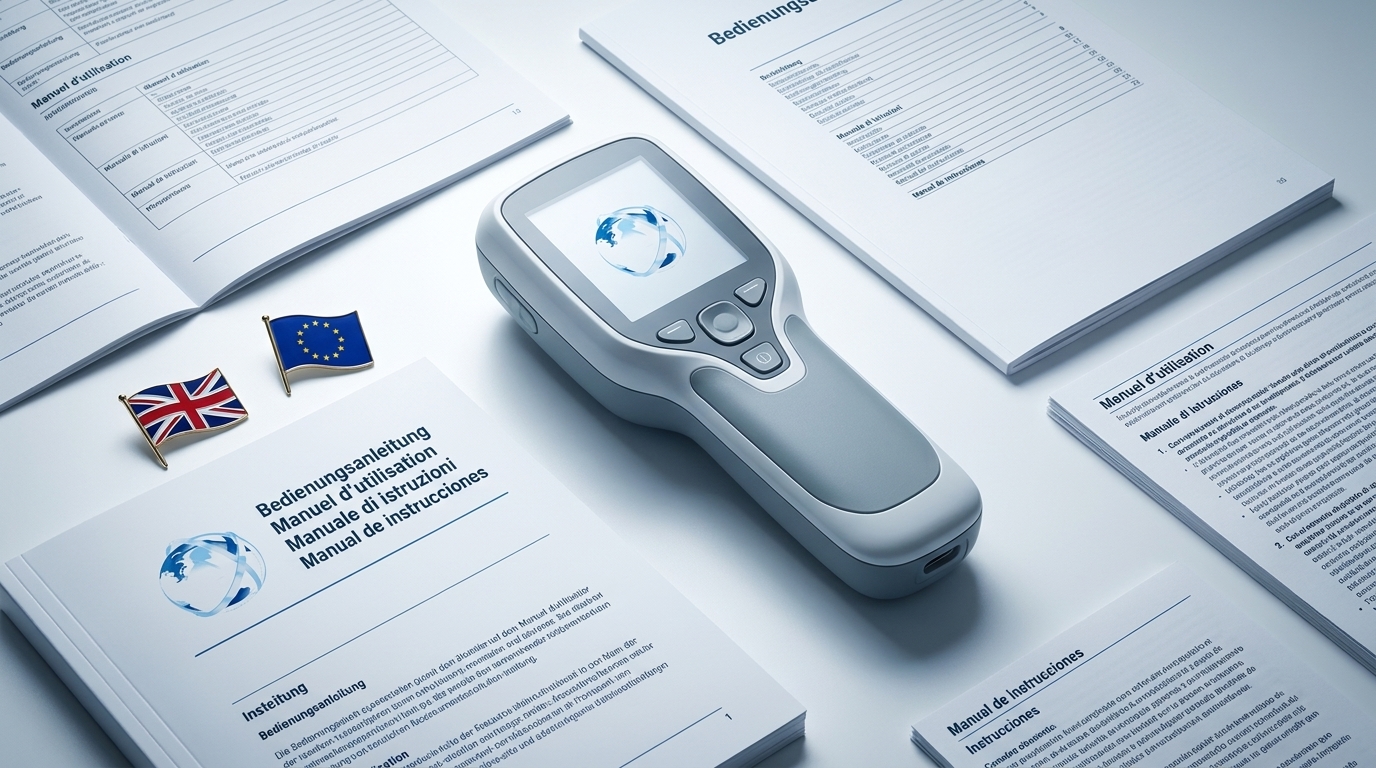
IFU Translation for Medical Devices: What Manufacturers Need to Know
If you manufacture medical devices for sale in the EU or UK, translating your Instructions for Use is not optional. Under EU MDR (Regulation (EU) 2017/745), manufacturers bear direct responsibility for ensuring IFUs, labels, and safety information are available in the official language of every member state where the device is distributed. Get it wrong and you face delayed market authorisation, failed audits, or, in the worst case, patient safety incidents.
Table of Contents
ToggleThis guide covers what the regulations actually require, where manufacturers most commonly run into problems, and what to look for when choosing an IFU translation partner.
What Is an IFU?
An IFU (Instructions for Use) is the document that tells users how to use a medical device safely and correctly. Under EU MDR, Article 2(14), it is defined as “information provided by the manufacturer to inform the user of a device’s intended purpose and proper use and of any precautions to be taken.”
IFUs cover a wide range of content depending on the device class and intended use: operating instructions, warnings, contraindications, maintenance procedures, disposal guidance, manufacturer contact details, and technical specifications. For complex devices, an IFU can run to hundreds of pages across multiple document types.
What EU MDR Requires for IFU Translation
EU MDR Annex I, Section 23 sets out the general requirements for information supplied with a device, including the IFU. The core obligation is clear: the information must be in the official language(s) of the EU member state(s) where the device is placed on the market.
Each member state determines its own language requirements. France requires French. Germany requires German. Belgium, depending on region, may require French, Dutch, or German. A device sold across 20 EU markets may require IFUs in up to 24 official EU languages.
The manufacturer is responsible for ensuring this. Not the importer. Not the distributor. The manufacturer.
Key MDR language requirements at a glance:
- IFUs must be in the official language(s) of the member state of distribution
- Labels and accompanying documentation carry the same requirement
- Digital IFUs (eIFUs) are permitted for certain device classes under Regulation (EU) 2021/2226, but language obligations still apply
- Technical files and clinical evaluation reports may be submitted in English in many cases, though member states can require local language versions
For the full per-country breakdown, the European Commission publishes an MDR language requirements table that is updated regularly.
UK Market: UKCA Marking and IFU Language Requirements
Post-Brexit, the UK market operates under a separate regulatory framework. The Medicines and Healthcare products Regulatory Agency (MHRA) oversees medical device regulation in Great Britain (England, Wales, and Scotland), and devices must carry UKCA marking to be placed on the GB market.
Under UKCA requirements, IFUs and labelling must be in English. For Northern Ireland, the Windsor Framework means CE marking under EU MDR continues to apply, so EU language obligations remain relevant for NI distribution.
Practical implications for UK-based manufacturers:
- A device sold in both the EU and GB requires IFUs translated for EU member states plus an English version for GB
- CE marking currently remains valid in Great Britain until further MHRA transition dates; always check current GOV.UK guidance for the latest position
- UK manufacturers exporting to the EU need EU MDR-compliant translations regardless of UKCA status
What Must Be Included in a Translated IFU
MDR Annex I, Section 23.4 lists the mandatory content elements for an IFU. Each element must be accurately translated, not summarised or adapted. The translation must convey the same meaning, in the same level of technical detail, as the source document.
Mandatory IFU content elements that require translation:
- Intended purpose and indications for use
- Contraindications and warnings
- Step-by-step instructions for safe use
- Information on residual risks and side effects
- Maintenance, calibration, and servicing instructions
- Shelf life and storage conditions
- Manufacturer and authorised representative contact details
- Device classification and applicable standards
- Batch codes, lot numbers, and version identifiers
- Disposal instructions (including WEEE and hazardous materials where applicable)
For implantable devices, additional information is required under MDR Article 18, including an implant card that must also be provided in the language of the member state.
Version control is a persistent challenge. When the source IFU is updated (new warnings, software changes, post-market safety corrections), all language versions must be updated consistently and simultaneously. A translation supplier with translation memory tools can make this substantially faster and cheaper, since only the changed segments require retranslation.
The Risks of Poor IFU Translation
Translation errors in IFUs do not stay on paper. They create real compliance and safety exposure.
Regulatory consequences:
- Non-compliant IFUs are a common finding in CE marking audits and MHRA inspections
- A failed audit can delay or block market entry entirely
- Post-market surveillance obligations under MDR Article 83 require manufacturers to monitor field performance, which includes translation-related issues reported by users or distributors
Patient safety consequences:
- Misunderstood operating instructions can lead to use errors
- Incorrectly translated warnings reduce their effectiveness
- For devices used directly by patients (home-use devices, consumer medical products), clarity in the target language is critical
Commercial consequences:
- Distributor relationships suffer when documentation quality is inconsistent across markets
- Warranty claims and field corrections cost significantly more than getting the translation right upfront
A common but avoidable failure is using separate translation vendors for different markets, without a central glossary or translation memory. Terminology drifts across language versions, inconsistencies compound with each update, and rework costs accumulate.
What to Look for in an IFU Translation Supplier
Not every translation agency has the specialism to handle regulated medical device documentation. When evaluating suppliers, focus on these criteria:
ISO 17100 certification
ISO 17100:2015 is the international standard for translation service processes. It requires a defined, audited workflow including a mandatory revision step by a second linguist. For regulated documentation, this is the baseline. Ask to see the certificate and check the scope of certification.
Medical device sector experience
Translators must understand the domain, not just the language pair. Look for translators with backgrounds in regulatory affairs, biomedical engineering, or clinical practice. A generalist translator working from a medical dictionary is not adequate for IFU content.
Terminology management
Consistent terminology across all language versions and across product updates is a regulatory requirement, not a preference. Suppliers using translation memory tools (such as MemoQ or SDL Trados) can maintain approved glossaries per client, per product line, and enforce consistency automatically.
DTP and typesetting capability
IFUs are often formatted documents, produced in InDesign, FrameMaker, or Word with specific layout requirements. Text expands in translation (German and French can run 20-30% longer than English). A supplier with in-house multilingual DTP capability delivers print-ready, format-consistent translated files without the need for a separate typesetting vendor.
Defined version control process
Ask how the supplier handles updates to previously translated documents. Translation memory means changed segments are identified automatically, only changed content requires retranslation, and unchanged content is retrieved at no extra cost. This matters significantly for ongoing IFU maintenance across multiple language versions.
Certificate of Accuracy
For regulated submissions, the translation should be accompanied by a signed Certificate of Accuracy confirming that the translation is complete and accurate. Check that this is included as standard.
How Global LTS Handles IFU Translation Projects
Global LTS is an ISO 17100:2015-certified translation agency based in the UK, with over a decade of experience in medical translation services for device manufacturers and pharmaceutical companies.
Our IFU translation workflow is built for regulated environments:
- Specialist translators with medical device, clinical, and life sciences backgrounds, matched to the specific device type and target market
- MemoQ-powered translation memory to maintain terminology consistency across all language versions, product lines, and document updates
- Multi-stage QA process including translation, independent revision, and a final check before delivery
- In-house multilingual DTP for InDesign, FrameMaker, Word, and other formats, delivering print-ready, layout-consistent files across all languages
- Certificate of Accuracy included with every project as standard
- Lifetime quality guarantee: if anything requires adjustment after delivery, we correct it at no charge
We currently support ongoing IFU and device documentation programmes for manufacturers distributing across EU member states, including projects requiring up to 32 simultaneous languages.
Recent projects include:
- C-Trak Apollo (gamma probe system): Full user manual translation into Italian, German, Spanish (EU), and Spanish (LatAm) with multilingual typesetting, ISO 17100-certified workflows
- GM Instruments (rhinometry devices): Translation of four technical manuals into Spanish, covering clinical, calibration, and safety-critical content
For device manufacturers also managing engineering documentation, installation manuals, and technical specifications alongside IFUs, our technical translation services handle the full documentation suite under a single workflow.
Getting a Quote
IFU translation timelines and costs depend on word count, number of target languages, format complexity, and whether existing translation memory is available.
Contact Global LTS with your IFU file (or a sample) and the list of target markets. We will confirm the translation scope, applicable glossaries, DTP requirements, and provide a detailed quote. Most standard IFU projects complete within 5-10 working days per language. Rush timelines are available on request.