
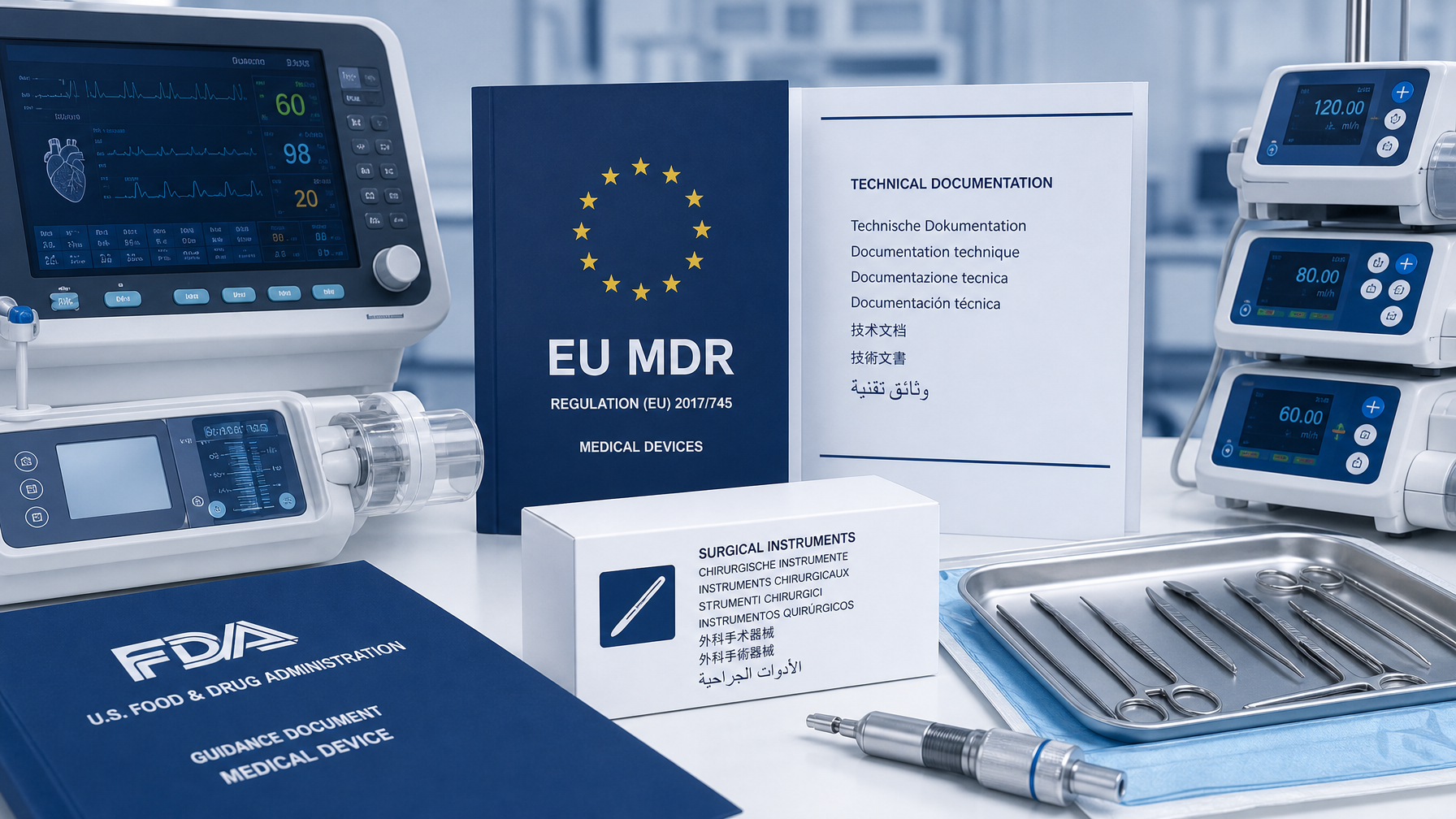
Medical Device Labelling Translation: Language Requirements, Symbols and Regulatory Compliance
Key Takeaways
- Medical device labelling must appear in the official language or languages of each country where the device is placed on the market — this is a legal requirement, not a commercial preference.
- Under EU MDR 2017/745, labels and IFUs must be provided in all official languages of the EU member states where the device is sold. For pan-European distribution, this means up to 24 languages.
- ISO 15223-1 symbols provide a standardised set of graphical symbols for medical device labelling that reduce the need for translated text on labels — but symbols must be used correctly and consistently with the applicable standard.
- Label space is a significant constraint in medical device translation — translated text is typically longer than English source text for European languages, requiring DTP adjustment to maintain legibility within the original label design.
- Translation errors on medical device labels create patient safety risks and regulatory compliance failures — human translation with expert review under ISO 17100 is the required standard.
Medical device labelling encompasses everything that accompanies a device: the physical label on the device or its packaging, the Instructions for Use (IFU), outer packaging text, and any quick reference guides or patient information materials. Each of these must be available in the language or languages required by the regulatory framework governing the markets where the device is sold.
Table of Contents
ToggleThis guide covers the language requirements for key markets, the role of ISO symbols in reducing translation volume on labels, and the specific translation and DTP challenges that arise in medical device labelling projects.
Language requirements by market
European Union — EU MDR 2017/745 and IVDR 2017/746
Under EU MDR, the label and IFU for a medical device must be provided in the official language or languages of the EU member states where the device is made available. A device distributed across all 27 EU member states requires labelling in up to 24 official languages (some member states share official languages).
Manufacturers frequently use a combination of strategies to manage this volume:
- Multi-language labels — a single label containing required information in multiple languages, typically used for high-volume consumer devices where label space permits
- Language-specific labels — separate labels for each market, allowing full information in each language without space constraints
- Symbol-based labels with translated IFUs — minimising label text by using ISO 15223-1 symbols for common information, with full translated IFUs provided separately
The IFU has fewer physical space constraints than the label itself, which is why many manufacturers invest significant translation effort in IFU accuracy while using symbols to reduce text on the label.
United Kingdom — UKCA marking post-Brexit
Following Brexit, medical devices placed on the UK market require UKCA marking and must comply with UK Medical Devices Regulations 2002 (as amended). Labelling for the UK market must be in English. Devices previously CE-marked for EU distribution require separate UK labelling to comply with UKCA requirements.
United States — FDA 21 CFR Part 801
Device labelling for the US market must be in English. Bilingual labelling (English plus another language) is permitted where consistent. See our separate guide on FDA translation requirements for full detail on US labelling obligations.
Japan — PMDA
Devices sold in Japan require Japanese-language labelling compliant with PMDA requirements. Japanese labelling requirements include specific information fields and formatting requirements that differ from EU and US equivalents. Japanese text is typically 40 to 60 per cent shorter than the English equivalent, which affects label layout.
China — NMPA
Devices sold in China require Chinese-language labelling approved by the National Medical Products Administration (NMPA). NMPA registration requires Chinese-language product documentation and labels as part of the registration dossier.
ISO 15223-1 symbols in medical device labelling
ISO 15223-1 defines a library of graphical symbols for use on medical device labels and IFUs. These symbols convey information that would otherwise require translated text — reducing the volume of language-specific content required on the physical label.
Common ISO 15223-1 symbols include:
- The hourglass symbol for "use by" date
- The snowflake symbol for temperature storage limits
- The two-digit number in a circle for "do not use if package is damaged"
- The caduceus-style symbol indicating prescription-only use
- The recycling and disposal symbols
Using symbols correctly reduces the amount of translated text that must appear on the physical label, which is particularly valuable where label dimensions are fixed and space is constrained. However, symbols must be used in accordance with the applicable standard version and cannot be invented or modified — a non-standard symbol used in place of translated text creates a regulatory compliance issue rather than solving one.
Where symbols are used, the IFU must still provide a full explanation of each symbol in the required languages. The symbol reduces text on the label; it does not eliminate the translation obligation for the IFU.
Translation and DTP challenges in medical device labelling
Text expansion
English text translated into most European languages becomes longer. German translations of English medical device labels are typically 25 to 35 per cent longer. French and Spanish are typically 15 to 25 per cent longer. Italian is similar. For a label with fixed physical dimensions — printed on a device or its packaging — this expansion has nowhere to go unless the DTP team adjusts font sizes, tracking, or layout to accommodate the longer translated text while maintaining legibility.
This is why medical device labelling translation projects require in-house multilingual DTP alongside translation. A translation delivered as a Word document or plain text file, without DTP rework in the original label design software, is not a print-ready label.
Right-to-left languages
Arabic and Hebrew labels require full layout reconstruction to accommodate right-to-left text direction. This affects not just the text alignment but the overall visual flow of the label — a label designed for left-to-right reading must be mirrored for right-to-left markets.
Japanese and Chinese
CJK labels require specific fonts and character spacing that differ from Latin-script typesetting. Japanese text contracts significantly relative to English — a label designed for English text proportions will have excessive white space in the Japanese version. The DTP team adjusts spacing and layout to maintain visual balance.
Multi-language labels
Labels containing the same information in multiple languages simultaneously must present each language clearly, without the label becoming visually cluttered or difficult to read. This requires careful DTP management of column structures, font sizes, and the visual hierarchy between languages.
Terminology consistency
Medical device labelling uses highly specific technical and regulatory terminology that must be consistent across every language version. The same anatomical term, device component name, or safety instruction must be translated identically wherever it appears — on the label, in the IFU, and in any accompanying documentation. A project-specific glossary and translation memory, maintained across the full labelling set, is the practical mechanism for achieving this.
The cost of labelling translation errors
A translation error on a medical device label is not a cosmetic issue. Labelling is the primary safety communication between the device and the person using it. An error in a warning, a contraindication, or a storage instruction has direct patient safety implications.
From a regulatory standpoint, a labelling translation error identified during a PMDA inspection, an EU MDR conformity assessment, or an FDA audit may require corrective action — including label withdrawal and replacement, which involves significant cost, delays, and potential market suspension.
Human translation with expert review under ISO 17100-certified processes is the standard required for medical device labelling. This means translation by a qualified subject-matter expert and independent review by a second qualified linguist — not machine translation, not bilingual non-specialist review.
Global LTS provides medical device translation services for labelling, IFUs, and regulatory documentation across 120+ languages, with in-house multilingual DTP for print-ready label delivery. Contact us to discuss your labelling translation project.
For related reading, see our guides on FDA translation requirements for medical devices and IVDR translation requirements.