
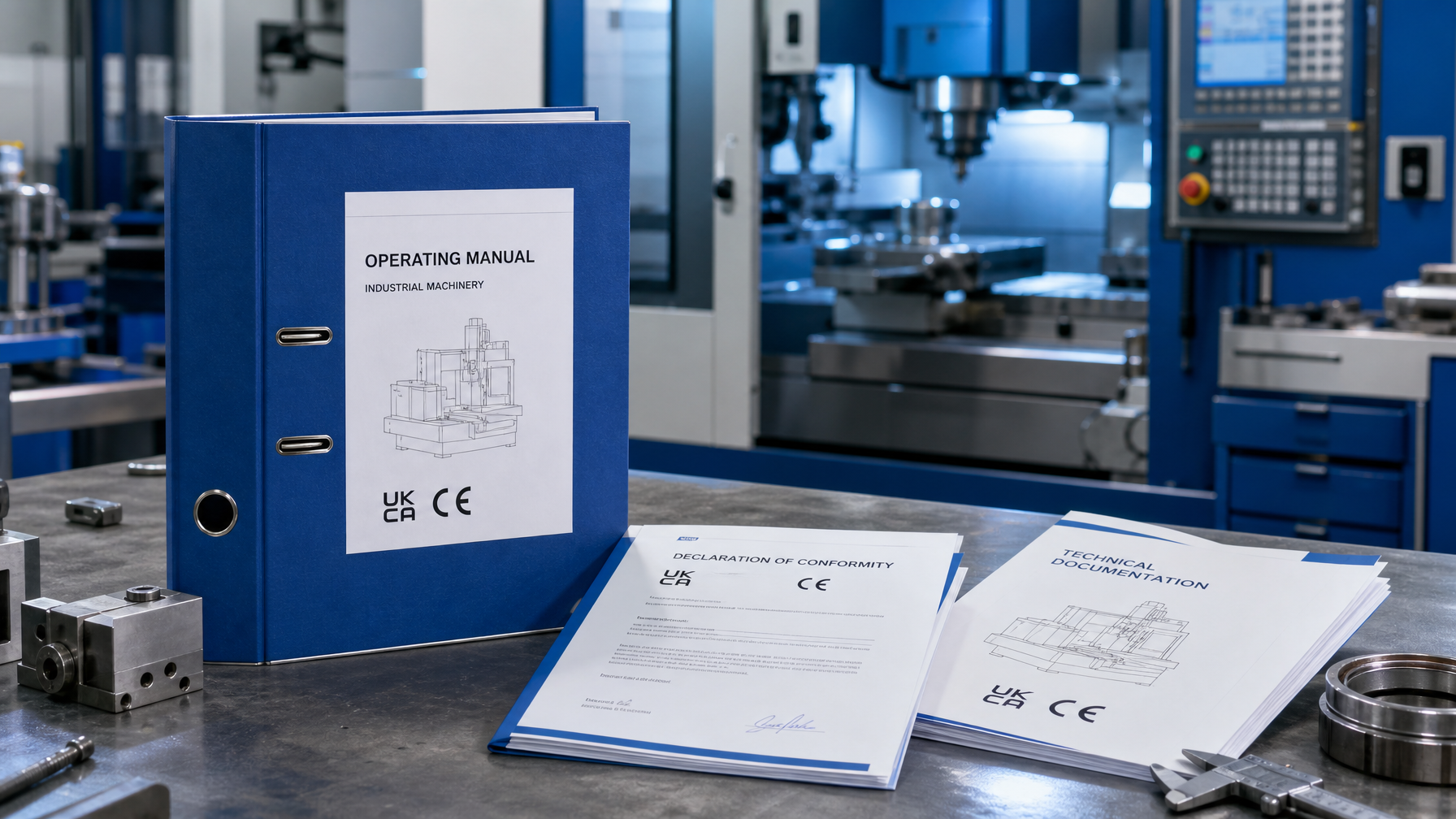
Translating UKCA and CE Marking Technical Documentation for Machinery Exporters
Key Takeaways
- Machinery and industrial equipment exported from the UK to the EU (or imported into the UK) must satisfy strict regulatory compliance frameworks under the EU Machinery Regulation and UKCA marking rules.
- Mandatory compliance files. Including Declarations of Conformity, Technical Construction Files (TCF), Risk Assessments, and Operating Manuals. Must be translated into the official language of each destination market.
- Under EU law, operating instructions and safety warnings must accompany the machine in the official language of the user's country before the equipment can be placed on the market.
- Inaccurate translation of safety alerts, hazard symbols, or operating limits creates severe legal liability, exposure to regulatory fines, and risk of industrial workplace injury.
- ISO 17100:2015 certified engineering translation guarantees that technical safety documentation meets international safety directives (e.g., ISO 12100).
For UK machinery manufacturers, industrial equipment exporters, and engineering firms, expanding sales across Europe and global markets requires total compliance with statutory safety standards. Following Brexit, manufacturers placing goods on both the UK and European markets must navigate two parallel regulatory compliance regimes: UKCA marking in Great Britain and CE marking (under the new EU Machinery Regulation 2023/1230) in the European Union.
Table of Contents
ToggleA central requirement of both UKCA and CE marking compliance is providing accurate, fully translated technical documentation in the official language of each destination territory.
This guide explores the mandatory translation requirements for machinery compliance, details key technical files, and outlines risk mitigation strategies for engineering exporters.
The Legal Requirement: Translating Machinery Documentation
Under the EU Machinery Directive 2006/42/EC and the EU Machinery Regulation (EU) 2023/1230 (which becomes mandatory in January 2027), placing industrial machinery on the European market requires providing operating instructions in the official language of the destination country:
1. Mandatory Local Language Manuals
Article 10 of the Machinery Regulation explicitly mandates that all machinery must be accompanied by instructions and safety information written in a language easily understood by end-users, as determined by the target EU member state. Selling machinery into Germany, France, Italy, or Spain with English-only manuals violates EU law.
2. EU Declaration of Conformity
The official Declaration of Conformity (DoC) signed by the manufacturer must be translated into the official language of the country where the machinery is placed on the market or put into service.
Key Compliance Documents That Require Technical Translation
- Original Operating and Maintenance Instructions: Step-by-step user guides detailing machine installation, commissioning, operation, routine maintenance, and decommissioning.
- Safety Documentation & Hazard Warnings: Machinery safety alerts, emergency stop procedures, noise emission disclosures, and personal protective equipment (PPE) rules.
- Technical Construction Files (TCF): Engineering risk assessments (ISO 12100), circuit diagrams, structural calculations, and component test certificates.
- Declarations of Conformity & Incorporation: Legal attestations certifying compliance with relevant directives (e.g., Low Voltage Directive, EMC Directive, ATEX Directive).
- Control Panel Software UI & Warning Labels: Physical machine danger labels, warning plates, and digital HMI (Human-Machine Interface) touchscreen text.
The Danger of Poor Compliance Translation
Treating regulatory translation as an afterthought or relying on generic machine translation introduces severe risks:
- Workplace Injury and Liability: If a factory operator misinterprets an emergency lock-out/tag-out (LOTO) procedure due to a mistranslated safety manual, the manufacturer faces severe legal liability under international product safety laws.
- Customs & Market Border Hold-Ups: EU customs authorities and market surveillance bodies conduct spot audits on imported industrial machinery. Missing or improperly translated Declarations of Conformity result in shipment impoundment at border ports.
- Invalidated Insurance Coverage: Commercial product liability insurance policies often require full statutory compliance. Delivering uncertified or inaccurate technical manuals can void insurance protection in the event of an industrial accident.
Best Practices for Briefing Machinery Compliance Projects
- Supply Source Files (InDesign / XML): Provide original layout files so DTP teams can format localized manuals with identical hazard symbols, callout boxes, and warning icons.
- Build Terminology Memory Glossaries: Leverage software like MemoQ to lock in standard machinery terms across multi-language product families.
- Mandatory ISO 17100 Proofreading: Ensure every compliance file undergoes independent two-tier human review by qualified mechanical and safety engineering linguists.
Global LTS delivers ISO 17100:2015 certified engineering and compliance translation services for UK machinery exporters, industrial equipment manufacturers, and engineering consultancies across 120+ languages.
To discuss your UKCA and CE marking translation requirements or request a free quote, contact our technical team today or visit our engineering translation services page.