
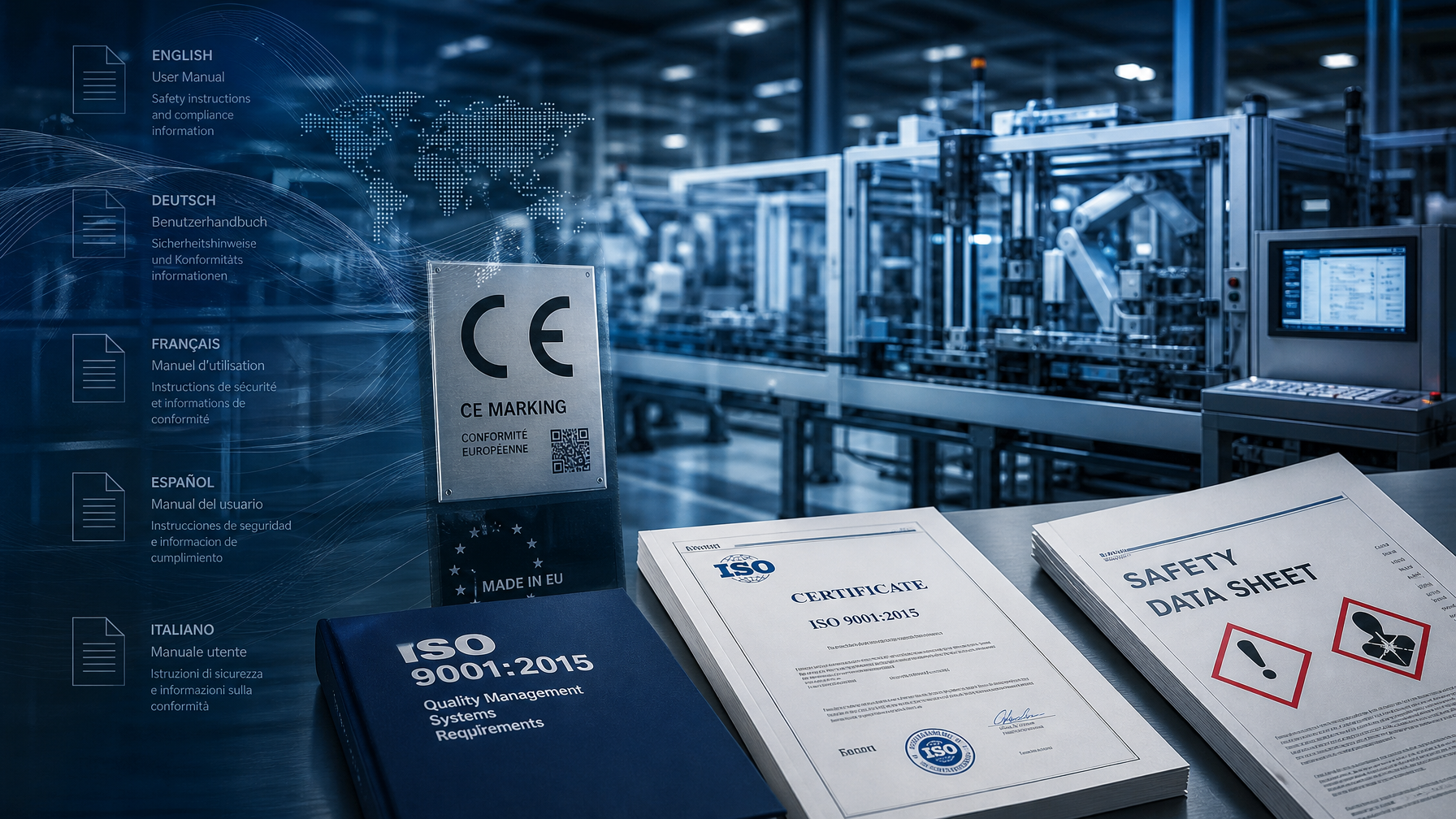
CE Marking Translation Requirements: What UK Manufacturers Need to Know
Key Takeaways
- CE marking is required for products placed on the EU market in regulated product categories. It signals conformity with the applicable EU directives or regulations.
- CE marking documentation — declarations of conformity, technical files, and instructions for use — must be available in the official language or languages of each EU member state where the product is placed on the market.
- UKCA marking is the equivalent conformity marking for products placed on the Great Britain market (England, Scotland, and Wales). UKCA documentation must be in English.
- Instructions for use are the most translation-intensive element of CE marking compliance — for a product distributed across the full EU, instructions may be required in up to 24 official EU languages.
- The declaration of conformity and instructions for use are legal documents — translation errors that result in inaccurate conformity claims or incorrect user instructions create both regulatory compliance failures and product liability risk.
For UK manufacturers exporting products to the EU, or EU manufacturers placing products on the UK market, CE marking and UKCA marking generate specific translation obligations that must be met before a product can legally be sold. These are not administrative formalities — they are legal requirements with direct implications for market access, regulatory compliance, and product liability.
Table of Contents
ToggleThis guide covers the translation requirements that arise from CE marking, what documents are affected, and what effective conformity marking translation requires.
What is CE marking?
CE marking (Conformité Européenne) is a mandatory conformity marking for products placed on the EU market in regulated categories. The mark signals that the product meets the applicable EU legislation governing safety, health, environmental protection, and consumer protection.
CE marking applies to a wide range of product categories governed by specific EU directives and regulations, including:
- Machinery (Machinery Directive 2006/42/EC, being replaced by Machinery Regulation EU 2023/1230)
- Electrical equipment (Low Voltage Directive 2014/35/EU)
- Electromagnetic compatibility (EMC Directive 2014/30/EU)
- Pressure equipment (Pressure Equipment Directive 2014/68/EU)
- Personal protective equipment (PPE Regulation EU 2016/425)
- Medical devices (EU MDR 2017/745 and IVDR 2017/746)
- Construction products (Construction Products Regulation EU 305/2011)
- Radio equipment (Radio Equipment Directive 2014/53/EU)
- Toys (Toy Safety Directive 2009/48/EC)
For each applicable directive or regulation, the manufacturer must demonstrate conformity through a technical file, issue a declaration of conformity, and affix the CE mark to the product.
What is UKCA marking?
UKCA (UK Conformity Assessed) marking is the equivalent conformity marking for products placed on the Great Britain market (England, Scotland, and Wales) following Brexit. It applies to most products that previously required CE marking for UK market access.
UKCA documentation must be in English. Products sold in both the EU and Great Britain require both CE and UKCA marking documentation, maintained separately.
Northern Ireland has a different arrangement: under the Windsor Framework, CE marking continues to apply for products placed on the Northern Ireland market alongside UKCA.
CE marking documents that require translation
Declaration of Conformity
The declaration of conformity (DoC) is the formal statement by the manufacturer that the product meets the requirements of the applicable directive or regulation. It includes the manufacturer's name and address, product identification, the applicable directive or regulation and harmonised standards applied, and the authorised signatory.
EU legislation does not always specify that the DoC must be in the language of the market. However, many EU member states require or strongly expect the DoC to be in the national language, and distributors and importers in those markets typically require a translated DoC before placing the product on sale. For products distributed across multiple EU markets, providing the DoC in the relevant language of each market is standard practice.
Instructions for Use
Instructions for use are the most clearly defined translation requirement in CE marking legislation. Most EU product directives explicitly require that instructions for use accompanying a product be in the official language or languages of the member state where the product is placed on the market. This requirement is stated in:
- Machinery Directive: instructions must be in the official language or languages of the member state
- Low Voltage Directive: instructions must be in the official language or languages
- PPE Regulation: instructions must be in the official language or languages
- Medical Devices (EU MDR): label and IFU must be in the official language or languages
For a product distributed across all 27 EU member states, instructions for use may be required in up to 24 official EU languages. For a product distributed in France, Germany, Spain, Italy, and Poland, five language versions are required.
Technical File
The technical file contains the full technical documentation supporting the conformity assessment — design drawings, risk assessments, test reports, calculations, and where applicable, third-party test certificates. Technical files are typically maintained in one working language (usually English) and presented to Notified Bodies in that language.
Where a Notified Body operates in a different language, or where the technical file must be shared with a national market surveillance authority that requires documents in the national language, translation of some or all technical file content may be required.
Labels and Packaging
Product labels and packaging for CE-marked products must comply with the applicable directive's labelling requirements. Where labelling information — safety warnings, operating parameters, disposal instructions — must appear in the official language of the target market, label translation is required alongside the instructions.
Common CE marking translation challenges
Volume management across multiple markets
A manufacturer distributing a CE-marked product across 15 EU member states may need instructions for use in 12 or more languages simultaneously, for a new product launch. Managing this volume — ensuring consistency across all language versions, maintaining a single authorised source document, and handling updates when the instructions change — requires a coordinated translation approach rather than ad hoc commissioning per market.
Technical accuracy in safety-critical content
Instructions for use for machinery, electrical equipment, and personal protective equipment contain safety-critical information: operating limits, hazard warnings, emergency procedures, and disposal instructions. A translation error that results in a user misunderstanding a safety instruction creates both a regulatory compliance failure and a product liability risk. Technical accuracy and native-language fluency in the target language are both required.
Keeping translations current with product updates
When a product is updated — a revised operating procedure, a new safety warning, a changed specification — the instructions for use must be updated and reissued in all required languages. Translation memory ensures that only the changed content requires retranslation, with unchanged segments applied from the approved memory. Without translation memory, every update requires a full retranslation at full cost.
Machinery Regulation transition
The EU Machinery Directive 2006/42/EC is being replaced by the Machinery Regulation EU 2023/1230, which applies from January 2027. The new regulation introduces updated documentation requirements that will affect the content and structure of technical files and instructions for use. Manufacturers currently preparing CE marking documentation for machinery should ensure their translation arrangements can accommodate the regulatory transition.
Global LTS provides manufacturing translation services for CE and UKCA marking documentation, including declarations of conformity, instructions for use across multiple EU languages, and technical file content. Contact us to discuss your CE marking translation requirements.
For related reading, see our guides on IATF 16949 and ISO 9001 translation and safety data sheet translation and REACH compliance.