
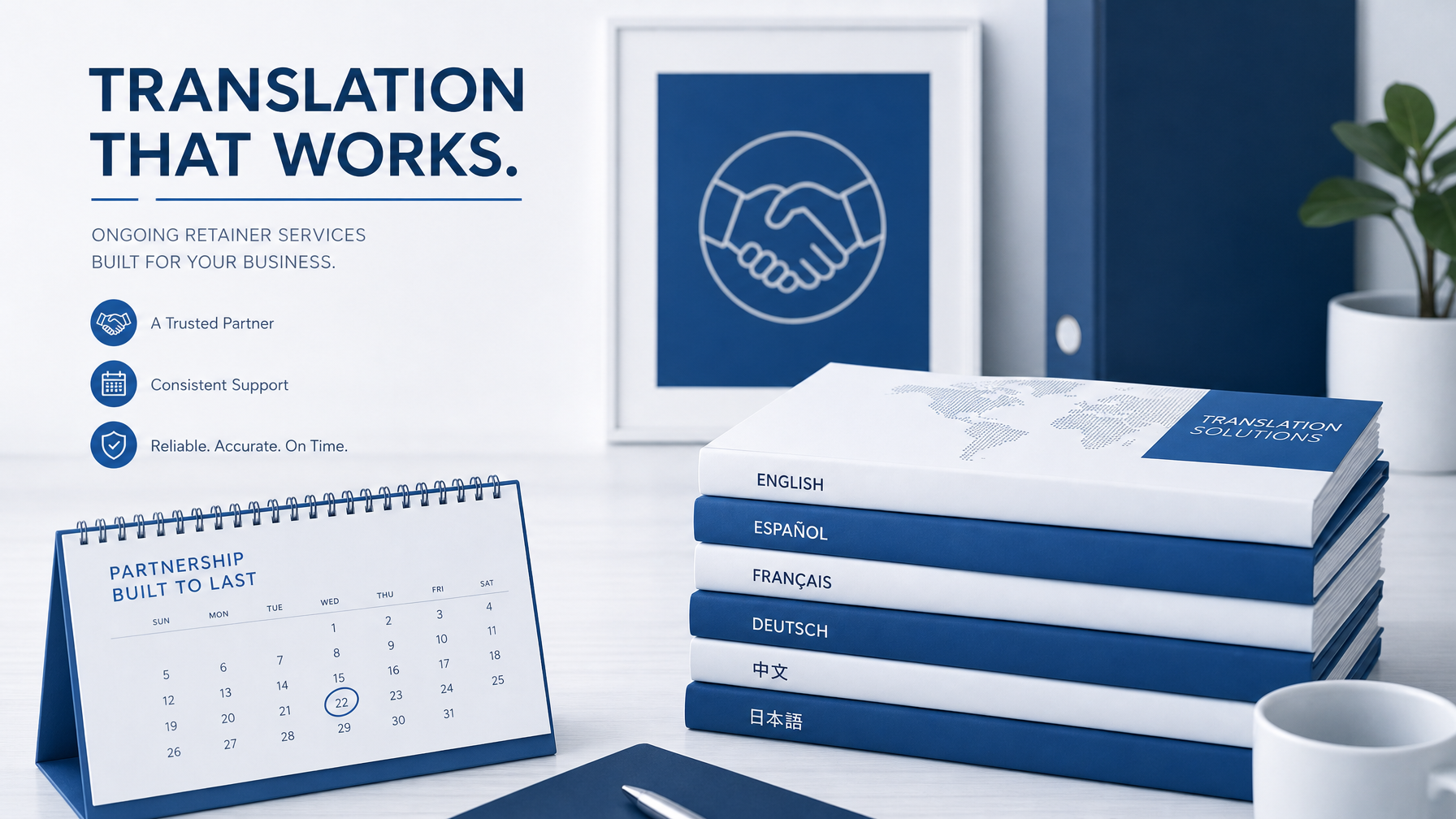
Translation Retainer vs Pay-Per-Project: Which Model Saves More Money?
Key Takeaways
- Pay-per-project translation is appropriate for businesses with irregular, unpredictable translation needs — one-off documents, occasional campaigns, or infrequent requirements.
- A translation retainer saves money for businesses that translate regularly, through lower per-word rates, elimination of quoting overhead, and reduced internal approval time.
- The cost comparison between the two models goes beyond per-word rates — it must account for the internal staff time spent on quoting, PO processes, briefing new translators, and managing quality inconsistencies.
- Translation memory reduces costs in both models, but the benefit compounds under a retainer because the memory grows faster and applies more consistently across a dedicated team.
- For most businesses with monthly or quarterly translation needs, a retainer produces lower total cost of translation over a 12-month period than commissioning the same volume project by project.
For businesses that translate regularly, one of the most practical decisions is how to structure the commercial relationship with their translation agency. The two main options are pay-per-project — commissioning and pricing each piece of work individually — and a retainer arrangement, where volume, rates, and turnaround are agreed in advance for an ongoing period.
Table of Contents
ToggleBoth models work. The question is which produces better outcomes for a given business, and the answer depends on how frequently you translate, how much internal overhead your current process creates, and how much you value consistency in your translated output.
How pay-per-project translation works
In a pay-per-project model, each translation requirement is treated as a standalone commission. You submit files, the agency analyses the word count and complexity, issues a quote, and you approve and proceed. Turnaround is agreed per project based on scheduling availability at the time.
Advantages of pay-per-project:
- No commitment required — suitable for businesses with occasional or unpredictable translation needs
- Full flexibility on volume, language combinations, and subject matter from one project to the next
- No minimum spend or contracted volume
Disadvantages of pay-per-project:
- Higher per-word rates than retainer pricing, because the agency prices each project independently without volume certainty
- Quoting and approval delay on every project — even a same-day quote adds hours or days before work can begin
- No guarantee of the same translators across projects — consistency of terminology and style depends on agency processes rather than dedicated assignment
- Translation memory benefits accumulate more slowly when different translators work on the same client's content across separate projects
How a translation retainer works
A translation retainer is a pre-agreed arrangement covering an expected volume of work over a defined period. Rates, turnaround SLAs, and translator assignments are fixed at the outset. Work is submitted without a quoting stage, begins immediately, and is delivered within the agreed SLA.
Advantages of a translation retainer:
- Lower per-word rates in return for volume commitment
- No quoting or approval delay per project — work starts on receipt of files
- Dedicated translator team builds deep familiarity with your content, terminology, and brand voice
- Translation memory grows faster and applies more consistently across a dedicated account team
- Predictable costs for budgeting and financial planning
Disadvantages of a translation retainer:
- Requires a volume commitment — less suitable for businesses with genuinely irregular needs
- Rates and terms are fixed for the period — if requirements change significantly, renegotiation may be needed
The real cost comparison
The most common mistake in comparing these two models is to look only at per-word rates. The true cost of translation in a pay-per-project model includes:
Internal staff time — every project requires someone to brief the agency, exchange emails, review the quote, raise a purchase order, and manage delivery. Across a year of regular translation work, this administrative overhead accumulates. A retainer eliminates most of it.
Delay costs — if urgent translation projects are held up by quoting and approval processes, the cost is not just time. Marketing campaigns miss deadlines. Product launches are delayed. Regulatory submissions are late. These delays have commercial consequences that do not appear in a per-word rate comparison.
Quality inconsistency — when different translators work on the same client's content across separate projects, terminology inconsistency accumulates. Fixing inconsistencies — either through correction rounds or through damage to brand consistency in published materials — has a cost that is rarely quantified but is real.
Translation memory underutilisation — translation memory is most valuable when a consistent team applies it consistently. In a fragmented per-project model, the memory may exist but its application is less systematic. Repeated content that should match previous translations may not do so if a new translator is not working from the same memory.
Which model is right for your business?
Pay-per-project is the right choice if:
- You translate occasionally — a few times a year or less
- Your translation requirements are genuinely unpredictable in volume and subject matter
- You have no regular content type that repeats across multiple projects
A retainer is the right choice if:
- You translate monthly or more frequently
- You have a consistent content type — marketing materials, technical documentation, legal content, training materials — that repeats regularly
- Internal quoting and approval processes are creating delays or administrative burden
- Terminology consistency across your multilingual content matters to your brand or compliance requirements
- You want predictable translation costs for budgeting purposes
For most businesses that translate on a regular cycle, the combination of lower rates, eliminated quoting overhead, faster turnaround, and improved consistency means a retainer produces lower total cost over a 12-month period than the same volume commissioned project by project.
Global LTS offers translation retainer arrangements for businesses across all sectors. Contact us to discuss your translation volumes and get a retainer quote.
For related reading, see our overview of how a translation retainer works and our guide on how to manage ongoing translation requirements.