
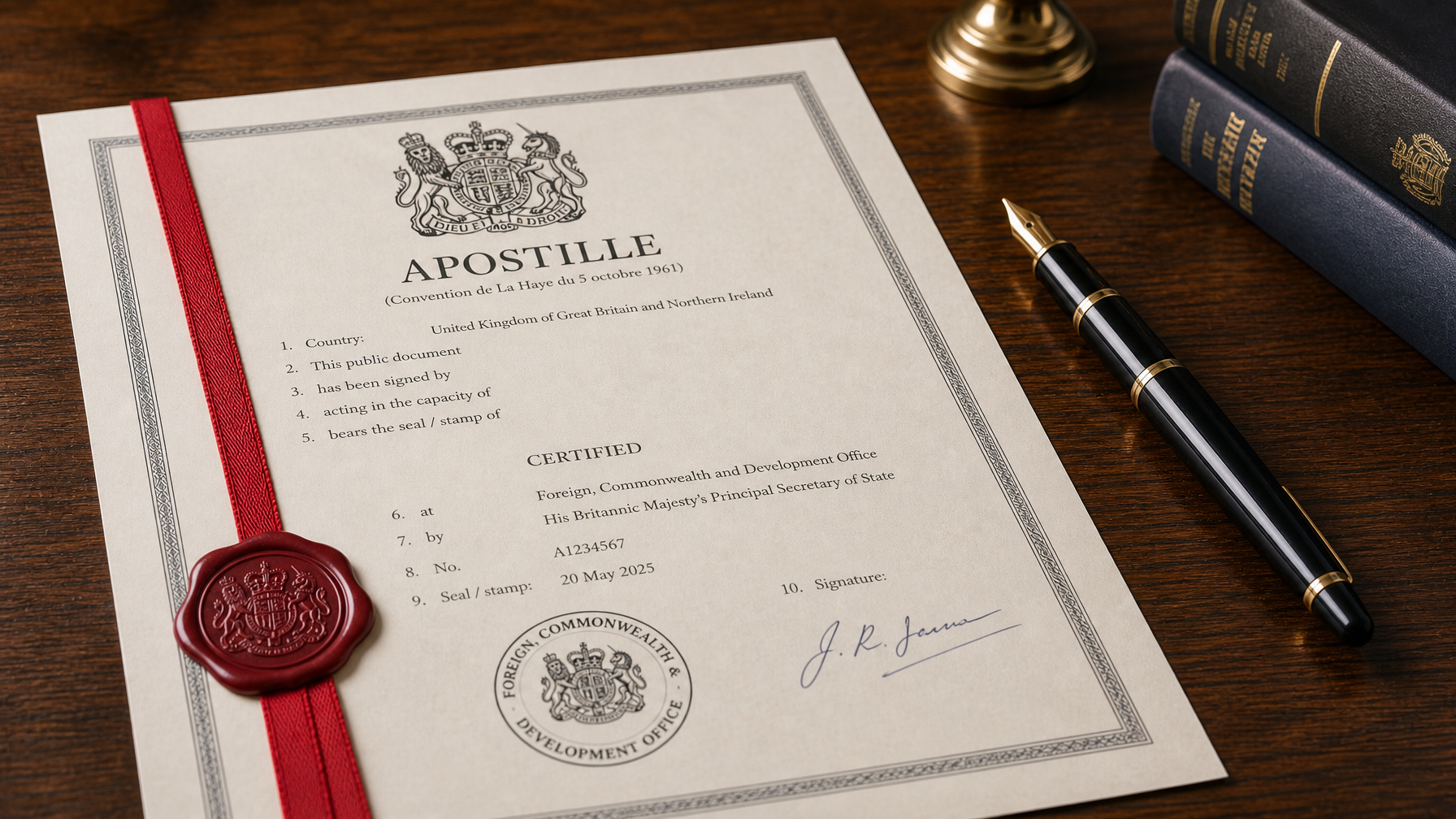
How to Get an Apostille in the UK: A Step-by-Step Guide
Key Takeaways
- An apostille is an official authentication stamp issued by the UK Foreign, Commonwealth and Development Office (FCDO) that makes UK documents legally recognised in 120+ countries signed up to the Hague Convention.
- The FCDO will only apostille certain types of documents — primarily public documents that bear an official UK signature or seal, such as birth certificates, court orders, notarised documents, and degree certificates signed by a university registrar.
- If your document needs to be translated before it can be used abroad, the translation itself must be notarised before the FCDO will apostille it.
- Standard FCDO turnaround is currently 4–6 weeks by post. A same-day premium service is available in person at the FCDO Legalisation Office in Milton Keynes.
- For documents that require both translation and apostille, working with a single provider that manages the full process — translation, notarisation, and FCDO submission — saves time and reduces the risk of errors between steps.
An apostille is required whenever a UK document needs to be legally recognised in another country that is a member of the Hague Apostille Convention. Without it, foreign authorities — notaries, land registries, courts, universities, immigration departments — have no standardised way to verify that a UK document is genuine. This guide sets out exactly how the process works, what it costs, and what to watch out for.
Table of Contents
ToggleWhat Is an Apostille?
An apostille is a certificate attached to a document — either physically or electronically — that authenticates the signature, seal, or stamp it bears. It does not verify the content of the document. It confirms that the document was issued by a recognised UK authority and that any signature on it is genuine.
In the UK, apostilles are issued exclusively by the FCDO Legalisation Office. The apostille takes the form of a standardised square stamp or certificate attached to the document, meeting the format requirements set out in the Hague Convention of 1961.
Which Documents Can Be Apostilled?
The FCDO will only apostille documents that bear a recognised UK official signature or seal. The most common eligible documents include:
- Birth, marriage, and death certificates issued by the General Register Office or local register offices
- Court orders and judgments issued by UK courts
- Notarised documents — any document that has been signed before a UK notary public
- Degree certificates and transcripts — provided they are signed by a university registrar or bear the university's official seal
- Companies House documents — certificates of incorporation, memoranda and articles of association
- DBS (criminal record) certificates
- Powers of attorney — after notarisation
Documents that have not been signed or sealed by a recognised UK authority — for example, privately prepared contracts, personal letters, or medical reports signed by a private doctor — generally cannot be apostilled directly. They typically need to be notarised first, which then makes the notary's signature eligible for apostille.
The Step-by-Step Process
Step 1: Establish What the Receiving Country Requires
Before starting the process, confirm with the relevant authority in the receiving country — the notary, the government office, the employer, or the immigration authority — exactly what they need. Some countries require the original document to be apostilled. Others require a certified translation of the document to be apostilled. Some require both. The requirements vary by country and by document type, and getting this wrong means starting the process again.
Step 2: Obtain the Certified Translation (if required)
If the receiving authority requires a translation — which is common for personal status documents, powers of attorney, and corporate documents — the translation must be completed by a qualified translator before the apostille process begins. The translation is accompanied by a signed Certificate of Accuracy from the translator.
Step 3: Notarise the Document (if required)
If you are apostilling a translation, or a document that does not already carry an official UK signature or seal, it must first be signed before a UK notary public. The notary verifies the identity of the person presenting the document and the authenticity of the signature. The notarised document then carries the notary's signature, which the FCDO recognises for apostille purposes.
Step 4: Submit to the FCDO
The notarised document is submitted to the FCDO Legalisation Office. Submission options:
- Postal service: Submit by post to the FCDO Legalisation Office. Current standard turnaround is 4–6 weeks. The FCDO charges a fee per document apostilled.
- Premium same-day service: Available in person at the FCDO Legalisation Office in Daventry, Northamptonshire (previously Milton Keynes — check current FCDO guidance for the latest address). This is significantly more expensive but appropriate for urgent requirements.
- Online/e-Apostille: The FCDO has introduced an electronic apostille service for certain digitally signed documents. Check the FCDO Legalisation Office guidance for current eligibility.
Step 5: Receive and Use the Apostilled Document
Once processed, the FCDO returns the document with the apostille attached. The apostilled document is then ready for use in any of the 120+ Hague Convention signatory countries. No further authentication by the country's embassy or consulate is required — the apostille is sufficient.
Common Mistakes to Avoid
Apostilling the wrong document. If the receiving authority wants the original birth certificate apostilled but you apostille a certified copy, the document may be rejected. Confirm which version — original or certified copy — the authority requires.
Skipping the notarisation step. Translations and privately prepared documents must be notarised before the FCDO will apostille them. Submitting a translation without prior notarisation will result in the document being returned.
Not checking whether the receiving country is a Hague Convention member. If the destination country is not a signatory to the Hague Convention, an apostille is not the correct authentication route. Countries outside the Convention — including some in the Middle East, Asia, and Africa — require a different process known as legalisation through the relevant country's embassy.
Starting the translation after the apostille. If both a translation and an apostille are needed, the sequence matters: translate first, notarise the translation, then submit for apostille.
Conclusion
The UK apostille process is straightforward once the sequence is clear: confirm requirements, translate if needed, notarise, submit to the FCDO, and receive the stamped document. The most common source of delay is starting the process in the wrong order or submitting documents that are not yet eligible for apostille.
Global LTS manages the full apostille translation process — translation, notarisation, and FCDO submission — as an integrated service. See our apostille translation services page for details, or contact us to discuss your specific document requirements. For documents intended for UK authorities rather than foreign ones, see our certified translation services.