
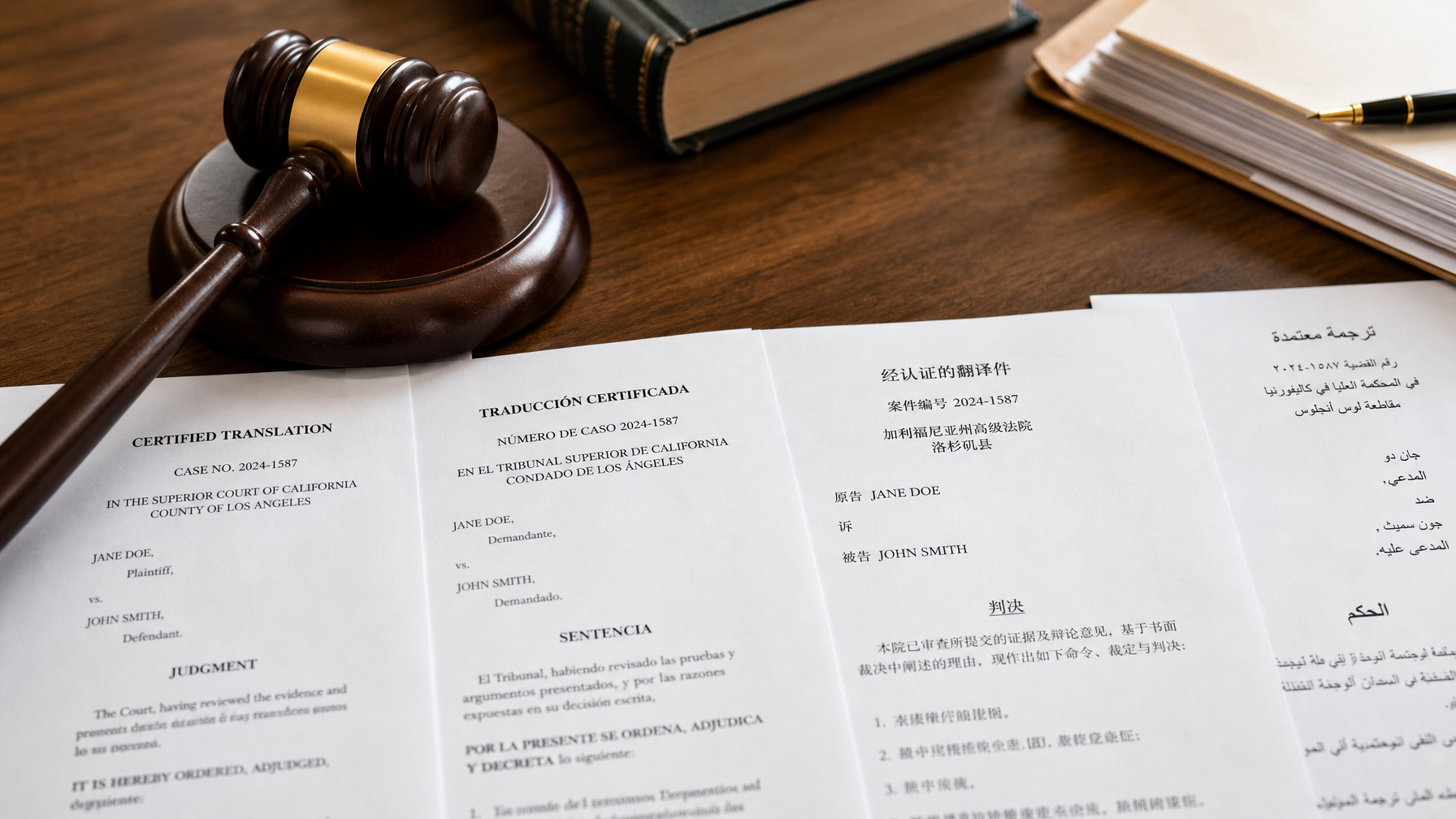
Legal Translation for UK Court Proceedings: What Documents Need Translating and When
Key Takeaways
- UK courts require that any foreign-language document submitted as evidence is accompanied by an accurate English translation — untranslated documents are generally inadmissible.
- The Civil Procedure Rules set out requirements for document service across jurisdictions, including when translations are needed for documents served outside England and Wales.
- Documents commonly requiring translation in UK court proceedings include witness statements, contracts, correspondence, corporate records, and foreign court judgments.
- The translator does not need to be court-certified in England and Wales, but the translation must be accurate and the translator should be competent in both legal systems and languages involved.
- Getting translation wrong at the court stage — whether through inaccuracy, omission, or wrong register — can affect the outcome of a case and cause costly delays.
When a legal dispute crosses language boundaries, translation stops being a formality and becomes a matter of legal procedure. UK courts operate in English, and any document in another language that a party wishes to rely on must be translated before it can be considered as evidence or submitted as part of proceedings.
Table of Contents
ToggleWhen Is Legal Translation Required in UK Court Proceedings?
The general rule is straightforward: if a document is in a language other than English and a party wants to use it in court — as evidence, as an exhibit, or as part of a submission — an English translation must accompany it.
Under the Civil Procedure Rules (CPR), when documents are served on parties outside England and Wales, translations may also be required depending on the jurisdiction. CPR Part 6 addresses service out of the jurisdiction and sets out when a translation of the claim form and accompanying documents is needed for the party being served.
Beyond service requirements, Practice Direction 32 on evidence sets out requirements for witness statements and exhibits. Any exhibit that is in a foreign language should be accompanied by a translation, and the translator should confirm the accuracy of the translation.
Which Documents Commonly Require Translation
The range of documents that arise in cross-border litigation is broad. The most common categories include:
Contracts and agreements. Where a dispute centres on the interpretation of a contract drafted in a foreign language, or where the governing law of the contract is that of another jurisdiction, an accurate translation of the contract — including all schedules, annexures, and amendments — is essential. Mistranslation of a single contractual term can change the meaning of an obligation or a limitation of liability clause entirely.
Witness statements and affidavits. Where a witness provides a statement in their native language, an English translation must be prepared before the statement is filed. The translation should reflect the register and tone of the original — witness statements have a specific formal character in English proceedings that the translation should mirror.
Corporate documents. Company registers, board resolutions, articles of association, and share certificates from foreign-registered entities frequently arise in commercial litigation and insolvency proceedings. These documents often contain technical legal and corporate terminology specific to the jurisdiction of incorporation.
Correspondence and communications. Emails, letters, and internal documents in foreign languages may be submitted as exhibits. The full thread should be translated, not just selected messages, to avoid accusations of selective presentation.
Foreign court judgments and orders. Where a party seeks to enforce a foreign judgment in England and Wales, or where a foreign court order is relevant to the proceedings, an accurate translation of the judgment, including all operative parts and the court's reasoning, is required.
Regulatory and compliance documents. In proceedings involving regulated entities — financial services, pharmaceuticals, healthcare — foreign regulatory filings, inspection reports, or compliance records may need to be translated and submitted as evidence.
What the Translation Must Achieve
A legal translation for court use must do more than convert words from one language to another. It must:
- Accurately reflect the meaning of the original, including any ambiguities that exist in the source text (a translation that resolves an ambiguity that the original leaves open changes the document)
- Use the correct legal register and terminology for the type of document being translated
- Be consistent in terminology throughout, particularly for defined terms in contracts
- Carry a statement from the translator confirming accuracy and their competence to translate the document
In England and Wales, there is no single official accreditation body whose membership is a mandatory requirement for court translation — unlike some other jurisdictions. However, translators working on court documents should have demonstrable expertise in legal translation and ideally familiarity with both the source and target legal systems.
The Risk of Getting It Wrong
An inaccurate translation submitted to court carries real consequences. If the opposing party challenges the translation and the challenge is upheld, the document may be given less weight, or the court may order a fresh translation — adding cost and delay to the proceedings. In serious cases, a demonstrably inaccurate translation can affect credibility.
The more significant risk is subtler: a translation that is technically accurate word-for-word but misses the legal meaning of a term. Legal systems use the same words differently. "Good faith" in English law does not carry the same substantive meaning as bonne foi in French law or Treu und Glauben in German law. A translator who renders the term literally without recognising the legal significance of the difference produces a translation that is accurate in one sense and misleading in another.
Conclusion
Legal translation for UK court proceedings requires accuracy, legal knowledge, and an understanding of the procedural context in which the documents will be used. The stakes — admissibility, credibility, and the outcome of the case — make it a poor area for cost-cutting.
Global LTS provides legal translation services for UK court proceedings, commercial litigation, and cross-border dispute resolution, including contracts, witness statements, corporate records, and foreign judgments. Our translators combine native-language fluency with subject matter expertise in the relevant legal field. Contact us to discuss your court translation requirements.