
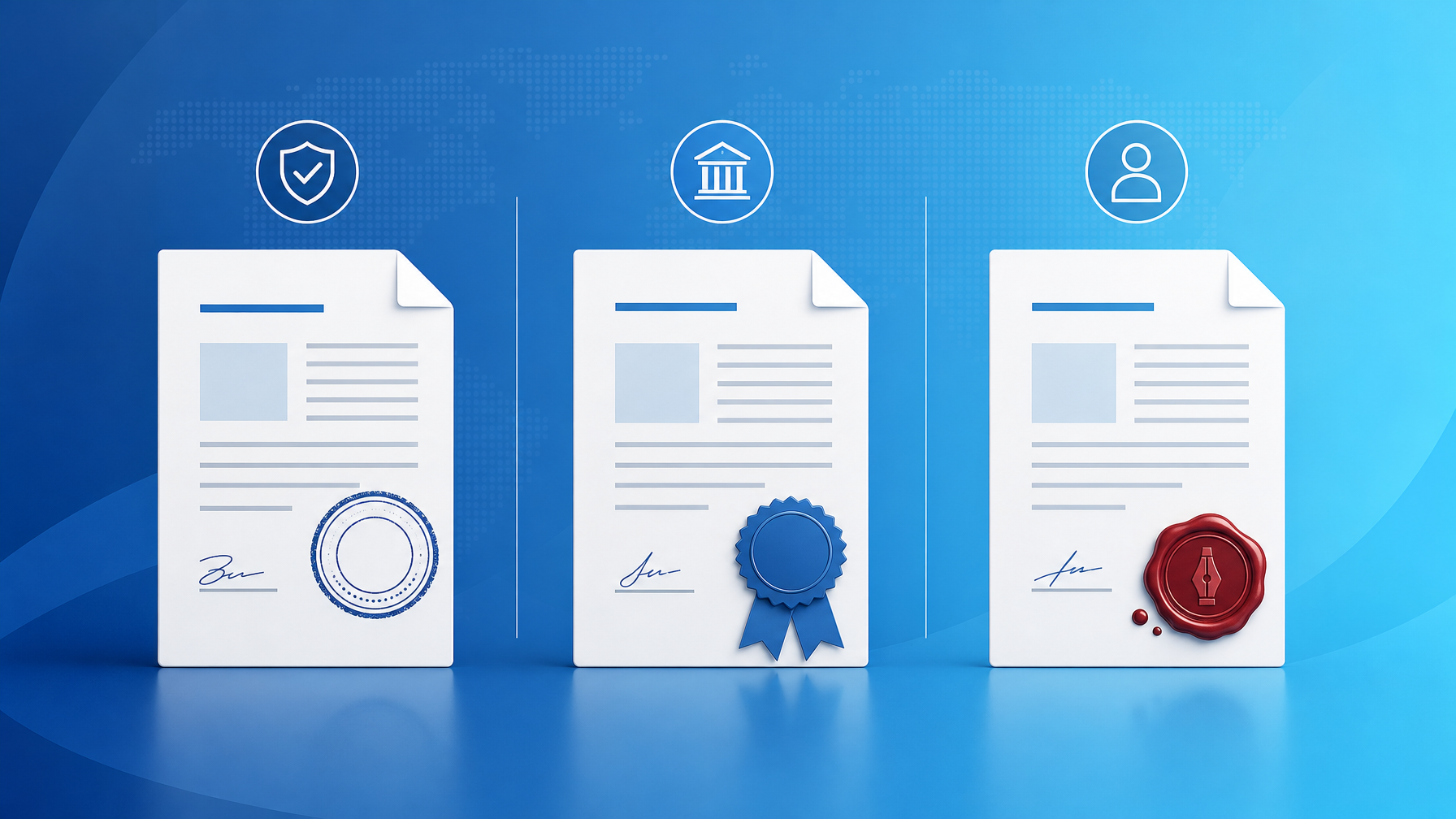
Certified vs Notarised vs Sworn Translation: Which Do You Need in the UK?
Key Takeaways
- Certified translation with a signed Certificate of Accuracy is sufficient for most UK official uses, including UKVI and Home Office applications.
- Notarised translation adds a notary public verifying the translator's identity — occasionally required for specific legal or overseas uses, not standard for UK immigration.
- Sworn translation is a European concept, not recognised as a distinct category in the UK, but sometimes required when a document will be used in a country like France, Spain, or Germany.
- Ordering the wrong type of certification wastes time and money without adding any legal value.
If you've been asked for a "certified translation" for a UK application, it's worth confirming exactly what's needed before you order anything, since certified, notarised, and sworn translation aren't interchangeable, and paying for more than you need is a common and avoidable cost.
Table of Contents
ToggleWhat Is a Certified Translation?
A certified translation is a translation accompanied by a signed Certificate of Accuracy, confirming that it's a complete and correct representation of the original document. This is the standard requirement for the vast majority of UK official uses: UKVI and Home Office applications, UK courts, universities, and professional registration bodies.
No notary is involved. The certifying translator or agency takes responsibility for the accuracy of the work.
What Is a Notarised Translation?
A notarised translation goes one step further: a notary public witnesses the translator signing the Certificate of Accuracy and confirms the translator's identity. Importantly, the notary isn't verifying that the translation is accurate; they're verifying who signed it.
Notarised translation is occasionally requested for specific UK legal proceedings, or for documents that will be used in certain overseas contexts. It isn't required for standard UKVI or Home Office submissions, despite this being a common assumption.
What Is a Sworn Translation?
Sworn translation is a formal category recognised in several European countries, including France, Spain, Germany, and Italy, where translators are officially accredited by a court, ministry, or consulate to produce legally binding translations under their own seal. In Spain, this accreditation comes from the Ministry of Foreign Affairs; in France and Germany, courts accredit sworn translators directly.
Sworn translation is not a recognised category in the UK. If you're dealing with a UK institution, you won't be asked for a sworn translation. If you're submitting a UK document (or its translation) to an institution in France, Spain, or another country that uses this system, a sworn translation may be specifically required instead of a standard certified one.
How Do I Know Which One I Need?
The deciding factor is who's asking for the document and where it will be used:
- UK institution (UKVI, Home Office, UK courts, UK universities): certified translation with a signed Certificate of Accuracy is normally sufficient
- A UK document going abroad, or specific legal proceedings requiring identity verification: notarised translation may be requested
- A document being submitted to an institution in France, Spain, Germany, Italy, or a similar country: sworn translation may be required by that country's rules, not the UK's
The safest approach is to ask the receiving institution directly what they require, rather than assuming, since the terminology is used inconsistently even among UK-based providers.
Does Ordering the Wrong Type Cost More Than It Should?
Yes, in both directions. Ordering a notarised or sworn translation when a straightforward certified translation would have been accepted adds unnecessary cost and turnaround time. Ordering only a basic certified translation when the receiving institution specifically requires sworn certification means the document gets rejected and needs redoing, which costs more overall than getting it right the first time.
At Global LTS, we handle certified, notarised, and sworn translation requirements, and we'll confirm which category actually applies to your situation before you order. See our full certified translation services, our guide to Certificate of Accuracy, or contact us to confirm what your specific application needs.